


 中文简体
中文简体 Français
 русский
 Español
 عربى
عربى Deutsch



Combined Center of Gravity on a Forklift: Stability Triangle and Load Limits
Admin 2026-09-24A forklift stays upright only as long as the combined center of gravity of the truck and its load remains inside the stability triangle formed by the two front wheels and the rear axle pivot. If the combined CG moves beyond that triangle, the forklift tips forward or sideways. Understanding the combined center of gravity on a forklift is therefore the most direct way to prevent overturns, read load charts correctly, and avoid ordering a machine with more capacity than the job actually needs.
In this article, we discuss what the combined CG is, how the stability triangle works, which operating factors move the combined CG, and why the concept should shape your equipment choices.
What Is the Combined Center of Gravity on a Forklift?
Every object has a center of gravity: the point where its entire weight may be considered to act. A forklift has its own CG, which depends on the counterweight, the chassis, the mast, and the position of the carriage. A load has its own CG too. When the load is on the forks, the two CGs are combined into a single system CG. That new point is what matters for stability.
The load center is not the same as the combined CG. Load center is a measurement on the load itself: typically 24 inches (600 mm) from the vertical fork face for standard counterbalance trucks. The combined CG is the net result of the forklift's weight and the load's weight, and it changes every time the load moves, lifts, tilts, or accelerates.
| Actual load center | Rated capacity at 24-inch center | Effective capacity |
|---|---|---|
| 24 in | 5,000 lb | 5,000 lb |
| 30 in | 5,000 lb | 4,000 lb |
| 36 in | 5,000 lb | 3,333 lb |
This simple calculation explains why a forklift rated for 5,000 lb at a 24-inch load center cannot safely lift a 5,000 lb load whose CG sits at 36 inches. The combined CG shifts forward because the load mass acts farther from the front axle, and the stability margin disappears.
The Stability Triangle and the Combined CG
The stability triangle is the projection of the three support points of a counterbalance forklift: the ground contacts of the two front drive wheels and the pivot point of the rear steer axle. The three points form a triangle. As long as the vertical projection of the combined CG remains inside this triangle, the truck is statically stable.
When the forklift is empty, its combined CG is the truck's own CG, and it sits comfortably inside the triangle. Adding a load moves the combined CG forward and upward. The heavier the load, the further it moves. Raising the mast moves the load CG higher, which is why elevated loads make overturns more likely even when the load is within rated capacity.
Dynamic operations also move the combined CG. Braking shifts it forward, turning shifts it toward the outside of the turn, and accelerating shifts it rearward. In each case the operator must leave enough margin inside the triangle for those temporary shifts.
| Action | Combined CG shift | Stability risk |
|---|---|---|
| Braking | Forward | Forward tip |
| Sharp turn | Outward | Side tip |
| Lifting mast | Upward | Reduced reserve |
| Tilt mast forward | Forward | Forward tip |
| Acceleration | Rearward | Reduced steering traction |
The practical conclusion is that a static load chart is only the starting point. A forklift that is stable on a flat concrete floor with a low, tilted-back load may tip in a real warehouse when the operator brakes hard in a turn with the forks raised.
Factors That Shift the Combined CG
Several variables determine where the combined center of gravity sits at any moment. Maintenance staff, supervisors, and operators should all recognize them.
- Load weight. Overloading moves the combined CG toward the load and beyond the front axle line.
- Load center distance. Long loads or unbalanced pallets place the load's CG farther from the fork face, causing the same deration shown earlier.
- Lift height. The higher the forks, the higher the combined CG rises. This narrows the lateral stability margin and increases tip-over sensitivity during turns.
- Mast tilt and fork position. Tilting the mast forward moves the load's CG forward; tilting it back moves it rearward into a safer position.
- Attachments. Side shifters, clamps, and rotators add dead weight at the front of the truck and often shift the load center forward, so capacity must be derated.
- Floor and tires. Uneven floors, wet surfaces, worn tires, and high dock ramps effectively change the support points and can reduce the real stability triangle.
How to Keep the Combined CG Inside the Triangle
Predictable stability begins with routine decisions. Use a short checklist before lifting and travelling.
- Check the data plate and load chart for the rated capacity at your actual load center.
- Keep the load centered from side to side and pushed fully back against the fork face.
- Use the shortest fork length that safely supports the load so the load CG stays close to the carriage.
- Travel with the mast tilted back and the forks about 4-6 inches above the ground.
- Slow down before corners, ramps, and dock edges.
- Do not stack loads to the top of the mast unless the load chart expressly permits it at that height.
- Remove attachments when they are not needed because they both add front weight and increase the load center.
For a more systematic view of capacity and truck selection, see our guide on how to choose a forklift.
Match the Truck to Your Actual Load Center
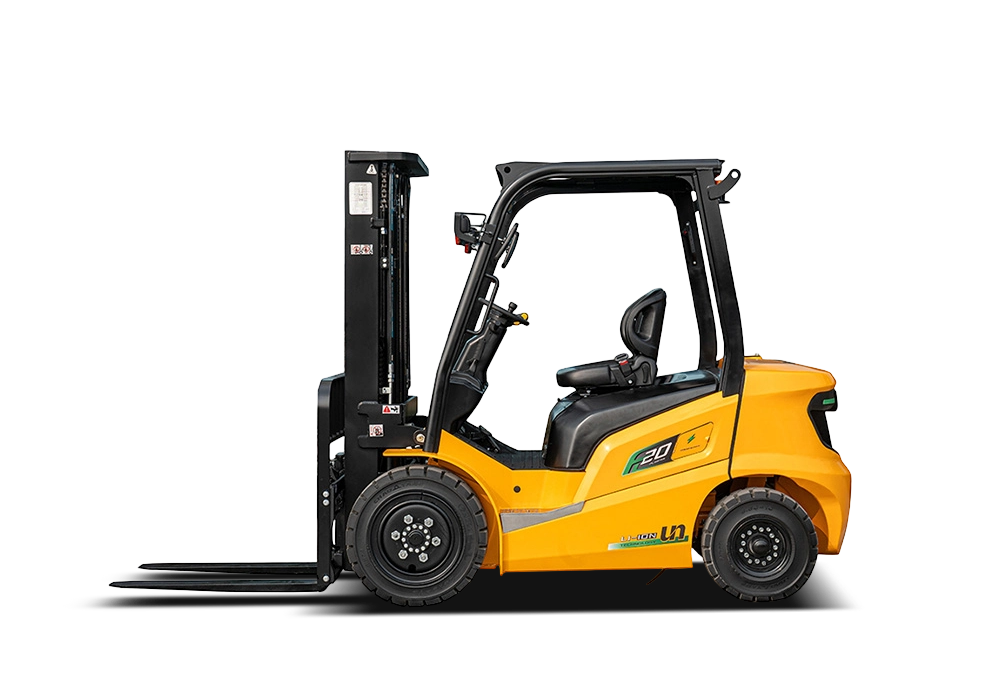
When you compare forklift models, the rated capacity is less meaningful than the load chart at the load center you actually use. For indoor operations that handle uniform pallets within a standard 24-inch load center, an electric counterbalance forklift can handle most jobs while keeping the combined CG low because the battery weight provides a stable counterweight. A modern lithium-ion electric forklift, for example, gives clean operation and a predictable load chart across common lift heights.
If your facility moves oversized loads such as long coils, bundles, or mixed pallets, measure where the load CG actually sits. You may need a truck with a longer wheelbase or a different load center rating rather than simply a higher capacity class.
Outdoor and Heavy-Duty Loads Still Follow the Same Rules
For heavy outdoor work on smooth concrete or rough yards, internal combustion models offer high drawbar pull and durable frames, but they follow the same combined CG rules. Verify that the rated capacity applies at your expected load center before ordering an internal combustion forklift for a demanding application.
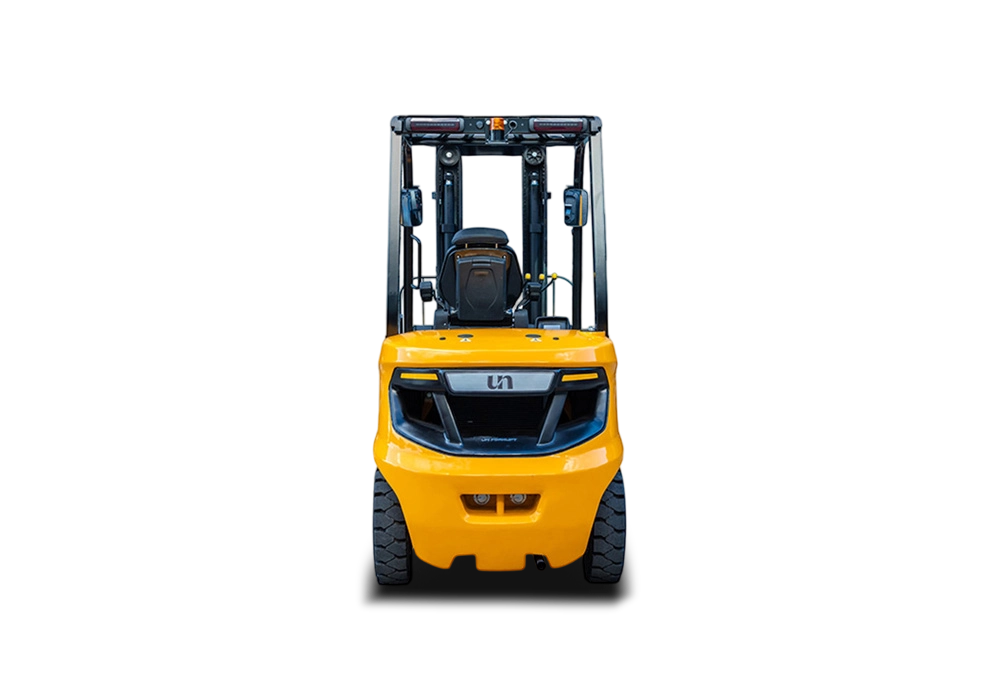 F Series 2.0T-2.5T Diesel Forklift for Heavy Outdoor WorkThis redesigned internal combustion forklift combines a streamlined body with reliable diesel engines and LED lights, offering durable performance for demanding applications where load center and stability discipline are essential.View Product →
Rough terrain does not change the law of stability; it changes the support points. On uneven ground, the effective stability triangle shrinks, and a load that would be safe on a flat floor can become marginal on a slope or pothole. Keep the same discipline with load center and speed.
Stability in Narrow Aisles and High Racks
In logistics and warehousing operations, the relationship between aisle width and load handling often points toward more specialized machines. Reach trucks and VNA trucks reduce the need for wide turning areas and bring the load closer to the truck's centerline, which changes the combined CG behavior compared with a counterbalance truck. However, they have their own height and floor tolerance limits.
See how we apply these principles in logistics and warehousing operations before finalizing your fleet specification.
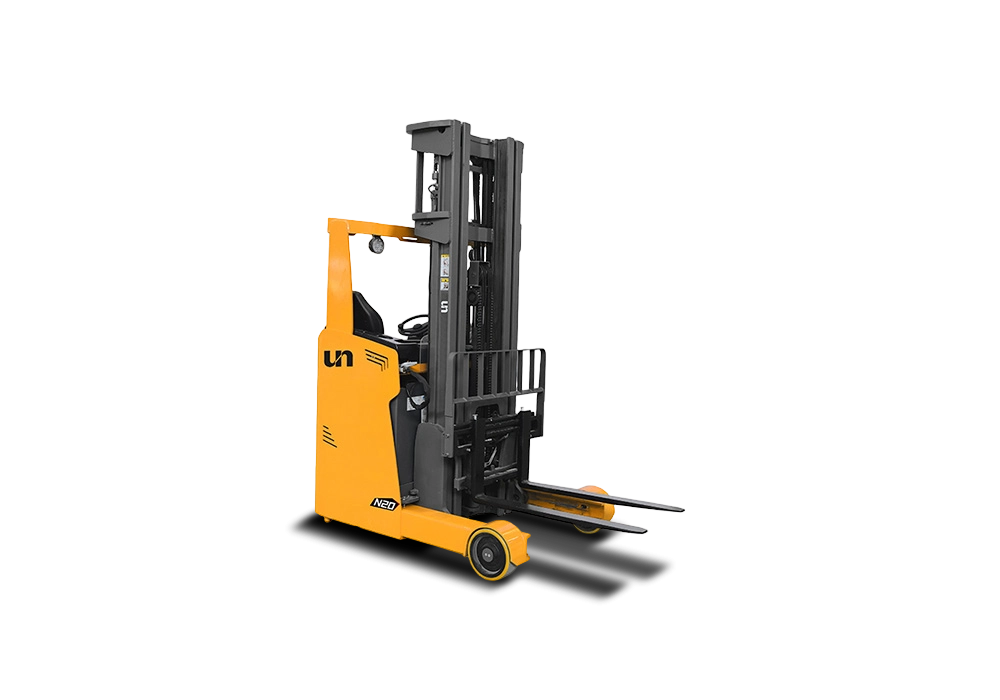 Sit-in Reach Truck for Efficient Warehouse OperationsA high-performance reach truck with AC technology and regenerative braking, designed for precise load handling in warehouse settings where combined center of gravity and load geometry matter for safe operation.View Product →
Final Thoughts on the Combined CG
Every operator and buyer should think of a forklift as two mass systems that become one while lifting. The combined center of gravity on a forklift is the real measure of whether a task is safe. Keep the CG inside the triangle by respecting load centers, carrying loads low, driving smoothly, and selecting a truck that actually fits the load geometry of your operation.
For exclusive deals and latest offers, sign up by entering your email address below.
Stay In Touch
ADDRESS : NO.1 ROAD ONE, XINDENG NEW DISTRICT, FUYANG, HANGZHOU, ZHEJIANG, CHINA 311404.
PHONE : +86-571-8688 8355 (AMERICA)
PHONE : +86-571-8886 9363 (EUROPE)
PHONE : +86-571-8688 8377 (ASIA, AFRICA, OCEANIA)
EMAIL : [email protected]
EMAIL : [email protected](PARTS INQUIRY)

