


 中文简体
中文简体 Français
 русский
 Español
 عربى
عربى Deutsch



Forklift Drum Clamp Guide: Types, Capacity, Safety, and Buyer's Checklist
Admin 2026-10-01A 200-litre drum shifts on the forks, catches a racking beam, and 15 litres of solvent spill onto the floor before the operator reacts. In plants that move drums daily, this is not an isolated accident; it is the predictable result of rotating a round container with flat forks. A properly specified drum clamp for forklift trucks turns that movement into a controlled, single-operator process—provided the clamp, the truck, and the hydraulics are selected together.
Here is the practical conclusion to keep while reading: never start with the clamp alone. Start with your heaviest drum, its gross weight, and your forklift's residual capacity after the clamp is installed. Then choose the clamp body, arm style, and optional rotation function that fit your industry.
The Drum Clamp for Forklift: What It Does and Why It Matters
A drum clamp mounts directly on the fork carriage so the truck can grip, lift, transport, stack, and often rotate steel, plastic, or fibre drums without a pallet. It removes both the pallet weight and the need for two workers in crowded lanes.
In chemical and pharmaceutical plants, a drum clamp also reduces exposure to spills because the drum never leaves the secure grip from pickup to set-down.
The common variations are:
- Manual clamps – no hydraulic connection; suitable for occasional movement and lighter plastic drums.
- Mechanical clamps – grip direction is linked to the lifting mechanism; reliable for routine stacking of standard steel drums.
- Hydraulic clamps – controlled through the forklift's auxiliary valve; best for high cycle counts and heavy drums.
- Rotating clamps – rotate the drum 90°, 180°, or 360°, which helps in dumping, mixing, or position palletising.
- Below-arm clamps – lift drums under the rolling hoops for side storage or long drum movement.
Do not select the cheapest or the heaviest-duty style automatically. Match the clamp to the drum's surface condition, the number of lifts per shift, and the truck's available hydraulic functions.
Capacity and Load Centre: Where Most Purchases Fail
The first specification most buyers ask for is the clamp's own rated capacity. That number, for example 450 kg, only states what the clamp can hold when the load stays within its designed centre. The real limit is set by the truck after the clamp is mounted.
A forklift is only rated at a specific load centre, usually 500 mm or 600 mm ahead of the fork face. An attachment adds its own mass and pushes the load centre further forward, so the truck's practical capacity drops. A 2.5 t forklift with a 150 kg clamp can have a residual capacity of about 2.2 t, and a 1.5 t truck with a large rotating clamp can fall to 1.2 t or below.
| Base capacity | Clamp assembly weight | Load centre after clamp | Approx. residual capacity |
|---|---|---|---|
| 1.5 t | 110 kg | 600 mm | 1.2–1.3 t |
| 2.0 t | 130 kg | 600 mm | 1.7–1.8 t |
| 2.5 t | 150 kg | 600 mm | 2.2–2.3 t |
| 3.5 t | 180 kg | 600 mm | 3.1–3.2 t |
The fix is straightforward: ask both the attachment supplier and the forklift manufacturer to state a residual capacity for the exact combination. On most counterbalance trucks, the final number must be shown on a revised capacity plate before the truck works legally with the attachment.
Compatibility: Fork Carriage, Mast, and Hydraulics
After capacity, the next failure point is mounting. The clamp's top hook and frame must fit the fork carriage class of the truck. The frame depth also changes the view ahead, so a clamp that is too thick can hide floor obstacles and create pedestrian risk.
Hydraulic clamps add another layer: your forklift must have an auxiliary hydraulic valve with sufficient flow and pressure. Typical clamp specifications ask for 80–140 bar and 5–15 l/min depending on model; the truck's auxiliary pump and service valve must be sized for that range. If there is any mismatch, you may need restrictors, pressure relief settings, or a different truck option.
These details are easier to verify before purchase than after installation. UN Forklift, for example, can specify the correct hydraulic flow, hose routing, and carriage option when the truck is ordered. That is why many quality-focused buyers in the chemical, logistics, and food sectors request a factory-integrated solution instead of adding a clamp at the local dealer's yard.
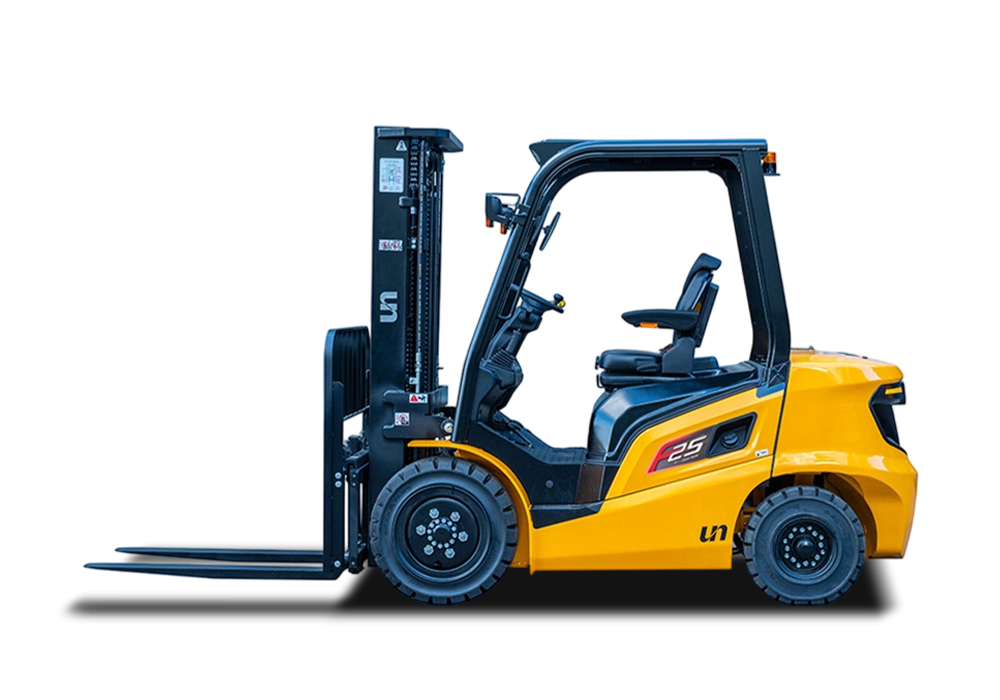
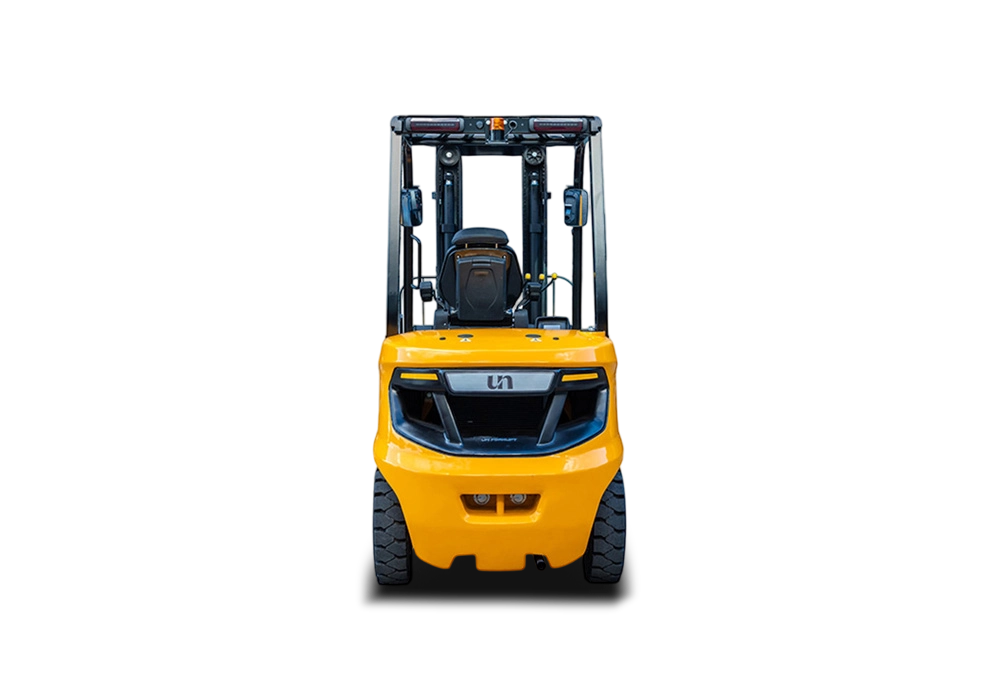 F Series 2.0-2.5 Ton Diesel Forklift with Integrated Clamp OptionsThis redesigned diesel forklift offers a streamlined body and LED lighting, while its optional hydraulic clamp, sealed links, and drip trays suit aggressive chemical and drum-handling environments.View Product →
Match the Clamp to Your Industry, Not Just to the Drum
Chemical and pharmaceutical
Aggressive liquids, dust residues, and strict spill containment make corrosion-resistant arms, sealed hydraulic links, and optional drip trays essential. If your plant uses 200 L drums on reactors or transfer stations, a 1.8–2.5 t electric truck with a compact clamp may give the cleanest combination.
Food and beverage
Hygiene policies favour stainless steel contact parts and washable frame construction. Low lithium electric truck emissions also keep process areas pleasant, while a rotating clamp lets you drain residual syrup or oil in a dedicated control area rather than on the aisle floor.
Logistics and warehousing
High-volume depots need predictable grip cycle times and good visibility. A hydraulic clamp with side shift, mounted on a 2.0–3.5 t electric or LPG truck, can feed lines or empty drums for recycling without manual handling. See the logistics and warehousing solutions page for layout ideas based on different truck types.
Heavy manufacturing and recycling
For 300 kg drums, damaged rims, or continuous sorting of drums, choose a wider clamp capacity margin and a larger base truck. The extra payload margin protects the mast, hydraulic pump, and operators when the drum density is higher than expected.
Safety, Inspection, and the Human Factor
A drum clamp can prevent many spills, but it also introduces new pinch points, side forces, and stability limits. Operators need practice with both light and full drums so they learn how the truck moves when the clamp is empty and when it grips a heavy container.
Daily inspection should cover:
- Hydraulic hoses and couplings for leaks, cracks, or rubbing points.
- Clamp pads for wear, embedded chemicals, or missing grip inserts.
- Pivot pins, retainers, and side-shift mechanisms for play.
- Function lock and auxiliary valve response before any load is raised.
Regulatory frameworks such as the U.S. OSHA powered industrial truck rules require the attachment to be approved and the truck to be re-rated. That means the plastered capacity plate must show the derated value with the clamp installed, and operator training should cover the clamp's controls, emergency lowering, and drum-friendly set-down.
Treat each drum as a pressurised or hazardous container until you confirm its cap, venting, and gross weight. In chemical and pharma settings, that one habit prevents most personal exposure events.
Buyer's Checklist: Seven Points Before You Order
- List every drum type you handle: steel, plastic, tight-head, open-head, 30 L, 60 L, 200 L, or 210 L.
- Measure the heaviest filled drum, including drum tare and any residual contents.
- Select a clamp rated at 125% or more of that gross drum weight.
- Confirm the fork carriage class and the clamp's mounting width match the truck.
- Check auxiliary hydraulic pressure and flow against the clamp specification.
- Ask the forklift manufacturer for a residual-capacity calculation and a derated nameplate.
- Budget for operator training, spare pads, and a manufacturer-approved inspection every 12 months.
Why Integration with the Forklift Matters
Adding a drum clamp after delivery is possible, but the final result depends on small details that a bolt-on kit cannot correct: the mast tilt speed, flow relief settings, hose route, and the added moment on the steer axle. Those variables define how quickly the operator can place a drum without banging it against racking.
UN Forklift has produced counterbalance forklifts since 1978 and builds diesel, LPG, battery-electric, and lithium-electric models in dozens of tonne classes. When the clamp is specified together with the truck, our engineers can prepare the hydraulic connections, recommend the correct mast and tyre type, and supply the derated capacity data your safety system needs. The LPG cushion-tire model, for instance, is a common choice for smooth indoor drum movement with low vibration.
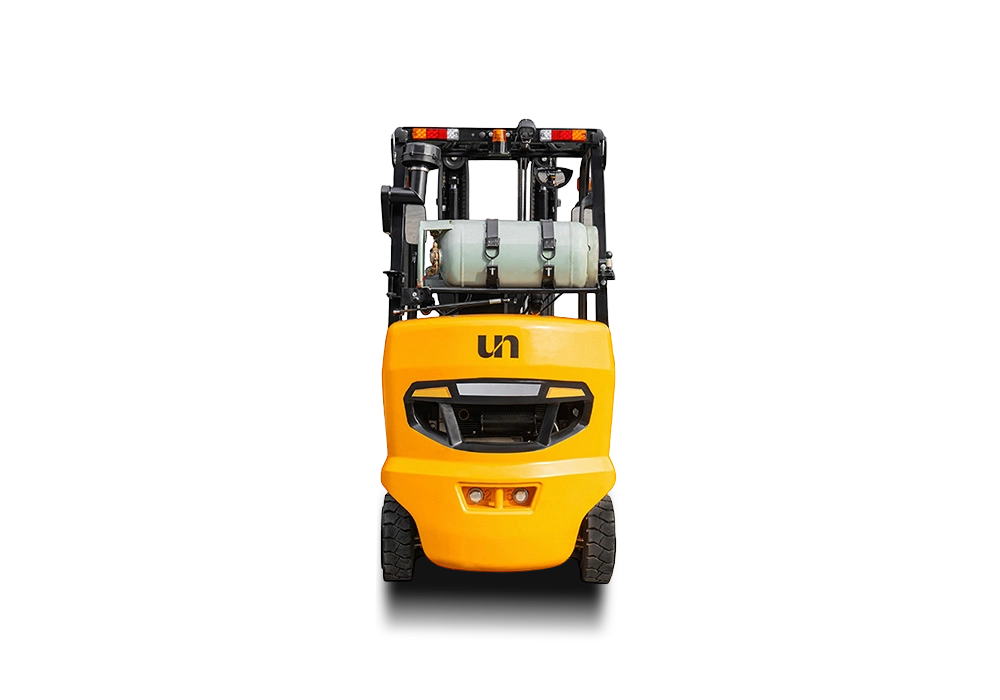 F Series 2.5-3.2 Ton LPG Forklift with Cushion Tires for Narrow AislesA compact second-generation cushion-tire LPG truck with a short wheelbase, designed for smooth indoor drum movement and high-density warehouse applications with low vibration.View Product →
With more than 96 model series and a service network covering Europe, Americas, Africa, and Asia, we supply both the truck and the confidence that the clamp will perform in daily production.
The right drum clamp for forklift operations is not a generic accessory; it is a built-in safety and efficiency device. Define your drum population, calculate the derated capacity, confirm the mount and hydraulic flow, and train the operator. When those four questions are managed together, the drum clamp pays for itself in the first few months and keeps working for years.
For exclusive deals and latest offers, sign up by entering your email address below.
Stay In Touch
ADDRESS : NO.1 ROAD ONE, XINDENG NEW DISTRICT, FUYANG, HANGZHOU, ZHEJIANG, CHINA 311404.
PHONE : +86-571-8688 8355 (AMERICA)
PHONE : +86-571-8886 9363 (EUROPE)
PHONE : +86-571-8688 8377 (ASIA, AFRICA, OCEANIA)
EMAIL : [email protected]
EMAIL : [email protected](PARTS INQUIRY)

