


 中文简体
中文简体 Français
 русский
 Español
 عربى
عربى Deutsch



Heavy-Duty LPG and Gasoline Forklift Solutions for Demanding Material Handling
Admin 2026-09-21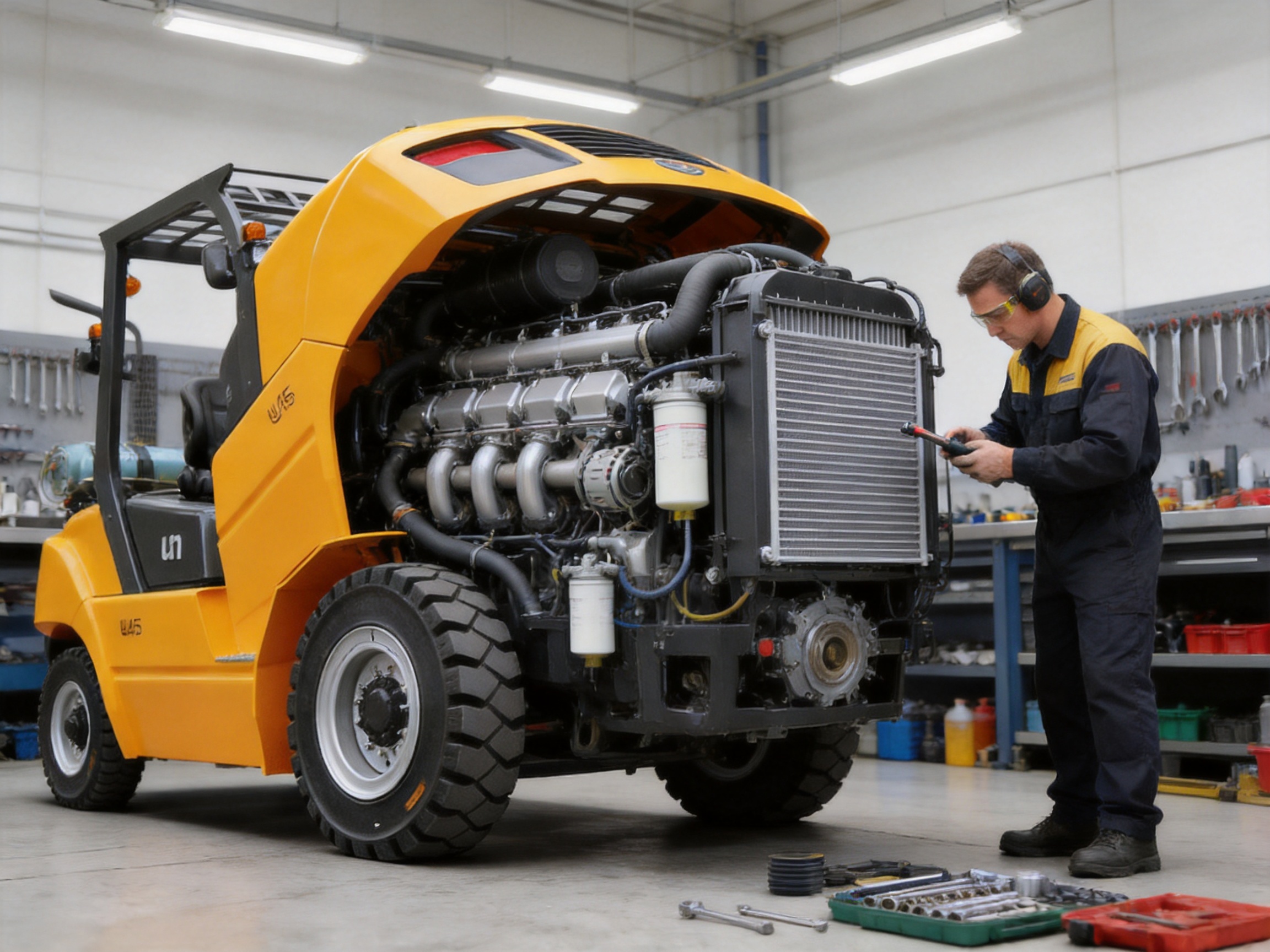
Medium- and large-scale material handling operations require more than basic lifting power. They need equipment that can move heavy loads safely, operate reliably through long shifts, fit into practical working spaces, and remain economical over many years of service. The N Series 4.0T–5.0T LPG and gasoline forklift is designed around these requirements. With rated capacities from 4,000 to 5,000 kilograms, a powerful six-cylinder engine, powershift transmission, reinforced chassis, wide-visibility mast, and service-friendly structure, this forklift provides a balanced solution for industrial facilities, distribution centers, manufacturing plants, building-material yards, logistics terminals, and outdoor storage areas.
This model is positioned for users who need more capacity than a conventional warehouse forklift can provide while still requiring the maneuverability, operator comfort, and operating economy expected from modern industrial equipment. Its LPG power system combines strong performance with lower carbon emissions than many conventional fuel alternatives. The robust cooling system supports stable operation in hot environments, while the heavy-duty frame and high-capacity axles are intended for demanding applications where forklifts may work continuously under substantial loads.
The product range includes the FGL40T, FGL45T, and FGL50T configurations, corresponding broadly to 4.0-ton, 4.5-ton, and 5.0-ton rated capacities. The standard specifications include a 500-millimeter load center, a 3,000-millimeter rated lift height, 1,070 × 150 × 50-millimeter forks, and a powershift transmission with two forward speeds and one reverse speed. Various mast configurations are available, including wide-view two-stage masts and three-stage full-free-lift masts for applications that require additional lift height or improved clearance inside buildings.
Designed for High-Capacity Industrial Handling
Forklift performance is determined by more than nominal lifting capacity. A machine must maintain stability, traction, braking control, structural strength, and predictable hydraulic response when carrying heavy materials. The N Series addresses these needs through a combination of substantial counterweight, durable chassis construction, high-capacity tires, a long wheelbase, and a hydraulic system designed for precise load control.
The three primary capacity choices give users an opportunity to select equipment according to actual operational requirements. The FGL40T offers a rated load capacity of 4,000 kilograms, the FGL45T provides 4,500 kilograms, and the FGL50T is rated for 5,000 kilograms. This range allows a fleet manager to avoid using an undersized machine for heavy loads or purchasing a larger forklift than necessary for routine work. Correct capacity selection can improve productivity, reduce unnecessary fuel consumption, and help maintain safer operating practices.
A 500-millimeter load center is used for the standard rated capacity specification. This is especially relevant when handling pallets, steel products, timber packages, machinery components, stone products, building materials, and other dense loads. Operators should always verify the actual load center, attachment weight, mast configuration, and residual capacity before lifting. The separate mast capacity chart provides additional guidance because rated capacity can change according to lift height, mast type, attachments, and load position.
The standard 3,000-millimeter rated lift height is suitable for many production, storage, and loading operations. For facilities requiring higher stacking, the product can be configured with masts reaching fork heights of approximately 3,300, 3,500, 3,700, 4,000, 4,300, 4,500, 4,700, 5,000, 5,500, and 6,000 millimeters, depending on the mast family and capacity configuration. These options support both conventional lifting and more specialized warehouse or industrial applications.
Compared with lighter-duty forklifts, the N Series is better suited to work where load mass, operating hours, and environmental conditions place continuous demands on the powertrain and frame. Compared with some larger machines, its approximately 1,485-millimeter overall width and 2,790- to 2,830-millimeter outside turning radius can help preserve maneuverability in practical industrial spaces. The exact operating envelope should be evaluated against aisle dimensions, pallet geometry, floor conditions, and the selected mast or attachment.
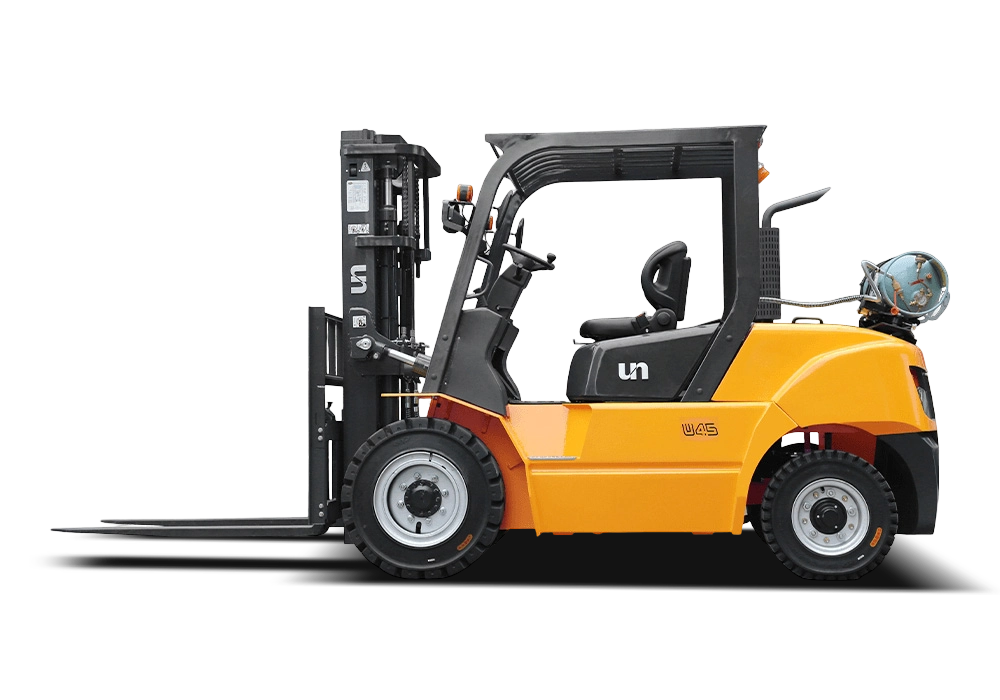
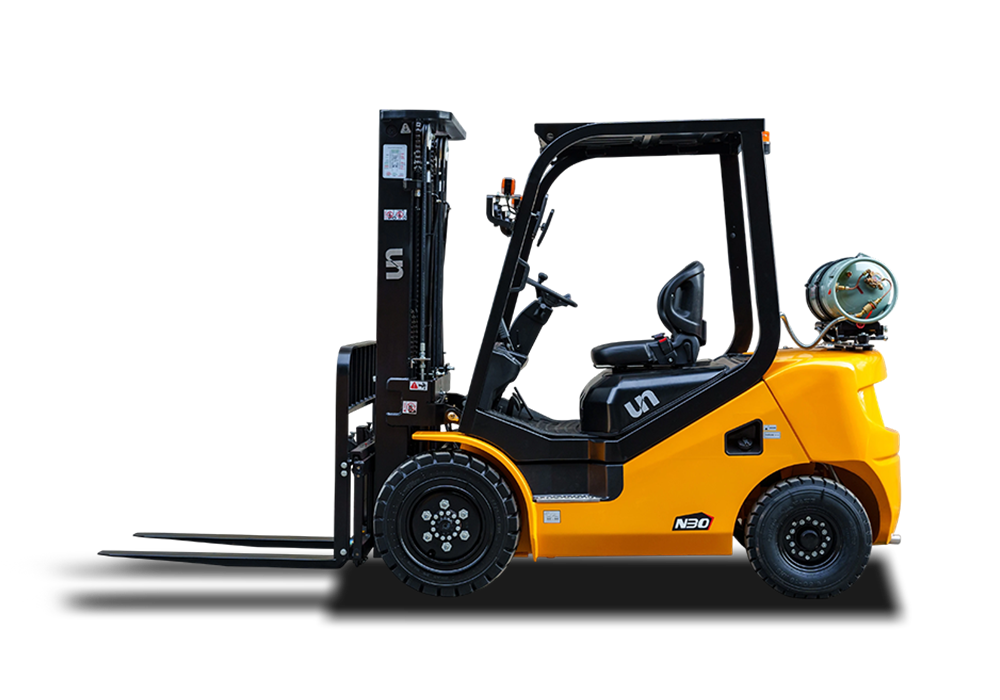
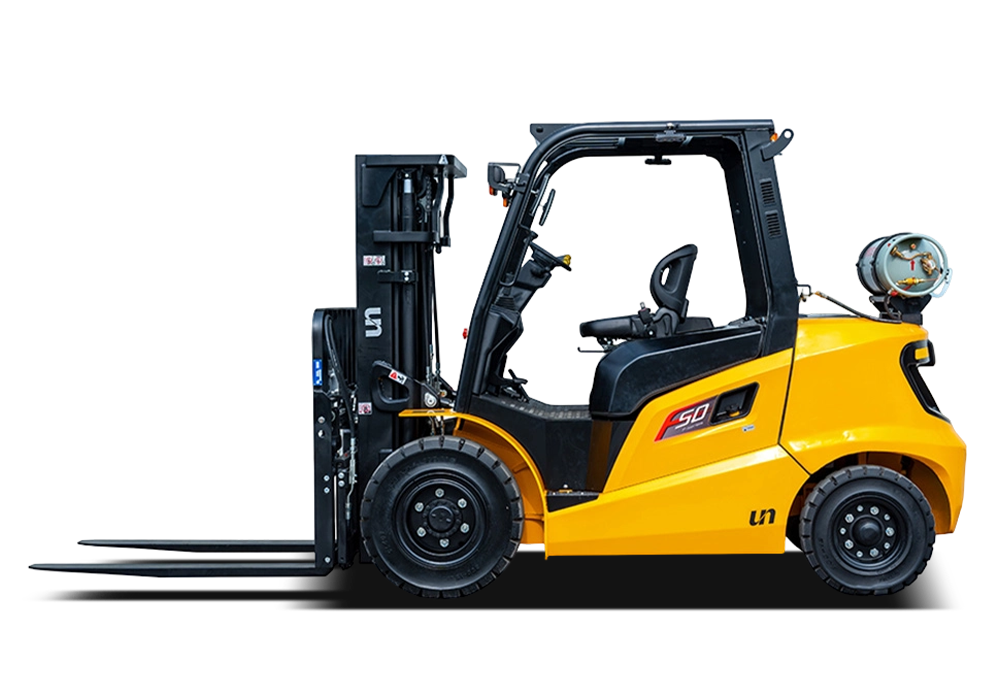
N Series 4.0T-Mini5.0T LPG&Gasoline Forklift
Powertrain Performance and LPG Operating Advantages
The forklift is equipped with a PSI4.3 engine supplied by PSI. The six-cylinder engine has a displacement of 4.294 liters, a rated output of 63 kilowatts at 2,000 revolutions per minute, and rated torque of 298 newton-meters at 1,200 revolutions per minute. This specification gives the forklift the reserve power needed to accelerate with heavy loads, climb ramps, approach loading docks, and maintain productive travel speeds across industrial yards.
The power system is matched with a powershift transmission offering two forward stages and one reverse stage. Powershift technology allows the operator to change direction and select travel speeds smoothly without the repeated clutch operation associated with some manual systems. In high-cycle applications, this can reduce operator fatigue and help maintain consistent movement between loading, transporting, stacking, and unloading points.
The published no-load travel speed is up to 22 kilometers per hour for one configuration and 20 kilometers per hour for another. Actual speed should be controlled according to load weight, surface condition, visibility, traffic, pedestrian activity, and site rules. The forklift is also specified with a maximum full-load drawbar pull greater than 21 kilonewtons and a full-load gradeability of at least 20 percent. These values indicate useful traction potential for ramps and uneven industrial routes, although safe operation still depends on correct load handling and suitable ground conditions.
LPG provides several practical benefits in indoor and semi-indoor material handling. Compared with many diesel applications, LPG combustion can help reduce visible smoke, soot, and carbon emissions when the engine is correctly maintained and operated. This makes the powertrain attractive for facilities that require internal combustion performance but want to manage air-quality concerns more effectively. LPG forklifts are commonly considered for manufacturing plants, food-related non-processing areas, distribution buildings with suitable ventilation, and operations that move between indoor and outdoor environments.
The product description emphasizes low emissions and all-weather adaptability. These characteristics are important for users who cannot depend entirely on battery charging infrastructure or who need extended operating periods without long charging interruptions. LPG cylinders can be exchanged relatively quickly by trained personnel under appropriate safety procedures. As a result, the forklift can support multi-shift applications where refueling logistics are properly planned.
The specification also lists a 90-liter fuel tank capacity. Because fuel configuration and market requirements can vary, customers should confirm whether the final unit is supplied for LPG, gasoline, or a dual-fuel arrangement and should verify the applicable fuel storage and connection system before purchase. The product title identifies LPG and gasoline capability, while the main power-type specification identifies LPG. This makes configuration confirmation an important part of the quotation and commissioning process.
Cooling and Continuous-Operation Stability
High-capacity forklifts often work under greater thermal load than smaller machines. Heavy lifting, repeated acceleration, ramp travel, high ambient temperatures, and long operating cycles all place additional demands on the engine, transmission, hydraulic system, and axles. The N Series uses an efficient cooling arrangement with a large radiator to help maintain stable operating temperatures in hot conditions.
A large radiator can improve heat dissipation by providing greater surface area for transferring heat from the coolant to the surrounding air. In practical terms, this supports engine stability during extended operation and helps reduce the likelihood of performance degradation caused by excessive heat. Cooling performance is also influenced by radiator cleanliness, airflow, fan condition, coolant quality, belt condition, ambient dust, and maintenance intervals. The forklift’s cooling design therefore works best when combined with a disciplined preventive maintenance program.
For operations in dusty yards, foundries, brick plants, recycling centers, ports, and construction-material facilities, cooling-system care is particularly important. Dust and debris can restrict airflow across the radiator and increase thermal stress. Operators and maintenance teams should inspect the radiator regularly, clean it using approved methods, and follow the engine manufacturer’s recommendations for coolant replacement and system inspection.
The stable cooling concept also supports productivity. When a forklift can maintain consistent engine and hydraulic performance through a long shift, operators can work with fewer interruptions. This helps reduce unplanned downtime and improves the predictability of loading schedules. For fleet owners, stable thermal performance can also protect the long-term condition of engine components and transmission oil, provided that service intervals are followed.
Hydraulic Control for Precise Load Handling
Hydraulic performance directly affects how an operator positions forks, controls a load, and stacks materials at height. The N Series uses hydraulic systems featuring Shimadzu pumps or comparable premium-brand components. These systems are intended to provide accurate control, dependable pressure generation, and consistent lifting performance.
The main specification lists an operating pressure of 17 megapascals for attachments. This provides a useful reference for evaluating compatible hydraulic attachments, such as side shifters, fork positioners, clamps, rotators, or specialized handling tools. Attachment compatibility must always be confirmed according to flow demand, pressure requirements, mounting dimensions, residual capacity, and the final application.
The standard lifting speed is listed as 450 millimeters per second without load and 430 millimeters per second with full load. The lowering speed is listed as 480 millimeters per second. These figures support productive load cycles while allowing the operator to make controlled adjustments. Actual cycle times will depend on mast height, load weight, hydraulic oil temperature, operator technique, and attachment configuration.
Precise hydraulic control becomes especially valuable when handling fragile, expensive, or irregularly shaped products. Smooth movement helps reduce sudden load shifts and allows operators to position forks accurately beneath pallets or support points. It also contributes to a more comfortable working environment because abrupt hydraulic movements can increase vibration and operator fatigue.
For customers selecting a side shifter, the published guidance states that load capacity is reduced by 200 kilograms when using a separated side shifter and by 100 kilograms when using an integrated side shifter. This reduction must be included in the capacity assessment. The actual capacity plate on the completed forklift should always take precedence over general catalog information.
Structural Strength and Chassis Configuration
The N Series is built around a heavy-duty chassis intended for industrial workloads. The standard wheelbase is 2,000 millimeters, while the front and rear tread dimensions are listed as 1,180 and 1,190 millimeters respectively. These dimensions contribute to stability and help distribute loads through the frame and axles.
The forklift uses 300-15-18PR front tires and 7.00-12-12PR rear tires. The high-ply construction supports demanding operating conditions and provides a strong foundation for carrying heavy loads. Tire selection remains an important application decision because surface type, temperature, debris, traction requirements, and indoor floor protection can affect the best configuration. Customers should confirm whether pneumatic, solid, cushion, or other tire options are required for their site.
The total unladen weight is listed at approximately 6,600 kilograms for the 4.0-ton version, 6,800 kilograms for the 4.5-ton version, and 7,100 kilograms for the 5.0-ton version. The weight of the forklift contributes to counterbalance stability and traction. It also means that site planning should include floor load limits, ramp capacity, transport arrangements, and loading-dock requirements.
The forklift has a ground clearance of 175 millimeters at the bottom of the mast. This can be useful when traveling over minor surface irregularities, expansion joints, yard transitions, and outdoor industrial pavement. It is not a substitute for a properly prepared operating surface, but it provides practical clearance for many general handling environments.
Fork overhang from the wheel center to the fork face is listed as 578 millimeters. The overall length to the fork face, excluding the forks, is listed at 3,091 millimeters for one configuration and 3,125 millimeters for another. Rear overhang ranges from approximately 550 to 614 millimeters depending on capacity. These dimensions should be considered when designing aisles, setting safety barriers, planning turning zones, and determining transport clearances.
The substantial construction gives this forklift an advantage in applications where a lighter machine may experience excessive wear. Heavy-duty components can support more consistent performance when the truck handles dense materials repeatedly. However, structural strength is most effective when the forklift is operated within its rated capacity and inspected regularly for damage, loose fasteners, tire wear, hydraulic leaks, and mast deformation.
Mast Options for Different Working Heights
Mast selection affects lift height, free lift, overall height, visibility, residual capacity, and the ability to operate beneath doors or roof structures. The N Series offers multiple mast choices so that users can configure the forklift for ground-level loading, rack storage, high stacking, container work, and specialized industrial handling.
The wide-view mast family includes models such as M270, M290, M300, M320, M330, M350, M370, M400, M450, and M500. The model names correspond to different mast height classes and configurations. The listed maximum fork heights extend from approximately 3,000 millimeters to 5,500 millimeters, depending on the selected mast. For users who need high stacking while maintaining a practical lowered height, these options provide flexibility during specification.
The M270 mast, for example, is listed with a 3,000-millimeter maximum fork height and an overall lowered height of 2,260 millimeters. The M290 raises the maximum fork height to approximately 3,300 millimeters, while the M300 reaches approximately 3,500 millimeters. Higher configurations continue through the M500, which is listed with a maximum fork height of approximately 5,500 millimeters. The capacity chart shows that allowable loads vary according to the selected capacity class and lift height.
For higher lifting requirements, the three-stage full-free-lift wide-view mast family includes TFM400, TFM430, TFM450, TFM470, TFM500, TFM525, TFM550, and TFM600. These masts provide maximum fork heights ranging from approximately 4,000 to 6,000 millimeters. Full-free-lift capability is useful when the forks must rise within the mast rails before the mast begins to extend significantly. This can help when working inside buildings with limited overhead clearance or loading materials into enclosed spaces.
The mast table identifies free-lift values that can reach approximately 2,044 millimeters on the TFM600 configuration, depending on the specification. This can make a three-stage full-free-lift mast a practical choice for operations involving low ceilings, containers, truck bodies, or multi-level storage. The exact free-lift height and overall height must be verified for the selected model because these values differ by mast configuration.
Mast tilt angles are listed as 6 degrees forward and 12 degrees backward for many wide-view configurations, while certain higher mast configurations use a 6-degree forward and 6-degree backward arrangement. Tilt control assists with load stabilization, fork insertion, and safe travel. Operators should always keep the load low and tilted appropriately during travel, following the training and safety requirements of the operating site.
Operator Safety and Ergonomic Design
Productivity depends on operator confidence and comfort as well as machine output. The N Series incorporates several features intended to improve visibility, reduce fatigue, and support safer daily operation. These include an operator presence system and seat switch, a wide-visibility mast, a high-strength overhead guard, suspended chassis design, adjustable steering, and an ergonomic seat.
The OPS and seat switch help prevent unintended movement when the operator is not correctly positioned. These systems are important safeguards, but they should complement—not replace—operator training, seat-belt use, daily inspection, traffic management, and safe operating procedures. Safety interlocks should never be bypassed or modified without authorization from qualified technical personnel.
Visibility is a central factor in forklift safety. The wide-view mast is designed to improve the operator’s sightlines through the mast assembly and toward the load. Better visibility can assist with pallet entry, rack alignment, travel-path awareness, and pedestrian detection. Visibility is still influenced by load height, attachment size, lighting, dust, traffic, and the direction of travel. Operators should travel in reverse when the load obstructs the forward view, where site rules permit.
The high-strength overhead guard is intended to protect the operator against falling objects and provide a secure protective structure. The guard must remain free from unauthorized modifications, damage, or obstructions. Its protection depends on correct use of the forklift and the suitability of the load-handling method.
The suspended chassis provides a larger foot space and contributes to a more comfortable driving position. Adjustable steering and an ergonomic seat help operators maintain a better posture during long shifts. Reduced physical strain can support concentration and consistent control, particularly when the forklift is used for repeated transport cycles.
An optional suspended powertrain system is also available. Suspending the powertrain can help isolate the operator from vibration generated by the engine and transmission. Lower vibration may improve comfort and reduce fatigue during extended operation. Customers should confirm the availability of this option for the selected market, configuration, and production schedule.
Maintenance Access and Service Efficiency
Maintenance design is one of the most important factors affecting the total cost of ownership of an industrial forklift. Even a powerful machine can become uneconomical if routine servicing is difficult, slow, or frequently postponed. The N Series includes features intended to give service technicians easier access to key components.
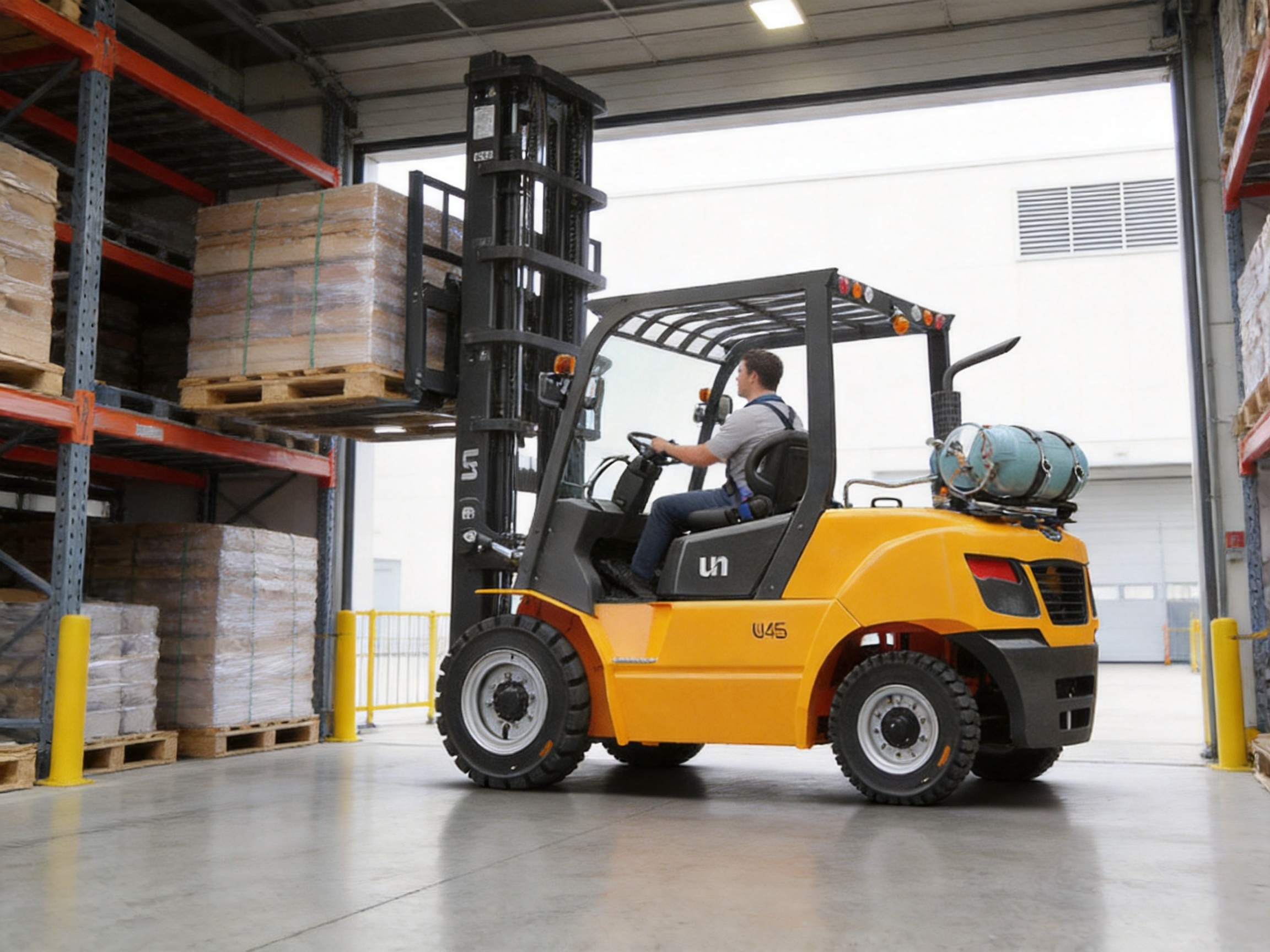
The engine cover rotates nearly 90 degrees, creating a broad opening for routine inspection, servicing, and component replacement. This arrangement can make it easier to reach the engine, filters, belts, hoses, electrical components, and other service points. Improved access reduces the time required for routine work and can make daily inspection more practical for operators and maintenance teams.
The transmission oil filter is designed for quick and user-friendly replacement. Regular oil and filter service is essential for powershift transmission reliability because contaminated or degraded oil can affect shift quality, lubrication, heat management, and component life. Maintenance personnel should use the recommended oil grade, follow the correct replacement interval, and dispose of used fluids according to applicable environmental regulations.
Preventive maintenance should include daily checks of engine oil, coolant, hydraulic oil, fuel connections, tire condition, forks, chains, mast rollers, brakes, steering, lights, warning devices, seat belt, overhead guard, and visible structural components. Weekly and periodic inspections should address battery condition, transmission oil, wheel fasteners, hydraulic hoses, lift-chain adjustment, radiator cleanliness, and attachment mounting points.
Service accessibility also supports fleet management. When inspection tasks are easier to complete, maintenance departments can improve documentation and identify small issues before they become major failures. A minor hydraulic leak, loose fastener, worn tire, or damaged fork heel can be corrected before it affects production or creates a safety risk.
UN Forklift’s manufacturing and service structure further supports this approach. The company combines research and development, production, sales, and service functions. Its stated production capacity, broad product range, international sales network, and parts support resources can help customers organize long-term equipment support. Availability of service technicians and spare parts should nevertheless be confirmed for the customer’s region before final purchase.
Manufacturing Capabilities and Product Development Strengths
The company behind the product has operated in the material handling field since 1978. Its reported facility occupies approximately 53,400 square meters and has an annual production capacity of about 15,000 units. These figures indicate a substantial manufacturing base capable of supporting multiple forklift categories, production planning, component integration, testing, and export preparation.
The product portfolio includes internal combustion forklifts, electric forklifts, warehouse equipment, rough-terrain forklifts, cushion-tire forklifts, and compact material-handling machines. The company describes its range as covering 17 varieties, 96 series, and more than 200 specifications. A broad portfolio can benefit customers that want to standardize equipment across different operating zones while sourcing from one experienced manufacturer.
Research and development is another stated strength. The company reports involvement in the development of China’s first reach forklift and very-narrow-aisle truck, as well as participation in the formulation of national electric forklift industry standards. It also holds national patents related to electric forklift technologies. These activities suggest experience in adapting forklift design to different energy systems, operating environments, and application requirements.
The manufacturer also reports OEM supply relationships with well-known domestic and overseas companies, including Hyundai Heavy Industries and Xuzhou Construction Machinery Group. OEM work generally requires consistent production control, specification management, quality documentation, and delivery coordination. Such experience can be valuable for customers seeking private-label programs, fleet supply, or customized equipment packages.
In recent years, the company has expanded its focus on new-energy products, including diesel-to-lithium-ion conversions and standard lithium-ion forklifts. This development complements its internal combustion expertise. Customers can therefore evaluate LPG, gasoline, diesel, lead-acid electric, lithium-ion, and specialized warehouse equipment within a broader energy-transition strategy.
For industrial buyers, manufacturing strength is not limited to the appearance of the finished forklift. It includes the ability to control welding quality, paint protection, hydraulic integration, powertrain installation, electrical routing, mast assembly, load testing, final inspection, and spare-parts supply. A mature manufacturer should also be able to document configuration changes, respond to regional standards, and support field feedback through product improvement.
How the Forklift Compares with Alternative Equipment
The N Series occupies an important position between smaller warehouse forklifts and specialized high-capacity machines. Its LPG powertrain offers an alternative to diesel when emissions, indoor usability, and operator environment are important considerations. At the same time, its internal combustion architecture provides longer operating cycles and rapid refueling compared with many battery-electric systems.
Compared with a battery-electric forklift in the same general capacity class, the LPG model may be more suitable where continuous multi-shift operation, outdoor travel, rapid refueling, or limited charging infrastructure are major concerns. The trade-off is that LPG operation requires fuel-cylinder management, ventilation, engine maintenance, and attention to emissions. A battery-electric model may be preferable where zero tailpipe emissions, quiet operation, and indoor air quality are the highest priorities.
Compared with a diesel forklift, the LPG model can offer a cleaner operating environment in suitable applications and may produce less visible smoke. It can be attractive for customers who need internal combustion power but want to reduce the environmental impact associated with conventional diesel use. Diesel may still be preferred for certain extreme outdoor applications, especially where fuel availability, torque characteristics, or severe ground conditions dominate the purchasing decision.
Compared with a smaller four-wheel forklift, the N Series offers a substantially higher capacity range and heavier-duty construction. This can reduce the need to divide heavy loads into smaller movements or assign multiple smaller forklifts to one task. The larger size, weight, and turning envelope must be considered, especially in narrow aisles or congested production areas.
Compared with some competing heavy-duty forklifts, the product’s combination of mast choices, wide-view design, service access, suspended chassis option, powershift transmission, and LPG operating capability creates a well-rounded specification. Buyers should compare complete configurations rather than headline capacity alone. Important comparison points include residual capacity at the required lift height, fuel consumption, service network, warranty terms, attachment compatibility, tire options, operator comfort, parts availability, and total cost of ownership.
Application Areas
The forklift is suitable for a wide range of medium- and heavy-duty handling operations. In manufacturing plants, it can move steel components, castings, machinery assemblies, finished goods, packaging materials, and production-line supplies. Its capacity range allows it to serve both routine material transport and occasional high-load assignments.
In logistics and distribution centers, the forklift can support trailer loading, unloading, pallet transfer, staging, and yard movement. The available mast configurations help users select a specification for floor-level handling or higher storage. Wide-visibility mast designs can be helpful where operators must align loads with racks or vehicle decks.
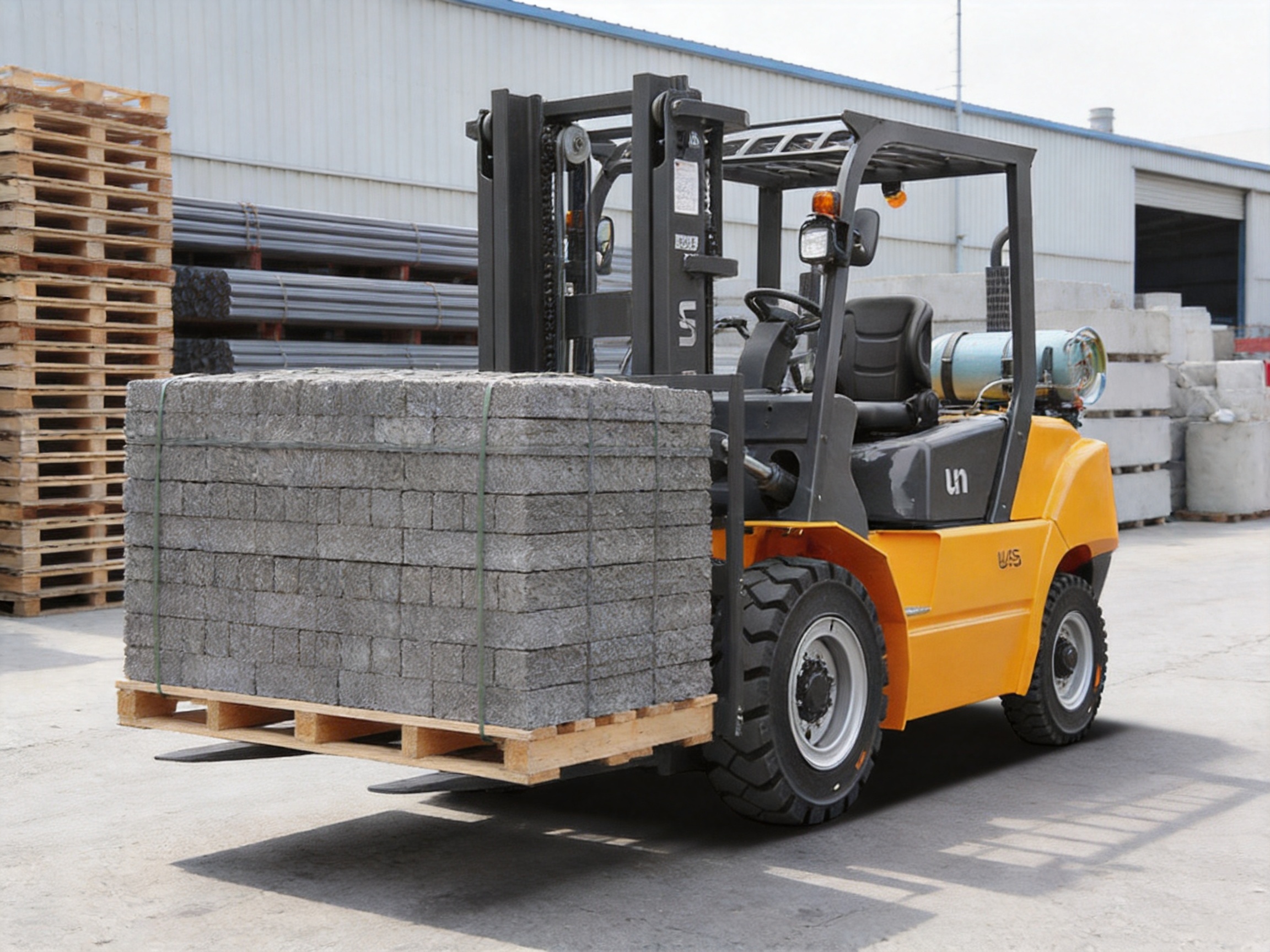
In building-material operations, the forklift can handle bricks, blocks, stone products, concrete components, timber packages, pipes, and bagged products. These materials are often dense and may be stored outdoors, making capacity, traction, cooling performance, and weather adaptability important selection criteria.
In ports, freight terminals, and outdoor storage yards, LPG power and high drawbar pull can support repeated movement over longer travel routes. Site managers should evaluate local fuel availability, ground conditions, salt exposure, drainage, traffic separation, and protection against corrosion.
In recycling, paper, packaging, and industrial processing facilities, the forklift can be configured with suitable attachments for bales, rolls, bins, or irregular loads. Attachment selection must be accompanied by a revised capacity assessment because the weight and load center of an attachment directly affect residual capacity.
In agricultural and food-related logistics environments, the forklift can be used for palletized products, feed, packaging, and supplies where local regulations and ventilation conditions permit LPG equipment. For operations involving hygienic production zones, customers should confirm the appropriate tire, exhaust, cleaning, and emissions requirements.
Specification Summary
| Item | Specification |
|---|---|
| Product type | LPG and gasoline heavy-duty counterbalance forklift |
| Model range | FGL40T, FGL45T, FGL50T |
| Rated capacity | 4,000 / 4,500 / 5,000 kilograms |
| Standard load center | 500 millimeters |
| Rated lift height | 3,000 millimeters |
| Fork size | 1,070 × 150 × 50 millimeters |
| Engine | PSI4.3, six-cylinder LPG engine |
| Displacement | 4.294 liters |
| Rated output | 63 kilowatts at 2,000 revolutions per minute |
| Rated torque | 298 newton-meters at 1,200 revolutions per minute |
| Transmission | Powershift, two forward and one reverse speed |
| Maximum drawbar pull at full load | Greater than 21 kilonewtons |
| Full-load gradeability | At least 20 percent |
| No-load travel speed | Up to 20–22 kilometers per hour |
| Overall width | 1,485 millimeters |
| Wheelbase | 2,000 millimeters |
| Ground clearance at mast | 175 millimeters |
| Front tires | 300-15-18PR |
| Rear tires | 7.00-12-12PR |
| Fuel tank capacity | 90 liters as listed in the product specification |
| Attachment operating pressure | 17 megapascals |
| Approximate total weight | 6,600–7,100 kilograms, depending on capacity |
The specification summary is provided for general product evaluation. Final values may vary according to mast, tire, attachment, fuel arrangement, market requirements, and optional equipment. The capacity plate, operating manual, and final technical quotation should be used for purchasing and operating decisions.
Purchasing and Configuration Considerations
Before ordering, buyers should identify the heaviest load, average load, maximum load center, required lift height, operating surface, aisle width, ceiling height, indoor or outdoor use, daily operating hours, fuel availability, and attachment requirements. These factors determine whether the 4.0-ton, 4.5-ton, or 5.0-ton model is most appropriate.
Mast selection should be based on more than maximum fork height. The buyer should confirm lowered mast height, extended mast height, free-lift height, residual capacity at the required lift height, overhead clearance, and visibility. A three-stage full-free-lift mast can be useful in restricted-height buildings, but it may influence weight, capacity, and purchase cost.
Attachment selection must be completed before the capacity rating is finalized. Side shifters, clamps, rotators, fork positioners, and other tools change the load center and add dead weight. The product information identifies capacity reductions for separated and integrated side shifters, but each attachment should be assessed individually.
Fuel planning is equally important. LPG users need a safe cylinder storage area, trained personnel, proper connection procedures, leak checks, and compliance with local regulations. Facilities must provide suitable ventilation and establish clear rules for refueling, cylinder transport, and emergency response.
Customers should also review service coverage, warranty support, spare-parts availability, operator training, preventive maintenance schedules, and commissioning procedures. A forklift is a long-term production asset, and the quality of local support can have as much influence on total ownership cost as the initial purchase price.
Q&A
What load capacities are available?
The product family includes the FGL40T, FGL45T, and FGL50T, with rated capacities of 4,000, 4,500, and 5,000 kilograms respectively. The actual allowable capacity depends on the load center, lift height, mast configuration, attachment, and operating conditions.
Is the forklift LPG-powered or gasoline-powered?
The product title identifies LPG and gasoline capability, while the main technical specification lists LPG as the power type. Buyers should confirm the exact fuel configuration, engine calibration, tank or cylinder arrangement, and regional specification before placing an order.
What engine is used?
The listed engine is the PSI4.3 manufactured by PSI. It has six cylinders, 4.294 liters of displacement, 63 kilowatts of rated output at 2,000 revolutions per minute, and 298 newton-meters of rated torque at 1,200 revolutions per minute.
What is the standard lifting height?
The standard rated lift height is 3,000 millimeters. Optional mast configurations can provide considerably greater fork heights, with available examples extending to approximately 6,000 millimeters depending on the mast type and capacity configuration.
Can the forklift work indoors?
It can be suitable for indoor or semi-indoor applications where LPG equipment is permitted and adequate ventilation is provided. The facility must evaluate emissions, airflow, fire safety, fuel storage, floor conditions, and local regulations before using an internal combustion forklift indoors.
What are the main operator-safety features?
The forklift includes an operator presence system and seat switch, a wide-visibility mast, a high-strength overhead guard, suspended chassis design, adjustable steering, and an ergonomic seat. These features support safer operation but do not replace proper training, seat-belt use, inspections, or site traffic controls.
How does the suspended chassis benefit the operator?
The suspended chassis provides more foot space and can improve comfort by reducing the effects of vibration. An optional suspended powertrain system is also available for customers who require additional vibration isolation during extended operating cycles.
What maintenance features are included?
The engine cover rotates nearly 90 degrees to provide easier access to the engine compartment. The transmission oil filter is designed for quick replacement. These features can reduce routine service time when combined with the correct maintenance schedule and qualified technicians.
What attachments can be used?
The forklift can be evaluated for side shifters, fork positioners, clamps, rotators, and other hydraulic attachments. Compatibility depends on hydraulic pressure, flow, mounting dimensions, attachment weight, load center, and residual capacity. The final attachment must be approved and reflected on the capacity plate.
How does a side shifter affect capacity?
The supplied product information states that a separated side shifter reduces load capacity by 200 kilograms, while an integrated side shifter reduces load capacity by 100 kilograms. The final rated capacity must be confirmed for the exact truck, mast, attachment, and load center.
Who manufactures the forklift?
The forklift is manufactured by Zhejiang UN Forklift Co., Ltd., a material handling equipment producer established in 1978. The company integrates research and development, manufacturing, sales, and service and supplies a broad range of forklift and warehouse equipment products.
What makes the manufacturer suitable for international buyers?
The manufacturer reports an international sales and service network covering Europe, South America, North America, Africa, and Asia. It also reports experience in OEM supply, electric forklift technology, internal combustion forklifts, new-energy products, and national industry-standard development.
Conclusion
The N Series 4.0T–5.0T LPG and gasoline forklift is designed for users who need dependable heavy-duty capacity, strong travel performance, practical mast flexibility, and manageable operating costs. Its 4,000- to 5,000-kilogram capacity range, PSI4.3 engine, powershift transmission, robust chassis, large radiator, hydraulic attachment capability, and multiple mast configurations make it suitable for a broad range of industrial handling tasks.
Its advantages over lighter-duty alternatives include higher capacity, stronger structural support, improved traction potential, and better suitability for continuous heavy handling. Compared with some diesel solutions, its LPG configuration can offer a cleaner operating environment and lower visible emissions in appropriate applications. Compared with battery-electric equipment, it provides rapid refueling and long operating cycles where charging infrastructure is limited. The best choice depends on the facility’s emissions requirements, operating hours, fuel strategy, floor conditions, and maintenance resources.
The manufacturer’s long operating history, broad product portfolio, stated production capacity, engineering background, OEM experience, and development of electric and new-energy equipment provide a strong foundation for product support and future fleet expansion. For customers seeking a heavy-duty forklift that combines industrial power with operator-focused design and service accessibility, this N Series platform deserves detailed consideration.
Final selection should always be based on the completed technical specification, capacity plate, attachment data, local safety regulations, fuel requirements, and a site-specific application review. With correct configuration, training, inspection, and maintenance, the forklift can serve as a productive and durable asset in demanding material handling environments.
References
1. Product technical information for the N Series 4.0T–5.0T LPG and gasoline forklift, including main specifications, mast configurations, operating features, and capacity notes.
2. Manufacturer-provided information concerning company history, production capability, product development, OEM experience, and international service coverage.
3. General principles of industrial counterbalance forklift selection, load-center evaluation, mast capacity assessment, and attachment compatibility.
4. General occupational safety practices for powered industrial trucks, including operator training, pedestrian separation, load stability, daily inspection, and preventive maintenance.
5. General guidance for LPG-powered industrial vehicles, including fuel-cylinder handling, ventilation, refueling procedures, emissions management, and workplace fire safety.
Product: N Series 4.0T-Mini5.0T LPG&Gasoline Forklift

For exclusive deals and latest offers, sign up by entering your email address below.
Stay In Touch
ADDRESS : NO.1 ROAD ONE, XINDENG NEW DISTRICT, FUYANG, HANGZHOU, ZHEJIANG, CHINA 311404.
PHONE : +86-571-8688 8355 (AMERICA)
PHONE : +86-571-8886 9363 (EUROPE)
PHONE : +86-571-8688 8377 (ASIA, AFRICA, OCEANIA)
EMAIL : [email protected]
EMAIL : [email protected](PARTS INQUIRY)

