


 中文简体
中文简体 Français
 русский
 Español
 عربى
عربى Deutsch



N Series 2.0T–2.5T LPG and Gasoline Forklift: Efficient, Safe, and Built for Demanding Material Handling
Admin 2026-09-29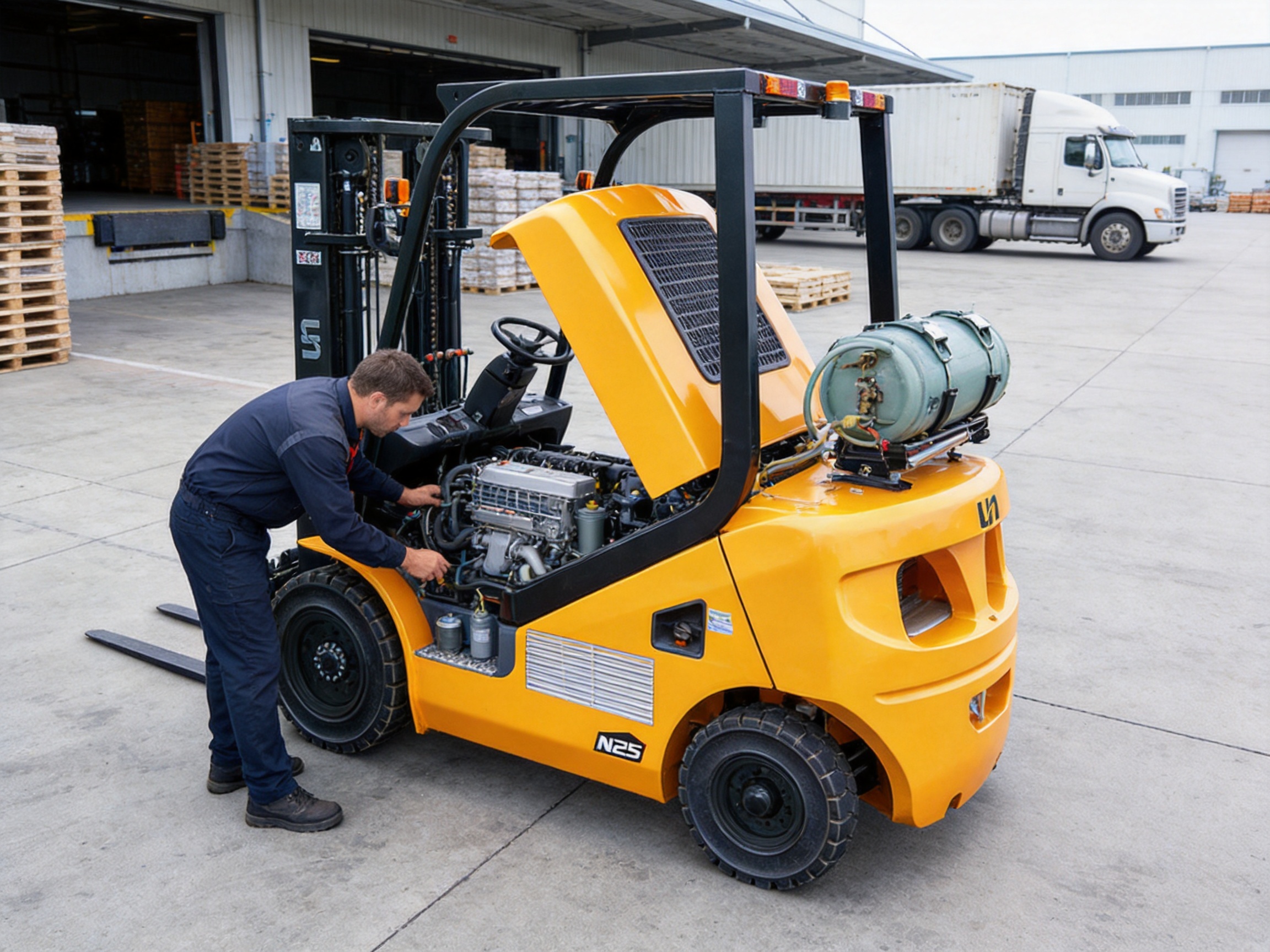
Introduction
Modern warehouses, manufacturing plants, distribution centers, construction sites, and logistics yards require material-handling equipment that can combine power, maneuverability, safety, and operating economy. A forklift must perform reliably throughout long working shifts while handling changing loads, uneven surfaces, narrow aisles, and demanding production schedules. For many small and medium-sized enterprises, the ideal machine must also remain practical to maintain and flexible enough for different applications.
The N Series 2.0T–2.5T LPG and gasoline forklift is designed for precisely this working environment. With rated capacities of 2,000 kg and 2,500 kg, a 500 mm load center, a 3,000 mm rated lift height, and a powerful internal-combustion powertrain, it provides a balanced solution for general industrial handling. Its LPG and gasoline configuration offers refueling flexibility, dependable outdoor performance, and the ability to work continuously without the long charging interruptions associated with some battery-powered alternatives.
The forklift combines a scientifically designed chassis, a GCT K21/25 or GK25 engine platform, hydraulic systems using Shimadzu pumps and valves, a Japanese-level transmission, and an integrated shifting system. It also incorporates important operator-centered features, including an integrated operator presence system, a seat switch, a wide-visibility mast, a high-strength overhead guard, adjustable steering, ergonomic seating, and a suspended chassis layout.
Beyond its product specifications, the machine is supported by the manufacturing capabilities of Zhejiang UN Forklift Co., Ltd. The company has operated in the material-handling industry since 1978 and integrates research and development, production, sales, and service. Its broad product portfolio, international support network, engineering experience, and focus on energy saving, environmental protection, efficiency, and safety provide a strong foundation for the N Series.
This article examines the design, operating advantages, technical performance, manufacturing strengths, application suitability, maintenance features, and competitive value of the N Series 2.0T–2.5T LPG and gasoline forklift.
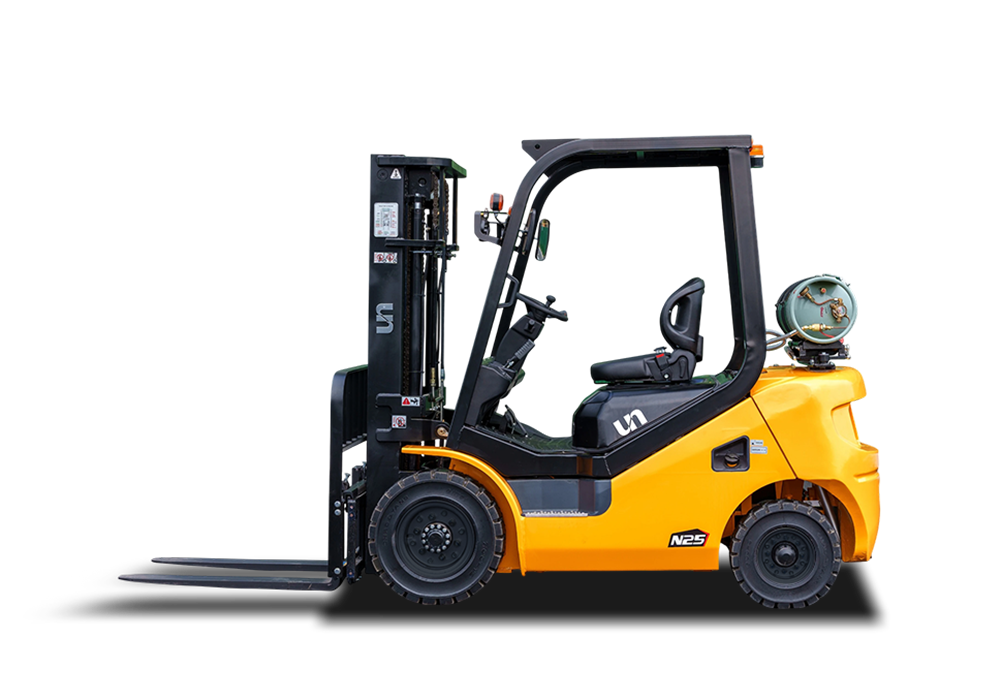
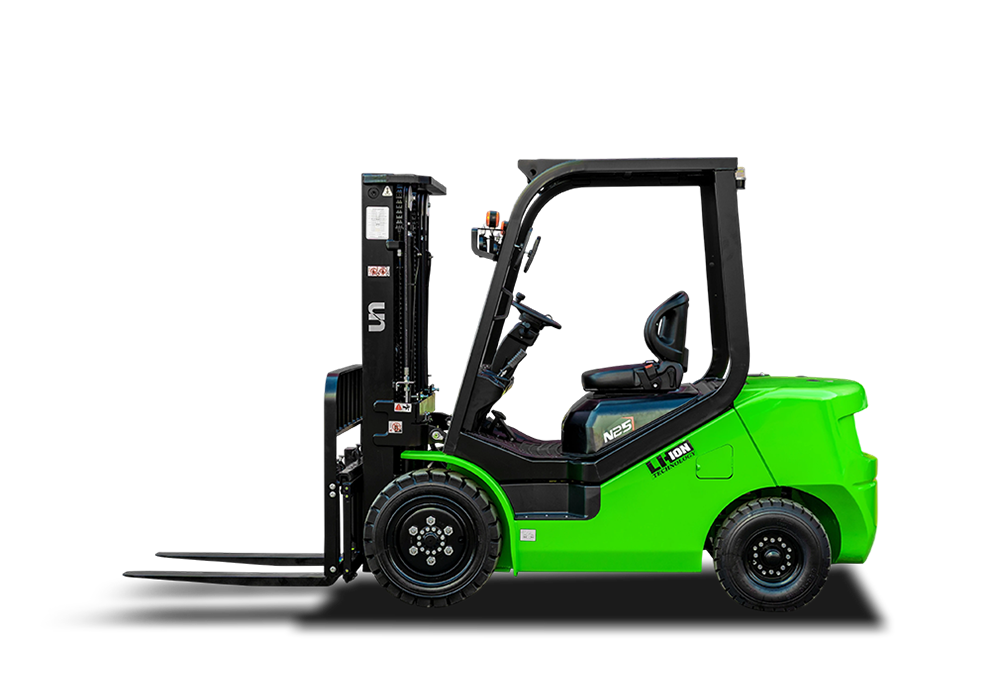
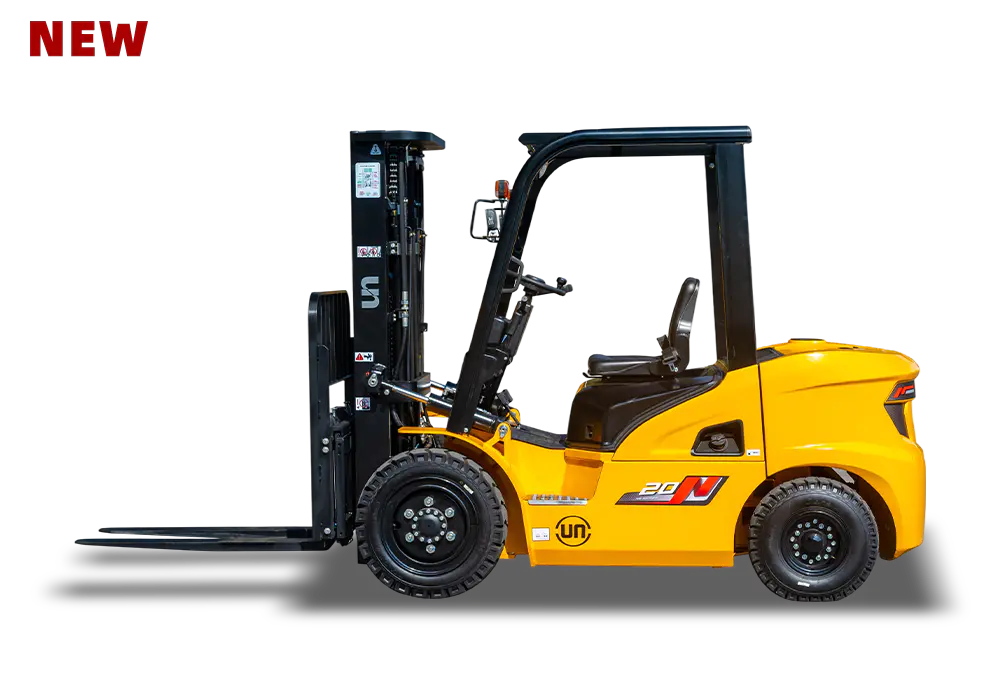
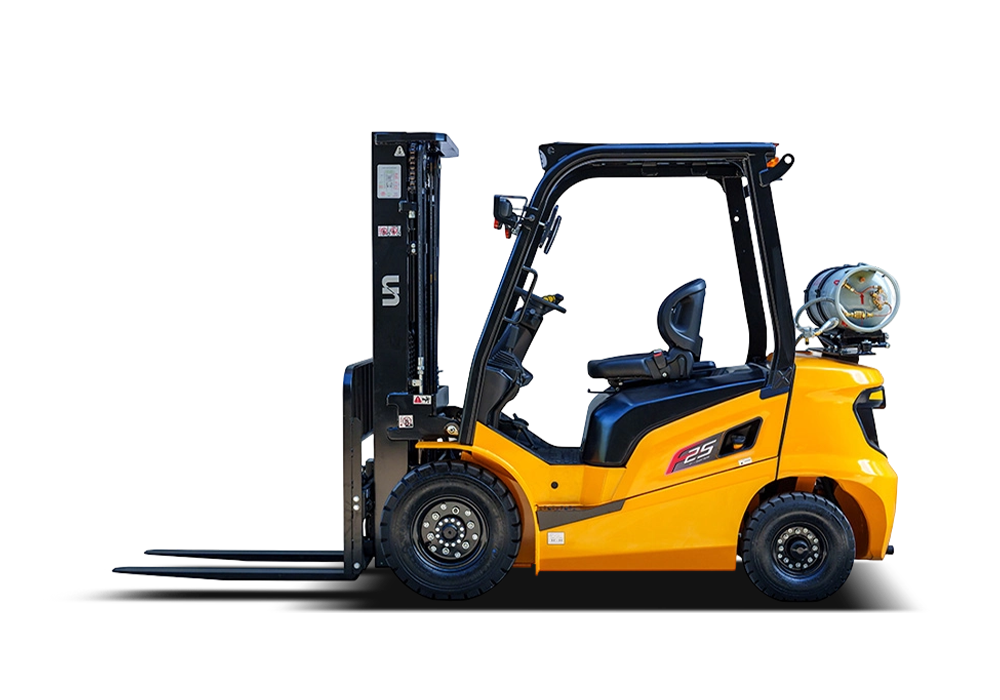
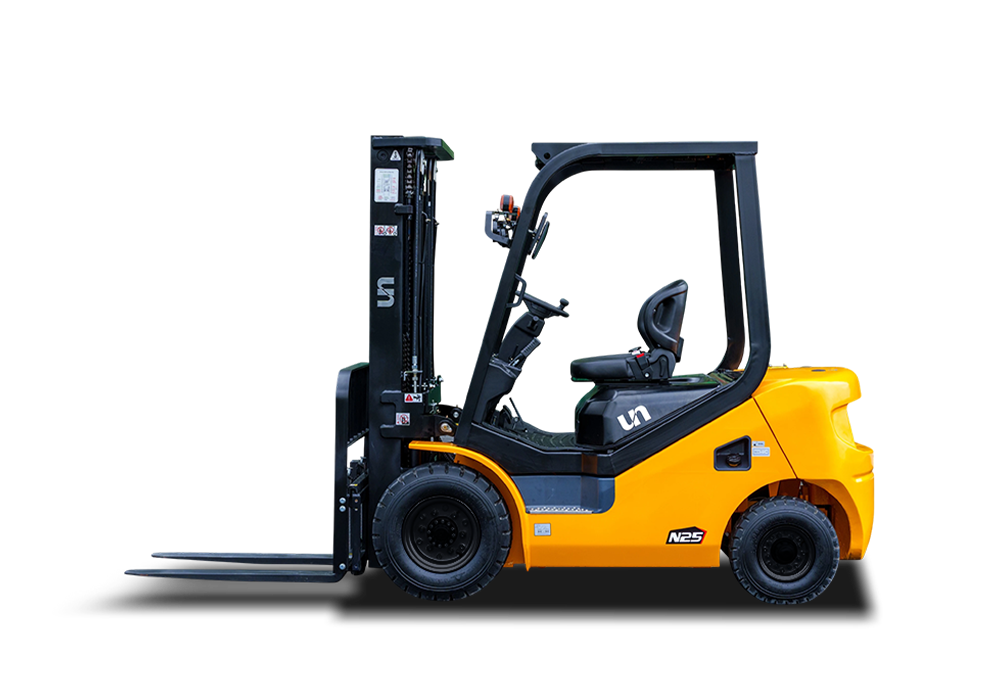
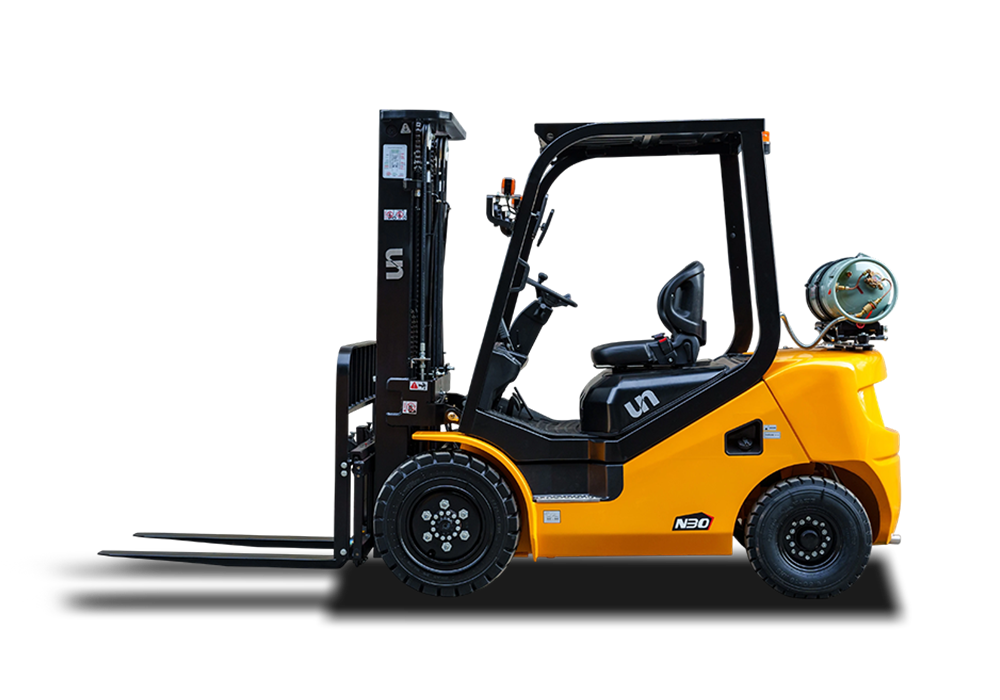
N Series 2.0T-2.5T LPG&Gasoline Forklift
Product Positioning and Core Value
The N Series is positioned as a versatile internal-combustion forklift for companies that need a capable general-purpose truck without moving into a larger, more specialized machine. Its 2.0-ton and 2.5-ton capacity classes cover a substantial portion of everyday pallet-handling requirements. These capacities are suitable for manufacturing components, packaged goods, raw materials, building supplies, warehouse pallets, and many other industrial loads.
The principal value of the forklift is balance. It offers sufficient power for demanding work while retaining dimensions that are manageable in ordinary industrial facilities. Its 2.0-ton and 2.5-ton models share a common 500 mm load center and a standard 3,000 mm lift height. This makes them straightforward to specify for common pallet-handling tasks, especially where loads are relatively uniform and the working height does not require a high-rise mast configuration.
Compared with many basic entry-level forklifts, the N Series places greater emphasis on complete operating performance. The chassis, powertrain, hydraulic system, cooling system, mast, operator compartment, and service access are developed as an integrated package. This approach helps avoid the compromises that can arise when individual components are selected without considering the overall operating environment.
The LPG and gasoline configuration is particularly useful for operations requiring a combination of indoor and outdoor handling. LPG generally produces fewer visible emissions and less soot than conventional diesel operation, while gasoline can provide convenient fuel availability in markets where gasoline infrastructure is established. Depending on local regulations and customer requirements, the machine can be configured for the appropriate fuel arrangement.
For businesses that cannot afford long equipment downtime, the forklift provides fast refueling and extended operating continuity. A fuel-powered truck can usually return to work quickly after refueling, whereas a battery forklift may require a scheduled charging period or the use of spare batteries. This distinction is important for multi-shift operations, high-throughput loading areas, and facilities without sufficient charging infrastructure.
Powertrain and Operating Performance
Responsive LPG and Gasoline Power
The powertrain is designed to deliver smooth, controllable performance across common material-handling tasks. The electronic throttle improves response and enables the operator to regulate travel and acceleration more precisely. This can be valuable when positioning a pallet near racking, entering a trailer, approaching a production line, or maneuvering around personnel and other machines.
The published specifications for the 2.0-ton and 2.5-ton configurations identify the GK25 engine platform, with an output of 37.4 kW at 2,500 rpm and rated torque of 176.5 N·m at 1,600 rpm. The four-cylinder engine has a displacement of 2,488 cc, a bore and stroke of 89 × 100 mm, and is paired with a hydraulic transmission. These figures provide a practical combination of torque and power for routine lifting, travel, ramp work, and yard operations.
The engine is supported by a large-capacity radiator and advanced cooling solutions. Temperature management is a critical issue for internal-combustion forklifts, especially in hot climates, enclosed loading zones, and applications involving repeated lifting and short-distance travel. A cooling system designed for stability helps reduce the risk of heat-related performance loss and supports reliable operation during demanding shifts.
Hydraulic Transmission and Shifting Control
The hydraulic transmission is configured with one forward stage and one reverse stage. This arrangement is well suited to forklift work, where the operator frequently changes direction while aligning with pallets or navigating between storage locations. The integrated shifting system is intended to provide smooth directional changes and controlled power delivery.
Smooth shifting is more than a comfort feature. It reduces shock loads on the drivetrain, helps protect the cargo from sudden movement, and allows the operator to maintain better control in congested workspaces. In repetitive applications, consistent shifting can also contribute to reduced fatigue and more predictable handling cycles.
The 2.0-ton and 2.5-ton models are listed with a no-load travel speed of up to 21 km/h and a full-load lifting speed of approximately 490 mm per second in the related specification configuration. Maximum gradeability at full load is listed at 20 percent, while maximum drawbar pull is listed at 17 kN under full-load conditions and 14.5 kN under no-load conditions. These values indicate that the truck is designed not only for level warehouse floors but also for moderate ramps, loading docks, and outdoor industrial surfaces.
Fuel Capacity and Continuous Operation
A 50-liter fuel tank supports extended operating periods between refueling intervals. Actual operating time depends on load, duty cycle, fuel type, ambient temperature, operator behavior, and maintenance condition. Nevertheless, the capacity provides a practical advantage for facilities that need dependable availability throughout the working day.
Fuel-powered forklifts also offer operational flexibility when electricity supply is limited or when a site has not invested in battery charging rooms, ventilation systems, spare batteries, or charging management. This makes the N Series attractive to construction materials suppliers, general manufacturing facilities, freight terminals, agricultural processing sites, and outdoor storage yards.
Structural Design and Load Handling
A forklift’s rated capacity is only one part of its practical performance. Stability depends on the relationship between the load center, wheelbase, counterweight, mast, axle loads, tire configuration, and operating surface. The N Series is designed around a 500 mm load center for its 2.0-ton and 2.5-ton models. Operators should always verify the capacity plate and load chart before handling loads with a greater load center or unusual shape.
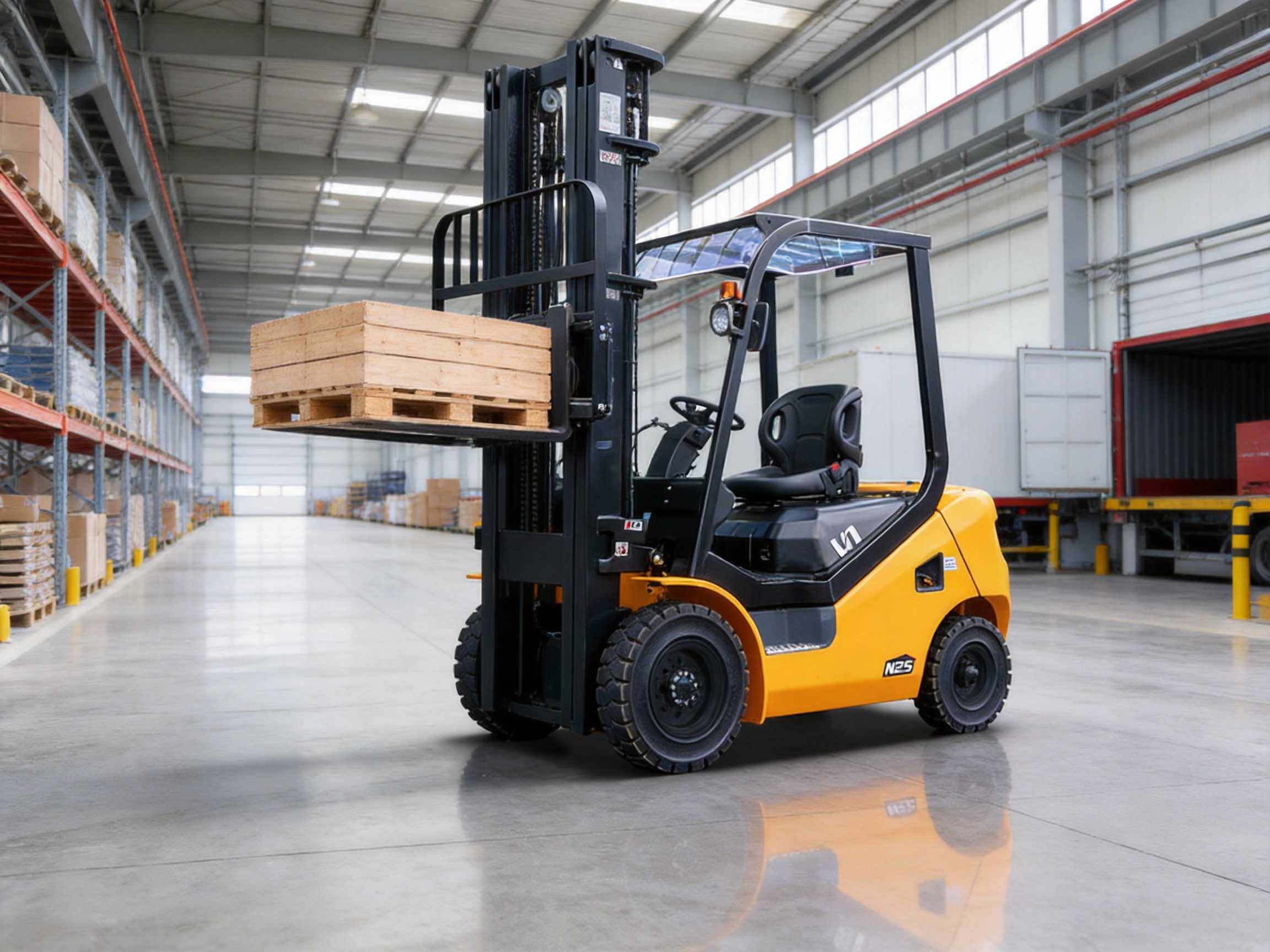
The rated lift height is 3,000 mm in the standard configuration. The mast has a lowered height of approximately 2,055 mm and an extended height of approximately 4,070 mm with the load backrest. The overhead guard height is approximately 2,215 mm. These dimensions provide a useful compromise between stacking capability and access to ordinary industrial buildings.
The standard fork size for the 2.0-ton and 2.5-ton configurations is approximately 1,070 × 125 × 40 mm. The mast tilt angle is listed as 6 degrees forward and 12 degrees backward. Forward tilt can assist with load placement, while backward tilt helps stabilize a pallet during travel. Correct use of mast tilt remains essential, and operators must avoid excessive tilt when a load is elevated.
The machine has a length to the face of the forks of approximately 2,630 mm without the forks, an overall width of approximately 1,170 mm, and an outside turning radius of approximately 2,365 mm in the related 2.0-ton and 2.5-ton specification table. The minimum aisle width for pallets is approximately 4,120 mm. These dimensions should be compared with the customer’s aisle layout, rack configuration, pallet dimensions, door openings, and turning requirements before purchase.
Stable Chassis Engineering
The chassis is scientifically designed to support both stability and durability. A forklift chassis must manage concentrated loads at the front, repeated braking and acceleration, torsional stress on uneven ground, vibration from outdoor travel, and impact loads caused by ordinary industrial use. The machine’s structural design, counterweight, axle arrangement, and mast interface are coordinated to provide a stable working platform.
Published data for the relevant models lists a wheelbase of approximately 1,650 mm, a front tread of approximately 970 mm, and a rear tread of approximately 980 mm. The total operating weight is approximately 3,620 kg for the 2.0-ton configuration and approximately 3,860 kg for the 2.5-ton configuration. Full-load axle distribution figures should be considered when assessing floor loading, ramp use, trailer access, and work on elevated platforms.
These values also demonstrate why professional operators must respect the rated capacity and load center. The forklift’s stability is engineered around defined operating conditions. Capacity is not simply determined by engine power; it is a function of the complete truck and the specific load geometry.
Hydraulic System and Handling Precision
The hydraulic system directly affects lifting smoothness, steering response, and attachment performance. The N Series uses Shimadzu pumps and valves to support reliable lifting and steering functions. Quality hydraulic components help maintain consistent control under changing load conditions and support predictable operation over long working periods.
Smooth lifting is important when handling fragile or unstable goods. A controlled hydraulic response allows the operator to raise a pallet without sudden movement, align the load with a rack beam, and lower it accurately into position. Smooth steering is equally important in confined areas because it helps the operator make small directional corrections without oversteering.
The operating pressure for attachments is listed at approximately 18.5 MPa in the related 2.0-ton and 2.5-ton configuration data. The actual suitability of an attachment depends on its hydraulic flow, pressure, weight, load center, and compatibility with the truck. Side shifters, fork positioners, clamps, rotators, and other attachments should be selected in consultation with the supplier and verified against the capacity chart.
The hydraulic system also benefits from the overall cooling design. Hydraulic oil temperature can rise during continuous lifting, intensive attachment use, and operation in hot environments. Effective thermal management contributes to stable control and helps protect seals, hoses, pumps, and valves.
Operator Safety and Ergonomics
Integrated Safety Systems
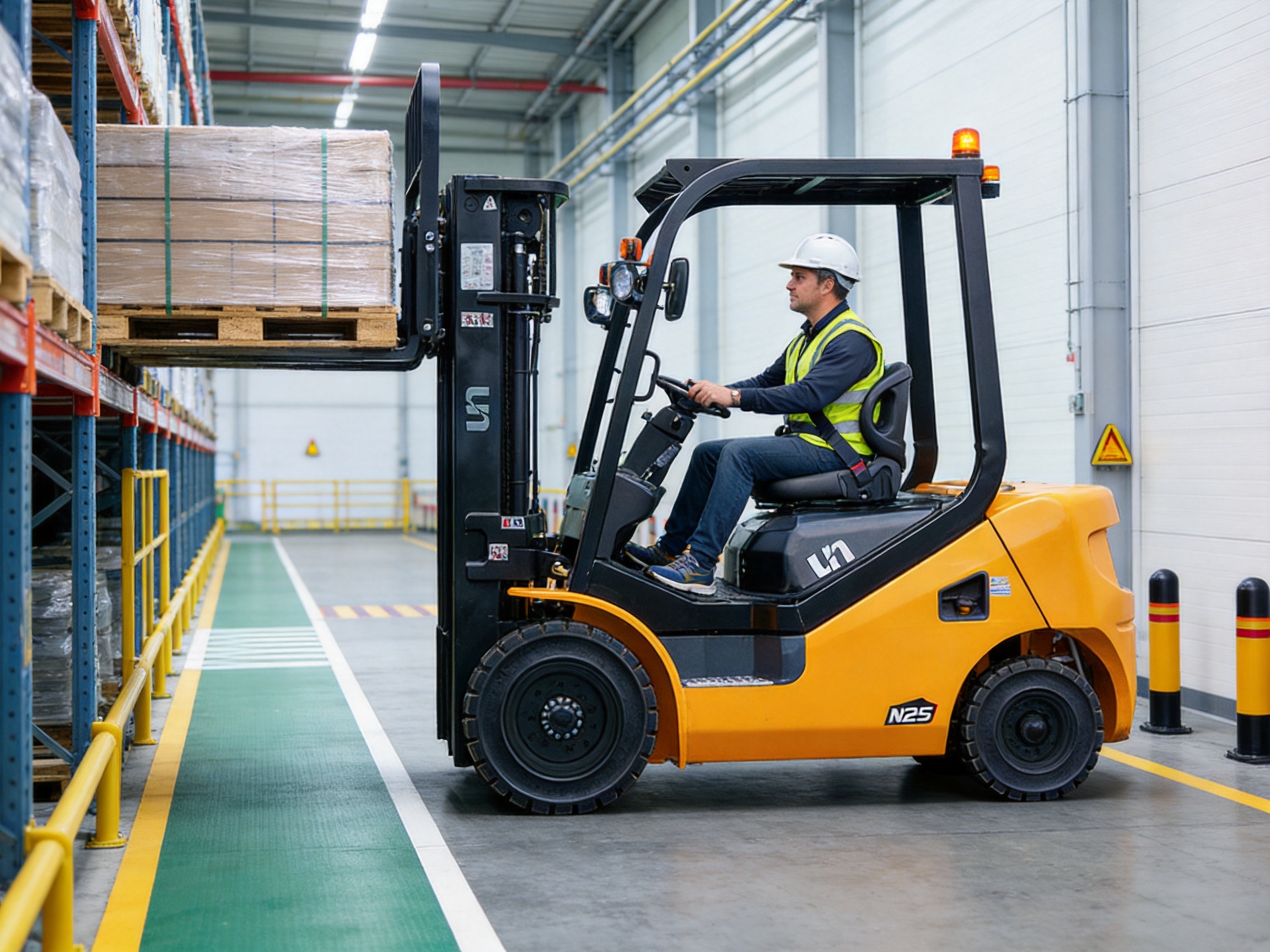
Operator safety is addressed through several integrated features. The operator presence system and seat switch are designed to help prevent unintended operation when the operator is not correctly positioned. Such systems can support safer working practices by linking machine functions to the operator’s presence in the seat.
A high-strength overhead guard provides protection from falling objects within the conditions for which it is designed. It is not a substitute for proper load securing, safe stacking, exclusion zones, or adherence to workplace safety procedures. Operators must keep clear of suspended or unstable loads and must never place any part of the body beneath an elevated load.
The wide-visibility mast improves forward sightlines. Visibility is essential when traveling with a load, entering a rack, crossing an intersection, or working near pedestrians. Good visibility can reduce the need for excessive head movement and support more accurate pallet placement. Even with a visibility-oriented mast, operators must travel with the load at a safe height and use spotters or warning systems where necessary.
Comfort for Long Shifts
Forklift operators may spend many hours seated in a fixed position, repeatedly turning to check the rear, looking upward during stacking, and making frequent directional changes. Poor ergonomics can contribute to fatigue, discomfort, and reduced concentration. The N Series addresses these concerns with a suspended chassis design intended to maximize legroom, adjustable steering, and ergonomic seating.
Additional legroom gives the operator more freedom to adjust posture and enter or exit the compartment. Adjustable steering allows the control position to be matched more closely to the operator’s body size and preferred driving posture. Ergonomic seating helps reduce pressure during extended shifts.
An optional suspended powertrain system can further enhance versatility and operator comfort. Suspension helps isolate the operator from vibration generated by the engine, drivetrain, tires, and uneven surfaces. The value of this feature is particularly apparent in outdoor yards, rough concrete areas, loading ramps, and applications involving frequent travel over expansion joints.
Comfort should not be viewed as separate from productivity. An operator who can work comfortably and maintain good visibility is more likely to perform accurate, consistent handling cycles. Reduced fatigue can also support safer decision-making late in a shift.
Maintenance and Serviceability
Wide Engine Hood Opening
Routine maintenance is a major factor in the total cost of ownership. The N Series engine hood opens to nearly 90 degrees, providing broad access to the engine compartment. This simplifies daily inspections, filter checks, fluid inspection, belt examination, battery access, and replacement of commonly serviced components.
Good service access reduces the time required for preventive maintenance. It also helps technicians identify developing issues before they become major failures. A machine that is difficult to open or inspect may encourage maintenance delays, whereas a practical service layout supports more consistent care.
Convenient Filter Replacement
The transmission oil filter is designed for convenient replacement. Service components that can be reached quickly help reduce maintenance labor and downtime. Regular filter replacement is important because contaminated or degraded transmission oil can affect shifting quality, component life, and overall drivetrain reliability.
Maintenance intervals should always follow the official service schedule and be adjusted for operating conditions. Dusty sites, high-temperature environments, heavy attachment use, frequent ramp travel, and multi-shift operation may require more frequent inspection or servicing than light-duty indoor use.
Preventive Maintenance Priorities
Operators should conduct a pre-shift inspection before using the forklift. Key inspection points include tires, forks, mast chains, hydraulic hoses, fluid levels, brakes, steering, lights, warning devices, seat belts, overhead guard condition, and visible leaks. The LPG system, fuel lines, connectors, and tank mounting should receive particular attention on LPG-equipped trucks.
Forks should be inspected for cracks, bending, excessive wear, and damaged locking devices. Chains should be checked for lubrication, elongation, corrosion, and abnormal movement. Tires should be inspected for cuts, separation, embedded objects, and appropriate inflation where pneumatic tires are used.
Preventive maintenance also includes cleaning the radiator and cooling passages. Dust, chaff, packaging fibers, and other debris can restrict airflow and increase engine or hydraulic temperatures. Keeping the cooling system clean is especially important in agricultural, recycling, construction, and outdoor storage environments.
Advantages Over Competing Forklift Options
Compared with Basic Gasoline Forklifts
Basic gasoline forklifts may offer a low initial purchase price, but some models provide limited operator protection, less refined control, restricted service access, or less developed cooling systems. The N Series offers a more complete specification, including electronic throttle control, an integrated safety system, a visibility-oriented mast, ergonomic improvements, and engineered hydraulic components.
Its value therefore extends beyond engine output. A company evaluating equipment should consider productivity, operator comfort, service time, component durability, safety support, and long-term availability rather than comparing only the initial price.
Compared with Diesel Forklifts
Diesel forklifts are often selected for high torque and heavy outdoor work, but they may generate more noise, visible exhaust, and particulate emissions than LPG or gasoline models. For applications where a diesel truck is not necessary, an LPG and gasoline forklift can offer a cleaner and more flexible alternative.
The N Series is suited to mixed indoor and outdoor applications where emission considerations, noise, and maneuverability matter. It is not intended to replace every heavy-duty diesel truck, particularly in extremely severe terrain or applications requiring substantially greater capacity. However, within the 2.0-ton to 2.5-ton range, it provides a practical balance between performance and environmental considerations.
Compared with Battery Forklifts
Battery forklifts are attractive for indoor use because of their quiet operation and absence of tailpipe emissions during operation. However, customers must consider charging infrastructure, charging time, battery replacement, temperature effects, and the need for additional batteries in multi-shift applications.
The LPG and gasoline N Series offers rapid refueling and continuous operation that can be advantageous where equipment availability is more important than zero tailpipe emissions. It may also be better suited to outdoor yards, construction-related work, wet conditions, or sites where charging facilities are not yet available.
The correct choice depends on the application. For an enclosed facility with strict indoor emission requirements, a battery or other zero-emission forklift may be preferable. For a mixed-use site requiring long shifts, fast refueling, and outdoor capability, the N Series can provide a stronger operational fit.
Comparison of Practical Operating Factors
| Factor | N Series LPG and Gasoline Forklift | Battery Forklift | Typical Diesel Forklift |
|---|---|---|---|
| Refueling or energy replenishment | Fast fuel replenishment and continued operation | Requires charging time or spare batteries | Fast refueling and extended operation |
| Indoor suitability | Suitable where ventilation and local regulations permit | Highly suitable for many indoor applications | More limited in enclosed areas |
| Outdoor flexibility | Strong flexibility for yards and mixed surfaces | Depends on design, tires, weather, and battery management | Strong outdoor performance |
| Operator control | Electronic throttle and hydraulic transmission | Electric drive control | Powerful internal-combustion response |
| Maintenance access | Wide-opening hood and accessible filter service | Fewer engine-related service items | Requires regular engine and emission-system maintenance |
| Best application profile | Mixed indoor/outdoor and multi-shift handling | Indoor, low-noise, low-emission operations | Heavy outdoor and severe-duty work |
This comparison is a general guide rather than a substitute for an application assessment. Floor conditions, ventilation, local regulations, duty cycle, load type, shift pattern, and fuel or charging availability should all be evaluated before selecting a forklift.
Manufacturing Strengths and Engineering Capabilities
The product is backed by a manufacturer with a long history in material-handling equipment. Zhejiang UN Forklift Co., Ltd. was founded in 1978 and integrates research and development, manufacturing, sales, and service. The company occupies approximately 53,400 square meters and has an annual production capacity of approximately 15,000 units.
A long operating history provides experience across different forklift categories, customer applications, regulatory environments, and market requirements. This experience can support product refinement in areas such as chassis design, mast geometry, hydraulic integration, powertrain selection, ergonomics, and serviceability.
The company offers a broad range of material-handling products, covering 17 varieties, 96 series, and more than 200 specifications. This breadth is significant because it indicates exposure to diverse handling requirements, from internal-combustion counterbalance trucks to electric forklifts, reach equipment, warehouse machinery, and specialized models.
The company’s history also includes the development of China’s first reach forklift and very narrow aisle truck. Its participation in the formulation of Chinese electric forklift industry standards and its national patents related to electric forklift technologies demonstrate engagement with both product development and industry advancement.
Integrated Research and Production
Vertical integration between research, production, sales, and service can improve communication across the product life cycle. Engineering teams can receive feedback from field applications, production teams can support design-for-manufacturing improvements, and service personnel can communicate recurring maintenance concerns to development departments.
For a forklift customer, this integrated structure can provide practical advantages. Product specifications are more likely to reflect real operating requirements, spare-parts planning can be coordinated with production, and technical support can be aligned with the actual machine configuration. It can also help the manufacturer respond to changing market requirements, including emissions standards, energy efficiency expectations, safety requirements, and operator comfort.
Quality-Oriented Component Selection
The N Series demonstrates an emphasis on selected components in critical systems. The engine platform, transmission, hydraulic pumps and valves, cooling system, safety switches, mast, chassis, and operator compartment all contribute to the finished machine. The use of recognized hydraulic components and a Japanese-level transmission reflects an effort to improve functional reliability and operating smoothness.
Component quality must be supported by proper assembly, inspection, testing, and service. A strong manufacturing process therefore includes more than purchasing reliable parts. It requires dimensional control, welding quality, hydraulic cleanliness, electrical testing, torque control, paint and corrosion protection, and final performance verification.
Although specific factory process details may vary by production batch and customer configuration, the manufacturer’s integrated production capability provides a foundation for controlling these stages. Customers requiring special configurations should request confirmation of applicable inspection standards, testing procedures, documentation, and acceptance criteria before delivery.
Applications and Industry Suitability
Manufacturing Plants
The N Series is suitable for moving raw materials, work-in-process goods, finished products, molds, steel components, wooden packaging, and production pallets. Its capacity range fits many common factory loads, while its compact dimensions support movement between production areas and warehouse zones.
The smooth hydraulic system can assist with accurate placement near assembly lines. The ergonomic operator compartment supports repeated handling cycles, while the fuel-powered configuration provides flexibility for facilities that move goods between indoor production areas and outdoor loading yards.
Warehousing and Distribution
Distribution centers often require fast loading and unloading, frequent reversing, and reliable operation across long shifts. The N Series can be used for pallet transfer, truck loading, staging operations, and general storage work where the aisle dimensions are compatible with the truck’s turning radius and minimum aisle requirements.
Warehouse managers should consider ventilation when using LPG or gasoline equipment indoors. They should also establish pedestrian separation, speed controls, floor marking, charging or refueling procedures, and regular safety training.
Construction Materials
Construction-material suppliers frequently handle bags, blocks, pipes, timber, tiles, steel products, and packaged building systems. These goods may be stored outdoors or moved across rougher surfaces than those found in a conventional warehouse. The internal-combustion powertrain and practical ground clearance make the N Series appropriate for many yard applications, provided the surface, load geometry, and capacity requirements are suitable.
Food, Beverage, and Packaging Operations
LPG forklifts are commonly considered for operations where reduced visible exhaust and lower soot compared with diesel are important. Applications may include beverage distribution, packaging plants, food-related logistics, and consumer-goods warehouses. Site-specific hygiene rules, ventilation requirements, and local emissions regulations must always be observed.
Ports, Freight Yards, and Logistics Terminals
Freight terminals require quick turnaround, reliable travel, and the ability to operate in changing weather and surface conditions. The N Series can support loading and staging operations for moderate loads. Its fast refueling characteristics are useful when equipment must remain available during busy dispatch windows.
Specification Overview
The following table summarizes selected published specifications for the related 2.0-ton and 2.5-ton configurations. Specifications may vary according to fuel system, mast, tires, attachments, market requirements, and final configuration. Customers should confirm the official data sheet before ordering.
| Specification | 2.0-Ton Configuration | 2.5-Ton Configuration |
|---|---|---|
| Rated load capacity | 2,000 kg | 2,500 kg |
| Load center | 500 mm | 500 mm |
| Rated lift height | 3,000 mm | 3,000 mm |
| Free lift height | Approximately 140 mm | Approximately 140 mm |
| Fork size | 1,070 × 125 × 40 mm | 1,070 × 125 × 40 mm |
| Mast tilt angle | 6 degrees forward / 12 degrees backward | 6 degrees forward / 12 degrees backward |
| Overall width | Approximately 1,170 mm | Approximately 1,170 mm |
| Turning radius | Approximately 2,365 mm | Approximately 2,365 mm |
| Travel speed without load | Approximately 21 km/h | Approximately 21 km/h |
| Maximum gradeability at full load | 20 percent | 20 percent |
| Wheelbase | Approximately 1,650 mm | Approximately 1,650 mm |
| Total weight | Approximately 3,620 kg | Approximately 3,860 kg |
| Engine platform | GK25 | GK25 |
| Rated engine output | 37.4 kW at 2,500 rpm | 37.4 kW at 2,500 rpm |
| Rated engine torque | 176.5 N·m at 1,600 rpm | 176.5 N·m at 1,600 rpm |
| Fuel tank capacity | 50 liters | 50 liters |
| Transmission | Hydraulic, 1 forward / 1 reverse | Hydraulic, 1 forward / 1 reverse |
| Attachment operating pressure | Approximately 18.5 MPa | Approximately 18.5 MPa |
The product information also includes related configurations covering gasoline, LPG, and combined gasoline/LPG variants. Some published tables list broader capacity ranges and additional models. These related specifications should not be interpreted as identical to every N Series unit. The actual model designation, power type, mast arrangement, tire specification, engine, dimensions, and performance should be verified in the quotation and final technical documentation.
Purchasing and Deployment Considerations
Before purchasing, a customer should prepare a clear application profile. Important information includes the maximum and average load weight, load dimensions, load center, lift height, aisle width, floor condition, ramp gradient, indoor or outdoor operating ratio, daily operating hours, number of shifts, ambient temperature, and required attachments.
Fuel choice should be evaluated according to local availability, storage rules, ventilation, emissions regulations, and expected duty cycle. LPG can be advantageous where clean-burning internal-combustion operation is required, while gasoline may be selected where it is readily available and permitted by the site’s safety policy.
Customers should also consider mast options. The standard 3,000 mm lift height may suit many applications, but higher or lower mast configurations may be required for specific rack systems, door heights, containers, or low-clearance buildings. Free lift, mast lowered height, and extended height should be checked against the facility’s ceiling and door clearance.
Attachment selection affects residual capacity. A side shifter, clamp, rotator, fork positioner, or other attachment adds weight and may move the load center forward. The truck may therefore lift less than its nominal capacity when equipped with an attachment. The supplier should provide a revised capacity chart where necessary.
Operator training is equally important. Drivers should understand load charts, stability principles, ramp procedures, pedestrian safety, mast operation, fuel handling, parking, pre-shift inspection, and emergency procedures. A technically advanced forklift cannot compensate for unsafe operating practices.
Q&A
What is the rated capacity of the N Series forklift?
The main product range described here includes 2.0-ton and 2.5-ton configurations, with rated capacities of 2,000 kg and 2,500 kg respectively at a 500 mm load center. The actual capacity may change with lift height, attachment weight, attachment position, load shape, and mast configuration. Operators should always follow the capacity plate on the specific truck.
Is the forklift powered by LPG, gasoline, or both?
The product family includes LPG and gasoline configurations, and related published specifications also identify combined gasoline/LPG models. The exact fuel system depends on the selected model and market configuration. The final quotation and technical data sheet should be used to confirm the fuel type.
What engine is used in the 2.0-ton and 2.5-ton models?
The related specification table identifies a GCT GK25 engine with a displacement of 2,488 cc, four cylinders, 37.4 kW rated output at 2,500 rpm, and 176.5 N·m rated torque at 1,600 rpm. Some product descriptions refer to the GCT K21/25 engine platform. Customers should confirm the precise engine designation for the ordered configuration.
What is the standard lift height?
The standard rated lift height is approximately 3,000 mm. The published related configuration also lists a free lift height of approximately 140 mm, a lowered mast height of approximately 2,055 mm, and an extended height of approximately 4,070 mm with the load backrest.
Can the forklift be used indoors?
It can be used indoors where LPG or gasoline equipment is permitted and where adequate ventilation and emissions controls are provided. Indoor use must comply with local regulations and the facility’s safety requirements. For tightly enclosed areas with strict zero-emission requirements, an electric forklift may be more appropriate.
What are the main maintenance advantages?
The engine hood opens to nearly 90 degrees, giving technicians broad access to the engine compartment. The transmission oil filter is also designed for convenient replacement. These features can reduce routine service time and make inspections easier, although maintenance intervals must still follow the official schedule.
Is the forklift suitable for outdoor work?
Yes. Its internal-combustion powertrain, hydraulic transmission, practical ground clearance, pneumatic tire configuration, cooling system, and 20 percent full-load gradeability make it suitable for many outdoor industrial applications. The site should be assessed for ground condition, slope, load type, and weather exposure.
Can attachments be installed?
The forklift can support suitable hydraulic attachments, subject to compatibility with the hydraulic pressure, flow, mounting interface, weight, and residual capacity. The published attachment operating pressure for the related configuration is approximately 18.5 MPa. A revised capacity chart may be required when an attachment changes the load center.
How does the forklift support operator comfort?
The design includes a suspended chassis layout for increased legroom, adjustable steering, ergonomic seating, and an optional suspended powertrain system. These features are intended to reduce vibration and improve posture during extended operating periods.
What should be confirmed before ordering?
Customers should confirm the exact model, fuel type, engine, mast, lift height, tire type, fork dimensions, attachment requirements, capacity chart, dimensions, operating environment, delivery documentation, warranty terms, spare-parts support, and local compliance requirements.
Conclusion
The N Series 2.0T–2.5T LPG and gasoline forklift is a practical solution for businesses that need dependable capacity, fast refueling, outdoor flexibility, and controlled operating costs. Its 2,000 kg and 2,500 kg models cover many general industrial handling requirements, while the standard 3,000 mm lift height and 500 mm load center support common pallet and material-handling tasks.
The machine’s advantages come from the combination of its major systems. The GCT engine platform provides useful power and torque, the hydraulic transmission supports smooth directional control, Shimadzu hydraulic components contribute to lifting and steering performance, and the cooling system is designed for stable operation in demanding conditions. The wide-visibility mast, operator presence system, seat switch, overhead guard, suspended chassis, adjustable steering, and ergonomic seating address important safety and comfort requirements.
Serviceability is another important strength. A hood that opens to nearly 90 degrees and an accessible transmission oil filter can simplify preventive maintenance and reduce avoidable downtime. When combined with proper inspections, qualified service, and genuine replacement parts, these features can support a lower total cost of ownership.
The forklift also benefits from the capabilities of a manufacturer with decades of industry experience, integrated research and production, a broad product portfolio, international market exposure, and a strong focus on energy efficiency, safety, and technological development. This manufacturing background gives customers access to more than a single machine; it provides the support of an established material-handling equipment producer.
For companies comparing gasoline, LPG, diesel, and electric forklifts, the final decision should be based on the complete application rather than one specification. Ventilation, emissions rules, shift length, charging infrastructure, fuel availability, aisle dimensions, load geometry, floor conditions, and service support all matter. When these factors align with its design strengths, the N Series can deliver a reliable and versatile material-handling platform for manufacturing, warehousing, logistics, construction materials, and mixed indoor-outdoor operations.
References
1. Manufacturer product information for N Series LPG and gasoline forklifts, including published product descriptions and technical specifications.
2. Manufacturer corporate information concerning research and development, production capacity, product categories, service network, and company history.
3. General principles of industrial forklift stability, rated capacity, load center management, and attachment selection.
4. General occupational safety guidance for powered industrial trucks, operator training, pre-shift inspection, pedestrian control, and load handling.
5. General maintenance practices for internal-combustion forklifts, hydraulic systems, cooling systems, tires, forks, masts, and transmissions.
Product: N Series 2.0T-2.5T LPG&Gasoline Forklift

For exclusive deals and latest offers, sign up by entering your email address below.
Stay In Touch
ADDRESS : NO.1 ROAD ONE, XINDENG NEW DISTRICT, FUYANG, HANGZHOU, ZHEJIANG, CHINA 311404.
PHONE : +86-571-8688 8355 (AMERICA)
PHONE : +86-571-8886 9363 (EUROPE)
PHONE : +86-571-8688 8377 (ASIA, AFRICA, OCEANIA)
EMAIL : [email protected]
EMAIL : [email protected](PARTS INQUIRY)

