


 中文简体
中文简体 Français
 русский
 Español
 عربى
عربى Deutsch



How a 3.0-Tonne Lithium-Ion Forklift Delivers Efficient Indoor and Outdoor Material Handling
Admin 2026-09-23Modern material-handling operations are expected to move more goods, reduce operating costs, improve workplace safety, and meet increasingly demanding environmental targets. A forklift must therefore do more than lift a specified load. It must provide dependable performance throughout long working cycles, operate comfortably in changing environments, require minimal maintenance, and offer a practical energy solution for businesses transitioning away from conventional internal-combustion equipment.
The VE Series 3.0T Li-ion Battery Forklift is designed to address these requirements with a combination of 3,000-kilogram lifting capacity, lithium-ion power, pneumatic tires, outdoor-capable ground clearance, integrated charging, and a chassis layout intended to deliver the familiar working characteristics of an internal-combustion forklift. It is positioned between traditional electric forklifts designed primarily for indoor use and combustion-powered forklifts that may produce higher emissions, noise, and operating costs.
With its 80 V/135 Ah lithium-ion battery, 10 kW drive motor, 12 kW lift motor, 11 km/h loaded travel speed, and 3,000 mm rated lift height, the forklift is suitable for warehouses, manufacturing plants, logistics yards, distribution centers, construction-material facilities, agricultural operations, and other applications requiring a versatile counterbalance truck.
The forklift is manufactured by Zhejiang UN Forklift Co., Ltd., a material-handling equipment producer with experience in research and development, production, sales, and service. The company’s manufacturing background, product portfolio, technical development, and international service network support the development of lithium-ion equipment intended for both established and emerging markets.
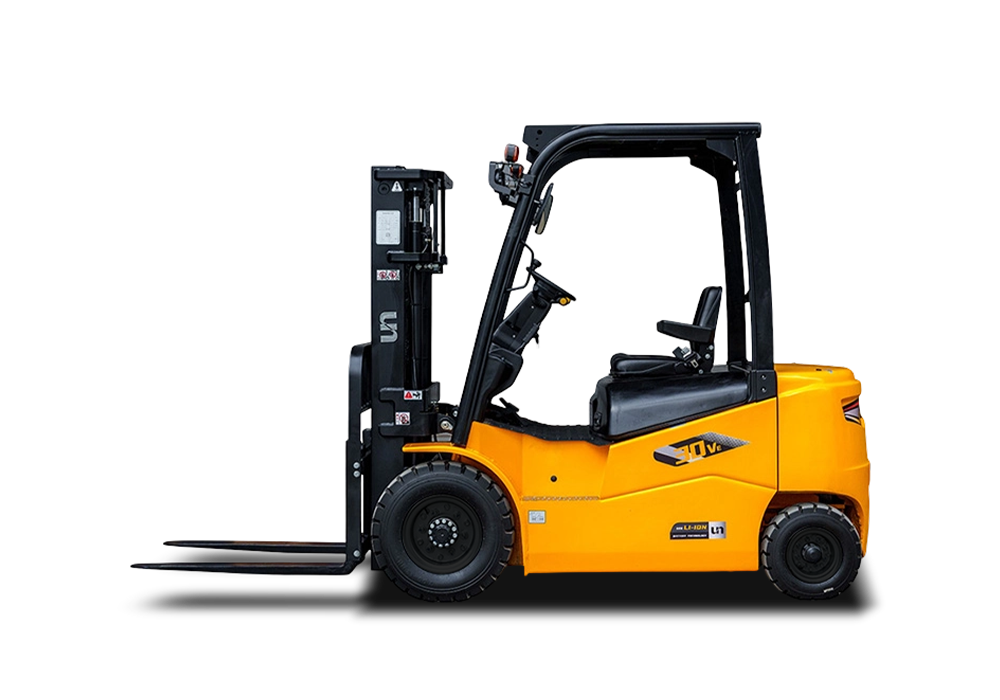
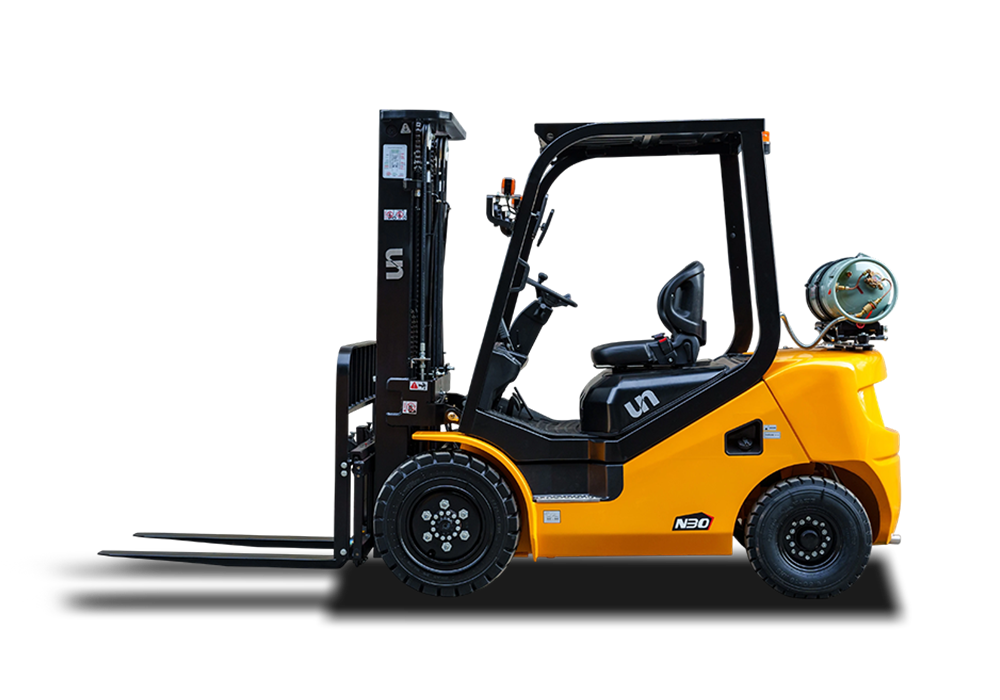
VE Series 3.0T Li-ion Battery Forklift
1. The Role of Lithium-Ion Forklifts in Modern Industry
Battery-powered forklifts have traditionally been associated with clean indoor operations. They are valued for low local emissions, reduced noise, and smooth operation, but many electric models have been limited by low ground clearance, restricted outdoor capability, long charging periods, or battery replacement requirements. These limitations can make operators hesitate to replace diesel, gasoline, or liquefied-gas forklifts in demanding applications.
Lithium-ion technology changes this equation. Compared with conventional lead-acid battery systems, lithium-ion batteries can provide more consistent voltage during operation, support opportunity charging, reduce routine battery maintenance, and simplify energy management. They also allow manufacturers to create practical battery packs that can be integrated into a forklift without requiring a large battery room or a dedicated battery-changing infrastructure.
The VE Series applies this technology to a 3.0-tonne pneumatic-tire forklift. Its design is not limited to light-duty indoor warehouse work. The higher ground clearance, pneumatic tires, casting steering axle, and 12% full-load gradeability are intended to support applications where the truck must travel across uneven surfaces, loading areas, plant roads, or outdoor working zones.
For operators, the main value is flexibility. One forklift can work inside a warehouse during one shift and move materials across an outdoor yard during another. This reduces the need to maintain separate fleets for indoor and outdoor operations and can improve overall equipment utilization.
1.1 A practical alternative to combustion-powered equipment
Internal-combustion forklifts remain useful in heavy-duty environments, but they also bring several operating considerations. Fuel costs can fluctuate, exhaust emissions may restrict their use indoors, engine noise can affect communication, and engines require regular servicing of lubricants, filters, belts, and other components.
The VE Series removes tailpipe emissions from the operating area and replaces the combustion engine with an electric drive system. This can make the truck more suitable for enclosed facilities, food-related operations, pharmaceutical environments, electronics production, and workplaces where noise and air quality are important. At the same time, its pneumatic tires and rugged configuration allow it to operate beyond smooth warehouse floors.
Rather than treating electric power as a compromise, the design uses electric power as a foundation for smoother control, easier monitoring, and lower routine maintenance. The result is a forklift intended to combine the environmental advantages of an electric truck with the working range and physical configuration often expected from a conventional counterbalance forklift.
2. Product Overview and Core Specifications
The VE Series 3.0T model is identified in the technical information as FB30-LVBE, with a related general model designation of FB30. It is a seated, counterbalance, electric forklift with pneumatic tires and a rated capacity of 3,000 kg at a 500 mm load center.
The rated load capacity is an important measure of the forklift’s suitability for industrial work. Three tonnes is sufficient for many palletized goods, raw materials, machinery components, building products, metal products, packaged goods, and industrial containers. The stated load center of 500 mm provides a clear reference for evaluating capacity in relation to load dimensions and attachment use.
| Specification | Value |
|---|---|
| Product series | VE Series |
| Model | FB30-LVBE / FB30 |
| Drive type | Electric battery drive |
| Operator type | Seated |
| Rated load capacity | 3,000 kg |
| Load center | 500 mm |
| Wheelbase | 1,750 mm |
| Total weight | 4,140 kg |
| Tire type | Pneumatic |
| Rated lift height | 3,000 mm |
| Overall width | 1,180 mm |
| Turning radius | 2,270 mm |
| Travel speed with full load | 11 km/h |
| Travel speed without load | 12 km/h |
| Full-load lifting speed | 250 mm/s |
| Full-load gradeability | 12% |
| Drive motor | 10 kW |
| Lift motor | 12 kW |
| Battery | 80 V/135 Ah lithium-ion |
| Battery weight | 106 kg |
| Drive control | MOS/AC |
These specifications show a balanced design. The forklift offers substantial lifting capacity without becoming excessively wide for its class. Its 1,180 mm overall width supports operation in industrial aisles and work areas, while the 2,270 mm outside turning radius provides useful maneuverability for a 3.0-tonne truck.
2.1 Lift and mast performance
The standard rated lift height is 3,000 mm, with a mast lowered height of 2,070 mm and an extended height of 4,070 mm when equipped with the backrest. The free lift height is 145 mm. These dimensions make the forklift suitable for common pallet racking, production-line feeding, loading dock work, and floor-level material transfer.
The mast tilts 6 degrees forward and 12 degrees backward. Forward tilt can assist with load placement, while backward tilt helps stabilize loads during travel. Operators should always consider the actual load shape, center of gravity, attachment configuration, and mast height when determining safe operating limits.
The forklift provides a lifting speed of 250 mm/s with a full load and 360 mm/s without a load. This difference reflects the normal relationship between hydraulic lifting performance and applied weight. The lift system uses a 12 kW motor, providing the power required for repeated lifting cycles in industrial applications.
2.2 Travel performance and maneuverability
The maximum travel speed is specified at 11 km/h with a full load and 12 km/h without a load. These speeds are appropriate for a counterbalance forklift operating in a controlled industrial environment. Actual speed should always be adapted to floor conditions, pedestrian traffic, load stability, visibility, turning space, and site rules.
The outside turning radius is 2,270 mm. This enables the operator to maneuver around production areas, loading zones, storage rows, and outdoor workspaces without requiring the large turning area associated with some larger-capacity trucks. The stated aisle width is 3,945 mm for 1,000 × 1,200 mm pallets positioned crossways and 4,145 mm for 800 × 1,200 mm pallets positioned lengthways.
The practical aisle requirement will depend on pallet dimensions, racking layout, steering technique, load dimensions, attachment choice, and the required clearance margin. Facility managers should confirm the actual operating envelope before purchasing or reconfiguring an aisle system.
3. Lithium-Ion Battery System and Energy Advantages
The forklift uses an 80 V/135 Ah lithium-ion battery with a stated battery weight of 106 kg. The battery system is supported by an integrated battery management system, commonly called a BMS. The BMS helps monitor important operating parameters, including battery condition, temperature, voltage, charging status, and protection limits.
Battery management is central to lithium-ion safety and performance. By continuously monitoring the battery pack, the system can help prevent operation outside permitted conditions and provide useful information to the vehicle control system. This contributes to predictable performance and supports the long-term reliability of the energy system.
3.1 Integrated charger
One of the most practical features is the built-in charger. An integrated charger reduces the need for a separate charging unit and can simplify installation in facilities where floor space is limited. It also makes the forklift easier to deploy across different operating areas because charging equipment remains associated with the truck.
Charging procedures must still follow the manufacturer’s instructions and applicable local electrical requirements. Operators should use a suitable power supply, maintain clear ventilation around the charging area, inspect cables and connectors, and prevent unauthorized modifications. A charging schedule should be established according to operating hours, battery condition, and production requirements.
3.2 Opportunity charging and fleet utilization
Lithium-ion forklifts are often well suited to opportunity charging, in which the vehicle is charged during planned breaks, shift changes, or idle periods rather than being removed from service for a long battery replacement process. This approach can support multi-shift work when the charging strategy is properly planned.
Opportunity charging can also reduce the need for spare batteries and battery-changing equipment. The economic benefit depends on duty cycle, electricity prices, utilization, charging infrastructure, and battery management practices. For some fleets, the ability to charge between tasks can produce a more flexible operating pattern than a conventional lead-acid system.
3.3 Battery durability and environmental protection
The product information states a five-year warranty and an estimated service life of approximately 4,000 lift cycles. The battery is described as a third-generation lithium-ion battery with IP67 waterproof and dustproof protection. IP ratings should be understood as protection classifications under defined test conditions, not as permission to expose the battery to any environment without assessment.
Protection against dust and water can be particularly valuable in outdoor applications, washdown areas, humid facilities, and locations where the forklift may encounter changing weather conditions. The battery enclosure, connectors, charging equipment, and vehicle controls should nevertheless be inspected regularly to ensure that sealing and protection remain effective.
The battery’s relatively compact capacity is consistent with the VE Series concept of offering a competitive cost for specific industries. Instead of installing an oversized battery for every application, the design can be matched to work patterns in which opportunity charging and efficient energy management are practical.
4. Indoor and Outdoor Operating Capability
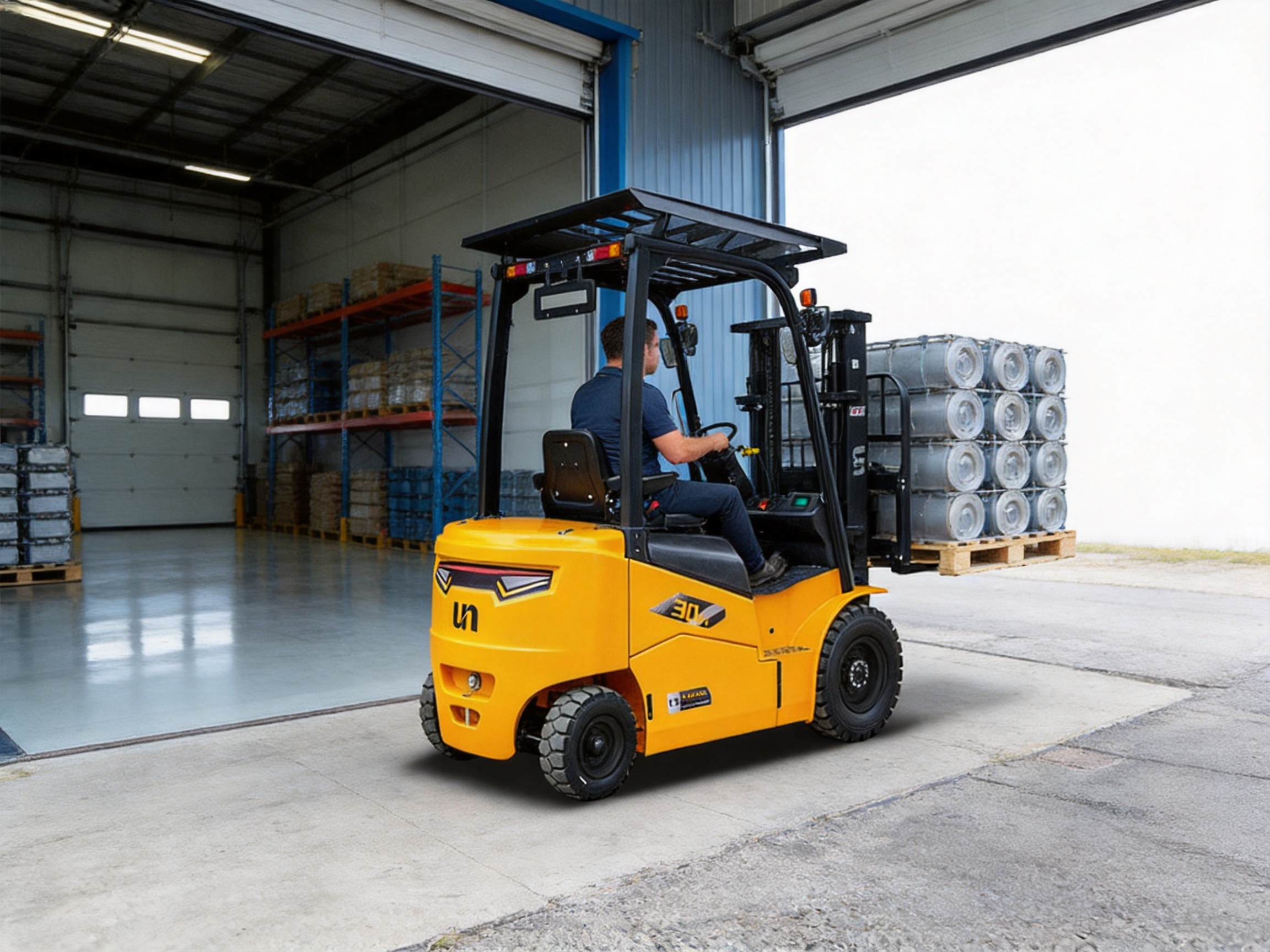
A major advantage of this forklift is its intended dual-environment capability. Indoor electric forklifts are often optimized for smooth concrete floors, low noise, and narrow aisles. Outdoor internal-combustion forklifts are commonly equipped with features that help them manage uneven ground and longer travel routes. The VE Series combines elements of both approaches.
The forklift has pneumatic tires, a ground clearance of 115 mm below the mast when laden, and 140 mm at the center of the wheelbase. Pneumatic tires can provide improved cushioning and traction on surfaces that are less uniform than polished warehouse floors. They are suitable for yards, loading areas, industrial roads, and outdoor storage zones, subject to site conditions and tire maintenance.
The casting steering axle contributes to structural durability and steering stability. A robust axle is important because the rear steering assembly is exposed to shock loads, uneven surfaces, turning forces, and repeated changes in direction. Proper inspection remains essential, but the component choice supports the forklift’s wider operating range.
The maximum gradeability is listed as 12% with a full load and 15% without a load. Gradeability depends on surface traction, ramp length, tire condition, load position, battery state, and site conditions. Operators should use approved routes, travel with the load positioned correctly, maintain adequate visibility, and follow the safety rules applicable to ramps and inclines.
4.1 Suitable applications
Potential applications include:
Warehouse receiving and dispatch operations where goods move between dock doors and indoor storage.
Manufacturing plants that transfer components between indoor production lines and outdoor staging areas.
Building-material distribution, where pallets may be stored under cover or in open yards.
Metal processing and fabrication facilities requiring a robust truck for coils, profiles, containers, and finished products.
Agricultural and food-supply operations where the forklift may operate in storage buildings, loading yards, and covered production spaces.
Logistics hubs handling palletized cargo across warehouses, trailers, containers, and external loading zones.
Rental fleets that need a versatile electric forklift capable of serving different customer environments.
The most appropriate application depends on the load type, operating hours, floor quality, ambient conditions, charging access, and required attachments. A site evaluation should be completed before final configuration.
5. Operator Comfort and Ergonomic Design
Operator comfort influences productivity, safety, and the consistency of material-handling work. A forklift that is difficult to enter, uncomfortable to drive, or poorly arranged can increase fatigue and reduce concentration over a long shift.
The VE Series is described as having a wider operating space, approximately 50% larger than that of a traditional electric forklift and comparable to an internal-combustion forklift. Additional space can make it easier for the operator to enter and exit the truck, adjust posture, operate pedals, and maintain control during repeated cycles.
The optimized stamped overhead guard is intended to improve visibility. Visibility is especially important when positioning loads, traveling near racking, approaching trailers, and working around pedestrians. The overhead guard must provide protection while avoiding unnecessary visual obstruction. Actual visibility also depends on mast design, load height, lighting, mirrors, camera systems, and operator positioning.
The seated operating position is appropriate for applications involving long travel distances and repeated lifting cycles. A seated configuration can reduce physical fatigue compared with pedestrian or standing equipment, particularly when the truck is used continuously throughout a shift.
Control layout and driving behavior are also important. The MOS/AC drive control system supports electric travel control and can help deliver smooth acceleration and deceleration when correctly configured. Smooth control reduces load movement, tire wear, and unnecessary stress on the drivetrain.
6. Maintenance, Diagnostics, and Serviceability
Electric forklifts generally have fewer routine service items than combustion-powered trucks because they do not require engine oil, engine filters, spark plugs, exhaust-system maintenance, or fuel-system servicing. However, they still require disciplined inspection of tires, brakes, steering, hydraulic systems, forks, mast components, battery connections, and safety devices.
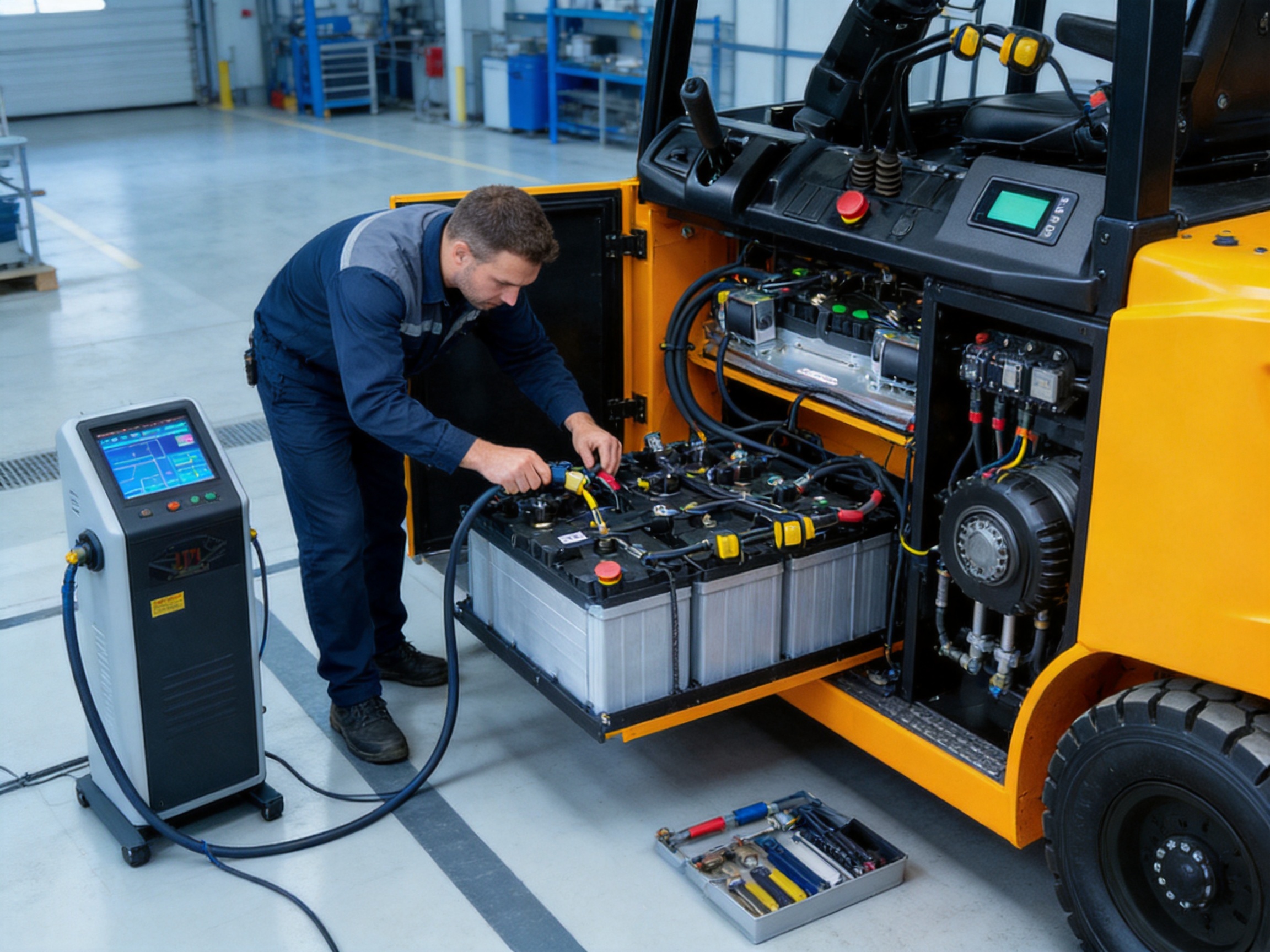
The VE Series is designed with several features intended to make maintenance more convenient. The battery pack can be changed from the side, supporting easier battery replacement when required. Side access may also help facilities that use battery service equipment or need to remove the pack for inspection.
The large hood opening angle and increased internal space provide better access to major components. Maintenance technicians benefit from clear access because it can reduce inspection time and make it easier to identify damaged cables, loose connections, hydraulic leaks, contamination, or abnormal wear.
6.1 Digital information and CAN bus monitoring
An LED screen provides real-time information about the forklift. Depending on the system configuration, this information may include operating status, battery condition, fault indications, service reminders, and other vehicle data. Clear information can help operators respond to issues before they develop into more serious failures.
CAN bus technology allows different electronic control units to communicate with one another. The product information states that CAN bus monitors the forklift continuously. This type of network can support coordinated control of the drive system, battery, display, and other vehicle functions.
For fleet managers, electronic monitoring can improve preventive maintenance planning. Instead of relying solely on calendar intervals, service decisions may also consider operating hours, fault history, charging behavior, and vehicle condition. A strong maintenance process should combine electronic information with physical inspections and trained technician judgment.
6.2 Key routine inspections
Before each shift, the operator should inspect the forks for cracks, bending, excessive wear, and secure mounting. The mast, chains, rollers, hydraulic hoses, and cylinders should be checked for visible damage or leakage.
Tires should be inspected for cuts, embedded objects, uneven wear, and correct condition. Pneumatic tires require attention to inflation pressure because incorrect pressure can affect stability, traction, ride comfort, and tire life.
The operator should test the service brake, parking brake, steering, horn, lights, reverse alarm, seat restraint, and other safety equipment. Battery connectors and charging components should be kept clean, dry, and free from damage.
Periodic service should include inspection of wheel fasteners, steering axle components, hydraulic fluid condition, mast lubrication points, brake performance, electrical connections, and structural elements. Service intervals should follow the manufacturer’s recommendations and be adjusted when the truck works in severe environments.
7. Manufacturing Strength and Engineering Background
The capabilities of a forklift manufacturer extend beyond the design of a single truck. Product consistency, component integration, quality control, technical support, and after-sales service all affect the ownership experience.
Zhejiang UN Forklift Co., Ltd. was founded in 1978 and is described as an integrated manufacturer covering research and development, production, sales, and service. The company occupies approximately 53,400 square meters and has an annual production capacity of 15,000 units. This scale provides a foundation for organized manufacturing, model development, component sourcing, testing, and international distribution.
The company offers a broad product portfolio covering 17 varieties, 96 series, and more than 200 specifications. A broad range can benefit customers that need more than one type of material-handling machine. A supplier able to provide electric forklifts, internal-combustion forklifts, reach equipment, warehouse trucks, and specialized models can help customers standardize procurement and service relationships across a mixed fleet.
7.1 Research and development
The company’s history includes the development of China’s first reach forklift and very-narrow-aisle truck. It also holds national patents related to electric forklift technologies and has participated in the formulation of Chinese electric forklift industry standards. These activities indicate experience in developing equipment for specialized operating environments rather than simply assembling generic components.
Research and development is particularly important in lithium-ion forklift production because the battery, charger, control system, motors, hydraulic functions, and safety systems must work together. A successful vehicle requires more than installing a battery in an existing chassis. Power management, thermal considerations, regenerative behavior, drive response, charging communication, and fault protection must be integrated into the complete truck.
The VE Series reflects this system-level approach through the combination of an integrated charger, BMS, electronic display, CAN bus monitoring, MOS/AC drive control, electric hydraulic lifting, and a chassis designed for both indoor and outdoor use.
7.2 Manufacturing process considerations
A modern forklift manufacturing process normally includes steel preparation, structural fabrication, welding, machining, painting, component assembly, electrical integration, hydraulic installation, battery-system installation, and final testing. Each stage affects the performance and service life of the completed truck.
The load-bearing frame and counterbalance structure must maintain dimensional accuracy and structural strength. Welding quality is important because the frame experiences repeated dynamic loads while carrying heavy materials. Machined interfaces must support correct alignment of the mast, axle, steering components, and drivetrain.
Surface preparation and protective coating help reduce corrosion, especially for forklifts used outdoors or in humid conditions. Paint quality also contributes to the visual identification of damage and supports a professional fleet appearance.
During assembly, electrical harnesses, connectors, controllers, sensors, hydraulic lines, and mechanical components must be installed according to controlled procedures. Correct routing protects cables and hoses from abrasion, heat, crushing, and excessive bending. Proper torque control on critical fasteners supports reliability and reduces the risk of loosening during operation.
Final testing should verify travel, lifting, braking, steering, mast movement, hydraulic performance, battery communication, charger function, display information, and safety devices. A manufacturer with integrated engineering and production capabilities is better positioned to identify problems at the system level and refine the product over time.
8. Advantages Compared with Conventional Forklift Options
The VE Series offers several advantages when compared with conventional lead-acid electric forklifts.
First, the lithium-ion battery can support opportunity charging and does not require the same watering routine associated with flooded lead-acid batteries. This can reduce battery-room requirements and simplify daily fleet management.
Second, the integrated charger reduces the need to purchase and install a separate external charging unit for every truck. This is valuable for smaller facilities, temporary work areas, and operations that need charging flexibility.
Third, the lithium-ion system can deliver consistent power during the working cycle. Stable voltage can support predictable travel and lifting behavior, although actual performance depends on battery state, temperature, controller settings, and duty cycle.
Fourth, the forklift has zero direct exhaust emissions during operation. This gives it an advantage over diesel, gasoline, and liquefied-gas trucks in enclosed areas and facilities with strict air-quality requirements.
Fifth, its pneumatic tires, higher ground clearance, casting steering axle, and gradeability make it more adaptable than many indoor-only electric forklifts. These features allow the vehicle to work across a broader range of surfaces and locations.
When compared with traditional internal-combustion forklifts, the VE Series can offer reduced operating noise, lower routine powertrain maintenance, and cleaner operation. It may also help companies meet carbon-reduction objectives and improve the working environment for employees.
When compared with larger electric forklifts, the stated battery capacity and integrated charging concept may provide a more cost-conscious solution for applications that do not require extremely long continuous operating periods. The right comparison should consider the total cost of ownership rather than purchase price alone.
9. Total Cost of Ownership Considerations
The purchase price of a forklift is only one part of its economic impact. A complete evaluation should include energy, maintenance, tires, battery replacement, charging infrastructure, operator productivity, downtime, training, and resale value.
Electricity costs can be more predictable than fuel costs, especially when charging is scheduled during lower-cost periods. The absence of engine oil, fuel filters, and exhaust components may reduce routine maintenance expenses. Regenerative or controlled electric braking, where available in the configuration, may also reduce mechanical brake wear.
Lithium-ion batteries generally require less daily maintenance than lead-acid batteries. They can also avoid some of the labor associated with battery watering, equalization charging, and battery-room management. However, lithium-ion equipment requires suitable charging procedures, trained personnel, and attention to battery condition.
Productivity benefits may come from reduced battery-change time, shorter charging interruptions, improved visibility, lower noise, and easier operation. The value of these benefits depends on the number of shifts, daily travel distance, lifting frequency, ambient temperature, and availability of charging opportunities.
Fleet managers should compare a complete operating model over the expected service life. A lithium-ion forklift may be especially attractive when the site operates multiple shifts, has suitable electrical infrastructure, and values reduced emissions and maintenance complexity.
10. Application Planning and Specification Selection
Before selecting the forklift, the customer should define the actual loads. Important questions include the maximum weight, load dimensions, center of gravity, pallet condition, required lift height, attachment type, and frequency of handling. A 3,000 kg rated capacity applies at the specified load center and under defined operating conditions; it should not be treated as an unlimited capacity for every load shape.
Facility layout must also be reviewed. The overall width is 1,180 mm, but the required operating aisle must include clearance for the load, mast, steering movement, racking, pedestrians, and potential surface irregularities. The published aisle figures provide a reference, while the final layout should be confirmed by a qualified material-handling specialist.
Outdoor users should assess road surfaces, slopes, drainage, dust, water exposure, lighting, and traffic separation. Pneumatic tires improve versatility, but they do not eliminate the need for maintained travel routes and safe operating procedures.
Battery planning should consider shift length, average load, travel distance, lift frequency, break schedules, and available electrical outlets. The stated 80 V/135 Ah battery is suitable for the intended product concept, but the actual operating duration must be validated under the customer’s specific working conditions.
Attachments can change the truck’s capacity, forward load distance, visibility, and stability. Any attachment should be approved for the forklift and included in the capacity evaluation. Hydraulic attachments may be supported by the stated 17.5 MPa operating pressure, but the attachment manufacturer and forklift supplier should confirm compatibility.
11. Safety and Responsible Operation
Forklift safety depends on the machine, the operator, the workplace, the load, and the management system. Even a well-designed forklift must be operated by trained and authorized personnel.
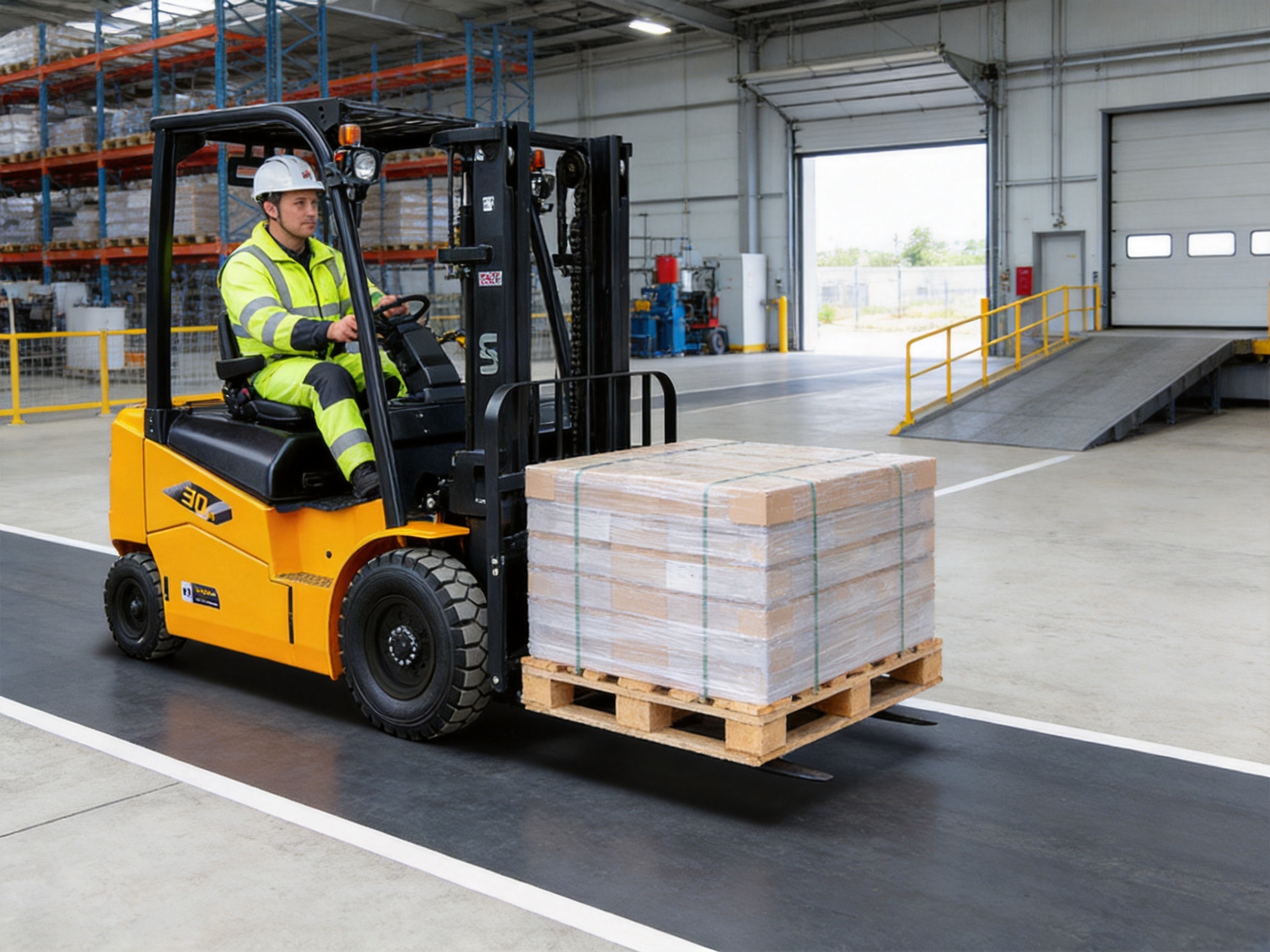
Operators should wear the seat restraint, keep the load stable, travel at a controlled speed, sound the horn where required, and maintain a clear view of the travel path. When the load blocks forward visibility, the operator should use an approved alternative travel direction or assistance procedure.
Loads should be centered on the forks and positioned against the load backrest where appropriate. Forks should be fully inserted under the load when conditions allow, and the load should be carried at a safe travel height. Operators must avoid sudden turns, abrupt braking, and lifting beyond the rated capacity.
Pedestrian routes should be separated from forklift routes whenever possible. Mirrors, barriers, warning signs, lighting, and speed controls can help reduce interaction risks. Outdoor operations require additional attention to weather, uneven surfaces, vehicle traffic, and changing visibility.
Battery charging areas should be kept orderly and protected from impact. Charging connectors should be inspected before use, and damaged equipment should be removed from service. The battery system should not be modified by unauthorized personnel.
Maintenance technicians should use appropriate lockout and isolation procedures before working on the electrical, hydraulic, or mechanical systems. High-voltage or high-energy components require suitable training and protective procedures.
12. Sustainability and Environmental Benefits
The transition to lithium-ion forklifts can contribute to broader sustainability goals. Electric operation eliminates direct exhaust emissions at the point of use, which can improve indoor air quality and reduce the environmental impact associated with local combustion.
Lower noise levels may improve working conditions and make it easier for operators and pedestrians to communicate. Reduced noise can also be valuable in facilities operating near offices, residential areas, food production, or noise-sensitive processes.
Energy efficiency is another important consideration. Electric motors can convert electrical energy into motion without the same combustion losses associated with fuel engines. The final environmental benefit depends on the electricity source, charging efficiency, battery life, maintenance, and end-of-life recycling practices.
A durable forklift with a long service life can reduce the environmental burden associated with frequent equipment replacement. The stated battery warranty and service-cycle expectations provide a framework for planning, although actual life depends on charging habits, temperature, duty cycle, and maintenance.
Companies implementing lithium-ion forklifts should also develop a responsible battery end-of-life plan. Batteries should be handled through approved channels for inspection, reuse, recovery, or recycling rather than being discarded with general industrial waste.
13. Why the Manufacturer’s Broader Portfolio Matters
UN Forklift’s product range includes electric forklifts, internal-combustion forklifts, warehouse equipment, reach trucks, and specialized material-handling models. This broader capability can be useful for companies that require a mixed fleet.
Some sites need lithium-ion forklifts for indoor work, heavy-duty combustion forklifts for outdoor yards, and warehouse trucks for narrow-aisle storage. Working with a supplier that understands all of these categories can make fleet planning more consistent. It may also simplify operator training, spare-parts management, maintenance coordination, and future replacement decisions.
The company’s international sales and service network includes partners in Europe, South America, North America, Africa, and Asia. International support is important because customers need access to technical information, replacement parts, service guidance, and warranty assistance after the initial purchase.
The company also serves as an original-equipment manufacturer for established industrial organizations. OEM experience typically requires attention to documentation, production consistency, engineering coordination, and customer-specific requirements. These capabilities can strengthen the supplier’s ability to serve distributors and end users in different markets.
14. Recommended Fleet Implementation Strategy
A successful transition to lithium-ion forklifts should be managed as an operational project rather than as a simple equipment purchase.
The first step is to record the current fleet’s working patterns. Managers should note daily operating hours, load weights, travel distances, charging or fueling routines, maintenance events, downtime, and operator feedback.
The second step is to identify which applications are best suited to lithium-ion equipment. Indoor routes, mixed indoor-outdoor routes, facilities with regular break periods, and locations seeking lower emissions are often strong candidates.
The third step is to evaluate charging locations. Power availability, cable routing, weather protection, traffic separation, and emergency access should be considered. Integrated charging can simplify deployment, but a safe and suitable electrical supply remains necessary.
The fourth step is to train operators and maintenance staff. Training should cover battery charging, display information, fault reporting, safe travel, load handling, tire inspection, and emergency procedures.
The fifth step is to monitor performance after deployment. Useful measures include energy consumption, operating hours, charging frequency, maintenance costs, unplanned downtime, operator acceptance, and productivity per shift.
Data from the first operating period can help determine whether additional units should be configured with the same battery capacity, different mast options, alternative attachments, or other application-specific features.
15. Frequently Asked Questions
Q1: What is the rated capacity of the VE Series 3.0T forklift?
The rated load capacity is 3,000 kg at a 500 mm load center. The actual allowable capacity may change with lift height, load shape, attachment use, and other operating conditions, so the capacity plate and manufacturer guidance should always be followed.
Q2: Is this forklift suitable for outdoor operation?
Yes. The forklift is designed for indoor and outdoor applications. Pneumatic tires, higher ground clearance, a casting steering axle, and stated gradeability support operation in yards, loading areas, industrial roads, and other suitable outdoor environments.
Q3: What type of battery does it use?
It uses an 80 V/135 Ah lithium-ion battery with an integrated battery management system. The battery is listed with a weight of 106 kg and is described as having IP67 waterproof and dustproof protection.
Q4: Does the forklift include a charger?
Yes. The VE Series includes a built-in charger. Charging must be carried out using an appropriate electrical supply and in accordance with the manufacturer’s instructions and local regulations.
Q5: How high can the standard mast lift?
The rated lift height is 3,000 mm. The mast has a lowered height of 2,070 mm and an extended height of 4,070 mm with the backrest under the stated configuration.
Q6: What are the travel speeds?
The listed travel speed is 11 km/h with a full load and 12 km/h without a load. Actual site speed should be controlled according to safety conditions, traffic, surface quality, and local rules.
Q7: What are the main advantages over a lead-acid electric forklift?
Key advantages include opportunity-charging potential, reduced routine battery maintenance, an integrated charger, consistent electric performance, and the elimination of fuel-related emissions. The exact benefit depends on the duty cycle and charging plan.
Q8: What are the main advantages over an internal-combustion forklift?
The forklift produces no direct exhaust emissions during operation, operates more quietly, and generally has fewer routine powertrain service requirements. It also retains features such as pneumatic tires and outdoor-capable ground clearance.
Q9: How does the forklift support maintenance?
It includes side battery swapping, a large hood opening angle, increased internal access space, an LED information display, and CAN bus monitoring. These features can help technicians inspect components and diagnose operating conditions more efficiently.
Q10: What type of tires does it use?
The forklift uses pneumatic tires. The listed front tire size is 7.00-12-12PR, and the listed rear tire size is 18 × 7-8-14PR.
Q11: Can attachments be installed?
Attachments may be possible when correctly matched to the forklift. The listed operating pressure for attachments is 17.5 MPa, but attachment compatibility, residual capacity, hydraulic flow, mounting, and visibility must be confirmed before use.
Q12: Who manufactures the forklift?
The forklift is manufactured by Zhejiang UN Forklift Co., Ltd., a Chinese material-handling equipment manufacturer with research, production, sales, and service capabilities.
Q13: How should buyers evaluate the battery runtime?
Runtime should be evaluated using actual shift length, average load, travel distance, lift frequency, ambient temperature, charging opportunities, and operator behavior. The nominal battery rating alone cannot predict operating hours in every application.
Q14: Is the forklift appropriate for narrow aisles?
The forklift has an overall width of 1,180 mm and a turning radius of 2,270 mm. It can operate in suitable industrial aisles, but the required aisle width must be checked against pallet dimensions, load clearance, racking design, and site safety margins.
Q15: What should be included in a pre-purchase assessment?
Buyers should review load capacity, load center, lift height, mast dimensions, aisle width, tire type, surface conditions, operating hours, battery charging requirements, attachment needs, maintenance support, spare parts, and local service availability.
16. Conclusion
The VE Series 3.0T Li-ion Battery Forklift is designed for companies that need the environmental and operating advantages of electric power without giving up the versatility associated with a traditional counterbalance truck. Its 3,000 kg capacity, pneumatic tires, 80 V lithium-ion battery, integrated charger, outdoor-capable chassis, and ergonomic operating area make it a practical option for mixed indoor and outdoor material handling.
The forklift’s value is supported by more than its headline specifications. Features such as the integrated BMS, IP67 battery protection, side battery access, electronic monitoring, CAN bus communication, casting steering axle, and large maintenance access areas address daily ownership requirements that influence uptime and total cost of operation.
Its manufacturer contributes experience in forklift research, electric technology, manufacturing, OEM cooperation, and international distribution. A broad product range and worldwide service relationships further support customers that need a long-term material-handling partner rather than a single machine.
For the best result, buyers should match the forklift to real operating conditions. Load dimensions, duty cycle, charging opportunities, floor and road surfaces, aisle layout, attachments, operator training, and service planning all affect performance. When these factors are evaluated carefully, a 3.0-tonne lithium-ion forklift can provide a reliable bridge between indoor electric equipment and outdoor heavy-duty handling, helping businesses improve productivity while moving toward cleaner and more efficient operations.
References
1. Product technical data for the VE Series 3.0T Li-ion Battery Forklift, including dimensions, capacity, performance, battery, motor, tire, and control-system information.
2. Manufacturer information for Zhejiang UN Forklift Co., Ltd., including company history, production capability, product portfolio, research and development activities, and international service network.
3. General principles of industrial truck capacity ratings, load centers, mast stability, attachment selection, and safe load handling.
4. General guidance on lithium-ion battery management systems, opportunity charging, battery protection, industrial charging practices, and end-of-life battery handling.
5. General occupational safety practices for counterbalance forklift operation, pedestrian separation, pre-shift inspection, operator training, and maintenance isolation procedures.
Product: VE Series 3.0T Li-ion Battery Forklift
For exclusive deals and latest offers, sign up by entering your email address below.
Stay In Touch
ADDRESS : NO.1 ROAD ONE, XINDENG NEW DISTRICT, FUYANG, HANGZHOU, ZHEJIANG, CHINA 311404.
PHONE : +86-571-8688 8355 (AMERICA)
PHONE : +86-571-8886 9363 (EUROPE)
PHONE : +86-571-8688 8377 (ASIA, AFRICA, OCEANIA)
EMAIL : [email protected]
EMAIL : [email protected](PARTS INQUIRY)

