


 中文简体
中文简体 Français
 русский
 Español
 عربى
عربى Deutsch



Electric End Rider Pallet Trucks for High-Throughput Warehouse Operations
Admin 2026-09-07Introduction
Modern warehouses require material-handling equipment that can move heavy loads quickly, safely, and consistently. As distribution centers become larger and order volumes continue to increase, pallet trucks must do more than transport pallets from one location to another. They must support long operating cycles, reduce operator fatigue, fit changing warehouse layouts, and deliver predictable performance under demanding conditions.
The PT27R and PT36R electric pallet trucks are designed for precisely these requirements. With rated capacities of 2.7 tonnes and 3.6 tonnes respectively, these electric end rider pallet trucks combine pedestrian operation, rider operation, high travel speed, substantial battery capacity, ergonomic controls, and durable construction. They are suitable for order picking, warehouse transportation, loading dock work, pallet staging, and other applications where productivity and load-handling capability are essential.
The two models are intended for demanding industrial applications rather than occasional light-duty use. Their design emphasizes operating efficiency, stability, serviceability, and operator protection. A spacious platform allows the operator to ride during longer transport cycles, while the jog button and side-travel functions make it possible to work beside the truck during picking and positioning activities.
This article examines the design, operating advantages, manufacturing strengths, technical specifications, and practical applications of the PT27R and PT36R electric pallet trucks. It also explains how these models can offer advantages over conventional walkie pallet trucks and less-capable electric transporters in high-throughput environments.
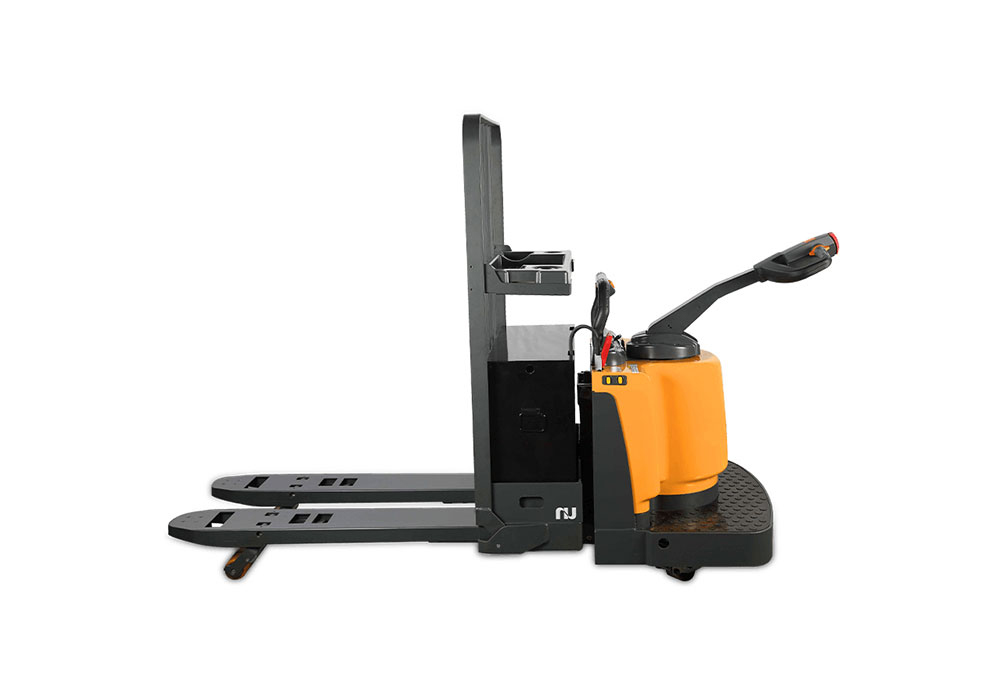
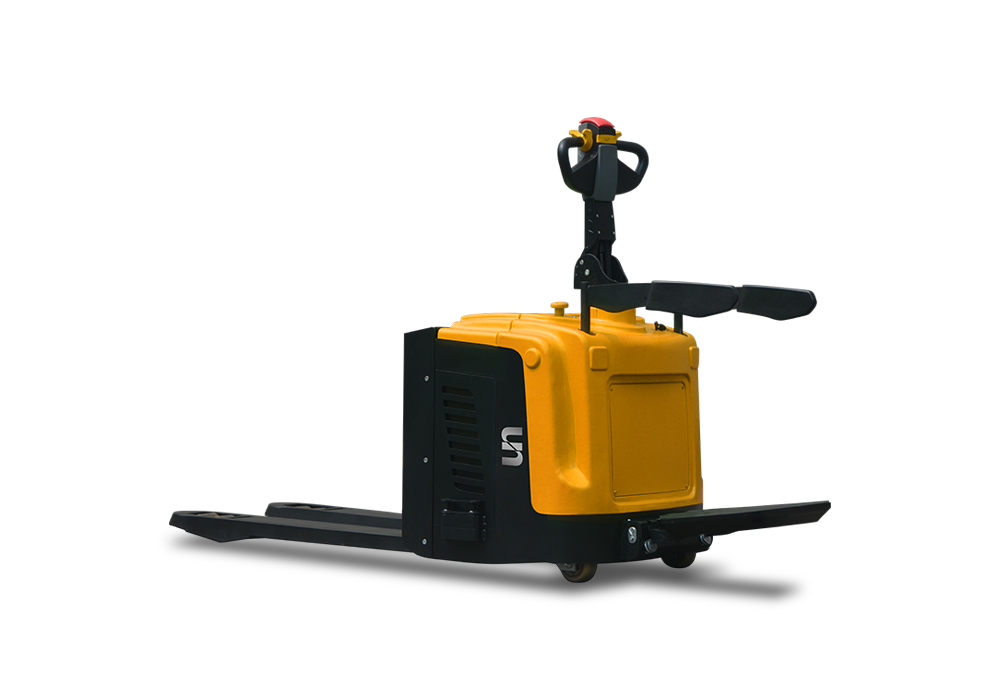
Electric Pallet Truck PT27R PT36R
Product Overview
The PT27R and PT36R are electric end rider pallet trucks developed for applications requiring both heavy load capacity and frequent pallet movement. The PT27R is rated for 2.7 tonnes, equivalent to approximately 6,000 pounds, while the PT36R is rated for 3.6 tonnes, equivalent to approximately 8,000 pounds.
Unlike a basic pedestrian pallet truck, an end rider design gives the operator the option of standing on a riding platform during transport. This arrangement is particularly useful when the truck must travel longer distances across a distribution center, production plant, cross-dock facility, or loading area. The operator can ride during extended movements and step off when close control or side-by-side order picking is required.
The trucks use battery-electric drive systems with alternating-current speed control. Electric propulsion provides smooth acceleration, precise control, and reduced local emissions compared with internal-combustion equipment. It also makes the trucks well suited to indoor environments where noise, exhaust, and air quality are important considerations.
Both versions use a 24-volt battery system with a nominal 350 Ah capacity. The battery compartment is designed around industrial battery requirements and provides flexibility for different battery dimensions. A battery weight of approximately 320 kilograms contributes to the overall balance and supports the high-capacity design of the trucks.
The PT27R and PT36R are fitted with polyurethane tires. Polyurethane provides a useful combination of low rolling resistance, durability, floor protection, and stability on finished warehouse surfaces. The tire arrangement is designed to distribute loads effectively while maintaining traction and maneuverability.
Two Capacity Options for Different Workloads
The PT27R is a practical choice for operations that regularly handle heavy pallets but do not need the maximum capacity of the larger model. Its 2.7-tonne rating offers a significant step up from many standard warehouse pallet trucks, while its dimensions and turning characteristics remain suitable for a wide range of warehouse applications.
The PT36R is intended for heavier loads, longer forks, and applications in which maximum load capacity is a primary consideration. With a rated capacity of 3.6 tonnes, it can support demanding transport work in manufacturing, bulk storage, heavy goods distribution, and dock operations.
The availability of two capacity levels allows users to select equipment according to actual workflow requirements. Choosing the correct capacity can improve energy efficiency, reduce unnecessary equipment costs, and ensure that the truck is neither overloaded nor oversized for the application.
Core Advantages in Competitive Warehouse Applications
High Capacity with Electric Operation
One of the principal advantages of these models is the combination of high load capacity and battery-electric propulsion. Many warehouse users must choose between compact electric pallet trucks with limited capacity and larger industrial vehicles that may be less convenient indoors. The PT27R and PT36R bridge this gap by offering heavy-duty capacity in an electric end rider format.
A 2.7-tonne or 3.6-tonne rating gives operators greater flexibility when handling dense products, full pallets, machinery components, building materials, beverage loads, paper products, and other heavy goods. Electric operation allows the trucks to work inside warehouses, production areas, and loading docks without the exhaust emissions associated with internal-combustion trucks.
The high-capacity design also reduces the need to divide a heavy movement into multiple trips. Where site conditions and load dimensions permit, a single transport cycle can move more goods, which may improve labor productivity and reduce congestion in busy aisles.
Rider Productivity for Longer Travel Distances
Conventional walk-behind pallet trucks can be effective over short distances, but repeated walking over long routes can increase fatigue and reduce productivity. The generous riding platform on the PT27R and PT36R allows the operator to ride during longer transport cycles.
The platform is designed to provide sufficient space for comfortable operation throughout the working day. By reducing unnecessary walking, the rider configuration can help operators maintain a more consistent work pace. It can also improve productivity in large facilities where pallet transfer routes extend from storage zones to staging lanes, production lines, or shipping docks.
The platform is not intended to eliminate the flexibility of pedestrian operation. Instead, it allows the operator to select the most appropriate working mode for each task. The truck can be ridden for transport, then operated from beside the load during order picking, pallet positioning, and close-quarters work.
Fast Travel for Higher Throughput
Travel speed is an important factor in high-volume warehouse operations. The PT27R has a travel speed of up to 11 km/h when laden and 14 km/h when unladen. The PT36R has a travel speed of up to 9.5 km/h when laden and 12 km/h when unladen. Actual operating speed depends on load, floor conditions, regulations, traffic, and site layout.
These speeds enable the trucks to complete more pallet movements within a given operating period than slower pedestrian equipment. Faster transport can be especially valuable in cross-docking, replenishment, and loading dock applications, where delays in one stage can affect the entire material flow.
High speed must always be combined with effective control and braking. The trucks use electromagnetic service brakes, and the operator controls are positioned on the tiller and grab bar for convenient access. Safe speed selection remains essential, particularly in mixed-traffic environments and areas with pedestrians.
Flexible Operator Modes
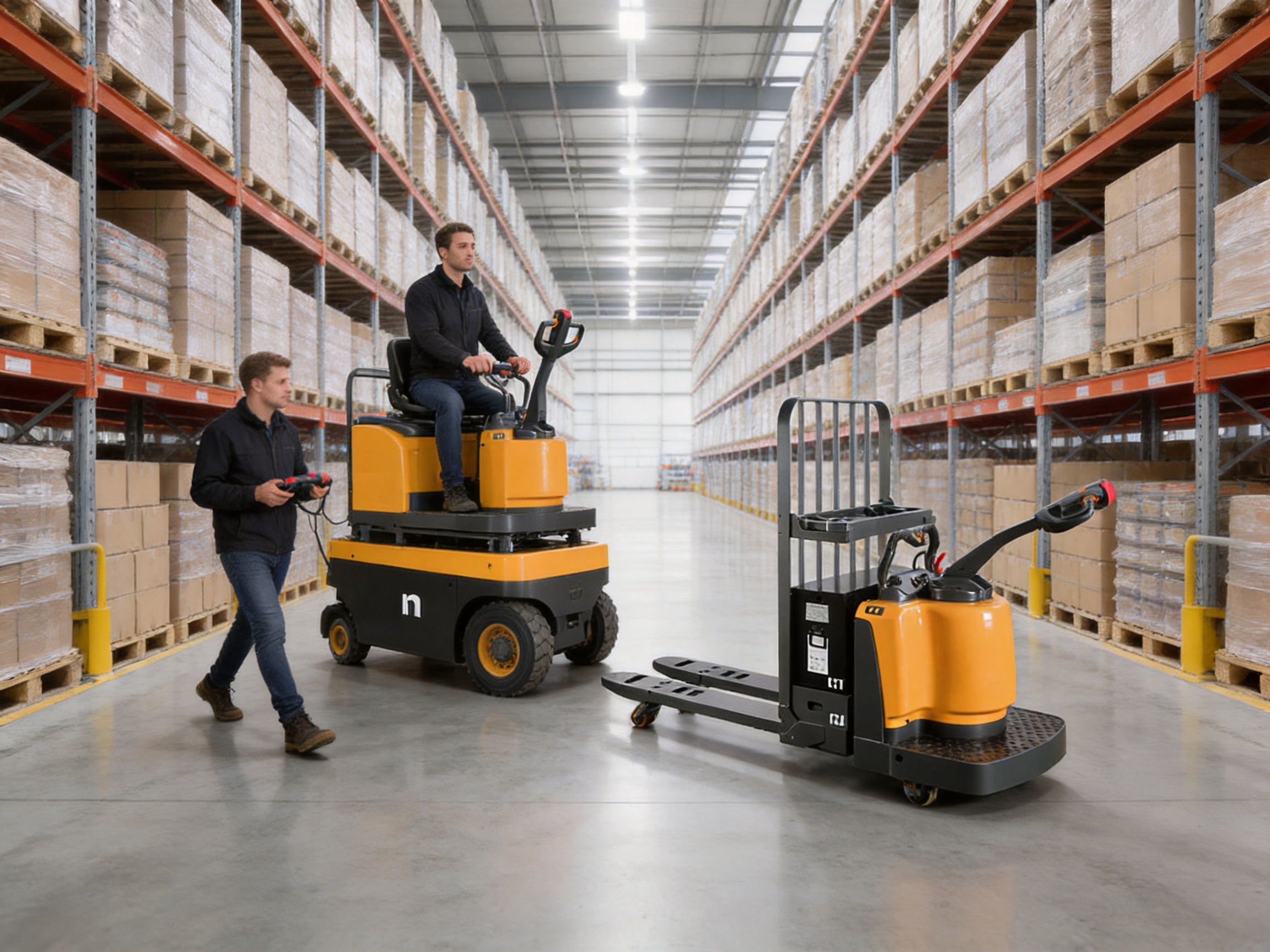
The control system supports both riding and walking operation. The jog button on the tiller allows the operator to walk beside the truck while maintaining control. This is useful when the operator needs to inspect the load, pick items from a pallet, align the forks, or guide the truck through a constrained position.
An additional side tracker supports travel in the tiller direction. This feature can improve productivity during order picking because the operator does not need to remain on the platform for every short movement. The coast mode allows the truck to move slowly and smoothly in appropriate situations, helping operators make controlled adjustments around pallets and storage locations.
This combination of operating modes can give the PT27R and PT36R an advantage over equipment designed exclusively for riding or exclusively for walking. The truck adapts to the task instead of forcing the operator to use one operating position throughout the entire work cycle.
Ergonomic and Safety-Oriented Design
Generous Platform
Operator comfort is a major factor in equipment productivity. A cramped or poorly designed riding platform can increase fatigue, create awkward postures, and discourage operators from using the riding function. The PT27R and PT36R include a roomy platform intended to provide comfortable support during extended work periods.
A comfortable platform can contribute to better operator concentration, especially during repetitive transport cycles. The platform design also supports quicker transitions between riding and walking modes. Operators can step on or off as required without treating the truck as a specialized vehicle that is suitable for only one kind of activity.
Ergonomic German-Style Tiller
The robust metal-cast tiller is designed around operator ergonomics and durability. Its shape and control layout support both walking and riding operation, giving the operator access to travel, lifting, lowering, and other functions without excessive hand movement.
The tiller is adjustable within a height range of approximately 880 to 1,550 millimeters in the drive position. This range accommodates different operator positions and supports practical control whether the user is walking behind the truck or standing on the platform.
A metal-cast construction can provide improved resistance to impact and long-term wear compared with lighter-duty control assemblies. In demanding warehouse environments, the tiller may encounter contact with pallets, racking, dock equipment, or other vehicles. Robust construction helps protect one of the most frequently used components of the truck.
Grab Bar with Integrated Controls
The grab bar provides a secure hand position during rider operation and incorporates electronic controls for convenient access. Control elements are arranged to support effortless operation and reduce unnecessary reaching.
A coated grab bar improves grip and provides a practical contact surface for the operator. In combination with the riding platform, it helps the operator maintain a stable working position during acceleration, deceleration, and turning. Operators must still follow site procedures and wear required personal protective equipment, but the equipment design supports safer handling behavior.
Electromagnetic Braking
Both models use electromagnetic service braking. This braking technology supports controlled stopping and is well suited to electric drive systems. It can provide responsive braking during normal operation while contributing to safe handling in warehouse traffic areas.
Braking performance depends on load, speed, floor condition, tire condition, and operator response. For this reason, users should establish appropriate speed limits, maintain clear travel paths, and train operators to account for the greater stopping distance of heavily loaded equipment.
Low Fork Height and Ground Clearance
The lowered fork height is approximately 83 millimeters, while ground clearance at the center of the wheelbase is approximately 25 millimeters. These dimensions support pallet entry and stable load transport on suitable industrial floors.
The low fork profile helps the operator engage standard pallets without requiring excessive lifting or manual adjustment. However, pallet openings, floor joints, ramps, and dock plates should always be checked before deployment because clearances vary among facilities and load carriers.
Battery and Electric Power System
24-Volt, 350 Ah Battery Configuration
The PT27R and PT36R use a nominal 24-volt, 350 Ah battery configuration. The listed battery type is associated with industrial 5PZS battery technology. The battery weighs approximately 320 kilograms, making it an important structural and counterbalancing element of the truck.
A large industrial battery supports extended use and high operating demand. The actual operating time between charges depends on load weight, travel distance, acceleration frequency, lifting activity, floor condition, temperature, battery age, maintenance, and duty cycle.
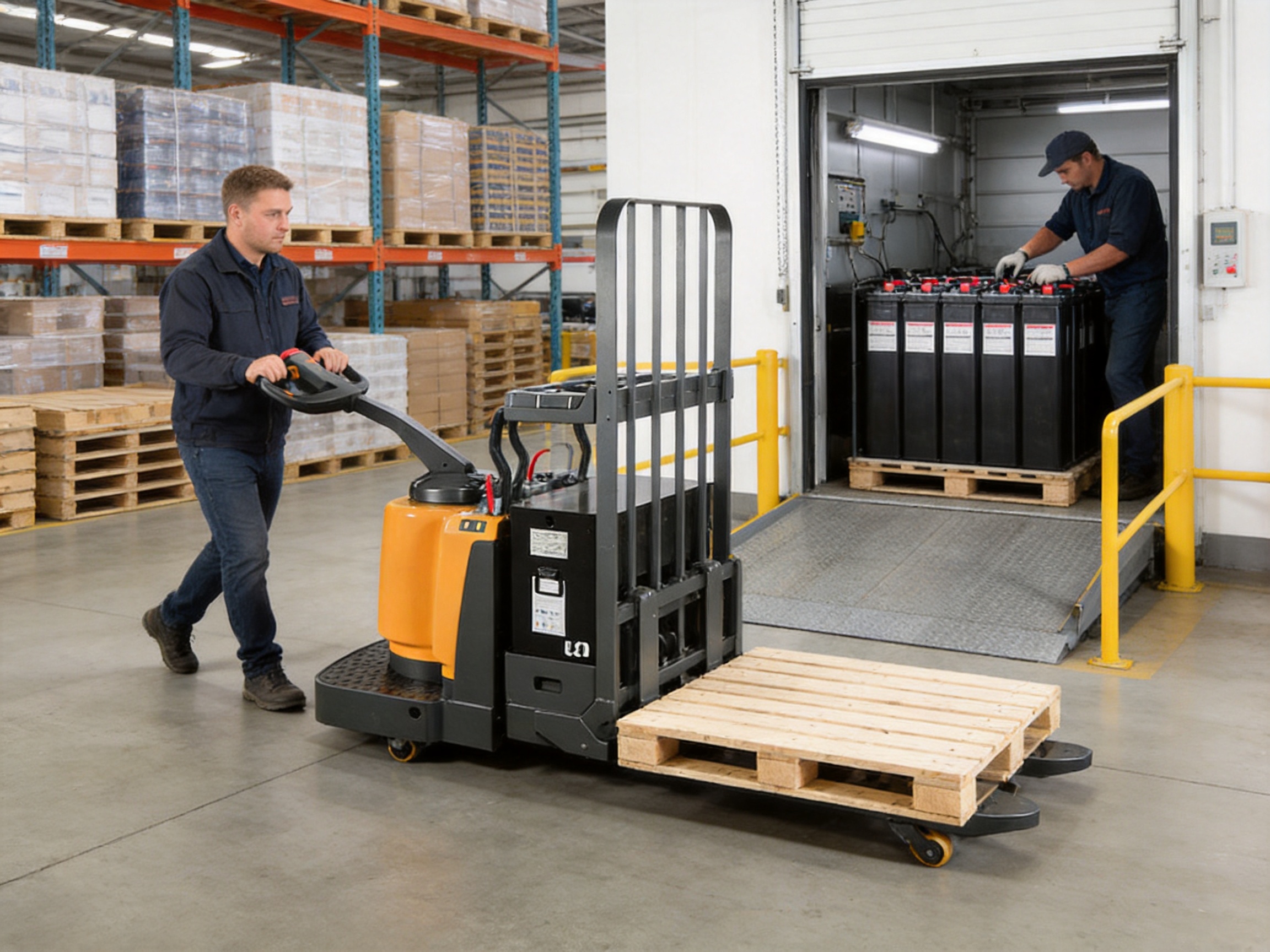
Battery planning is essential in multi-shift operations. Facilities should evaluate charging arrangements, spare battery requirements, charging ventilation, battery handling equipment, and operator procedures. The open battery compartment and optional battery rollers can make battery removal and replacement more convenient where frequent battery changes are part of the operating plan.
Open Battery Compartment
The approximately 13.8-inch open battery compartment is designed to accommodate a broad range of industrial batteries and different battery dimensions. This flexibility can be valuable when customers have existing battery standards or need to select a battery according to local supply conditions.
An open compartment can also simplify visual inspection and service access. Battery terminals, cables, connectors, and surrounding components should be inspected according to the maintenance schedule. Operators and maintenance personnel must follow battery manufacturer instructions, particularly when handling lead-acid batteries.
AC Drive Control
The trucks use AC speed control for the drive system. AC control can support smooth acceleration, controlled speed adjustment, and efficient management of motor output. It is suited to applications requiring frequent starting, stopping, reversing, and low-speed maneuvering.
In a busy warehouse, smooth control is often more valuable than maximum theoretical speed. Controlled acceleration can reduce load movement, limit wheel slip, and improve operator confidence. It may also reduce mechanical stress on the drive system and load wheels over time.
Motor Ratings
Each model is specified with a 3.8 kW drive motor rated under an S2 60-minute duty classification. The lift motor is rated at 2.2 kW under an S3 10 percent duty classification.
The separate drive and lift motor ratings reflect the different demands of traveling and lifting. Travel requires sustained power during transport, while lifting is typically intermittent. Proper duty-cycle operation, maintenance, and adherence to the rated capacity are necessary to achieve reliable performance.
Mechanical Construction and Load Handling
Fork Options
Fork length options listed for the product range include approximately 915, 1,067, 1,220, 1,372, 1,525, 2,135, 2,362, and 2,440 millimeters. The correct fork length depends on pallet dimensions, load geometry, aisle width, and the required load center.
The standard specification table identifies fork dimensions of 60 millimeters in thickness, with fork widths of approximately 230 millimeters for the PT27R and 255 millimeters for the PT36R. The width across forks varies by configuration. Customers should confirm the exact fork arrangement before ordering because fork length and spacing have a direct effect on load stability and maneuverability.
Long forks can improve handling of extended loads or multiple pallets when permitted by the application, but they also increase turning requirements and may affect load distribution. Shorter forks may be preferable in confined storage areas. Fork selection should therefore be based on an application review rather than capacity alone.
Turning Radius and Aisle Performance
The listed turning radius is approximately 2,145 millimeters for the PT27R and 2,660 millimeters for the PT36R in the principal specification set. The larger PT36R requires more space because of its greater capacity and extended design.
For pallets measuring approximately 1,000 by 1,200 millimeters and traveling lengthways, the listed aisle widths are approximately 2,700 millimeters for the PT27R and 3,900 millimeters for the PT36R. These figures provide a useful planning reference, but actual aisle requirements depend on pallet orientation, rack design, pedestrian traffic, safety clearances, floor conditions, and local regulations.
Compared with some larger sit-down forklifts, end rider pallet trucks can offer a relatively direct and efficient solution for horizontal pallet movement. They do not replace high-lift counterbalanced or reach trucks, but they can reduce the need to use such equipment for tasks that only require low-level lifting and transport.
Polyurethane Tires
Polyurethane tires are used on the front and rear positions, together with additional support wheels. The front tire size is listed as approximately 310 by 105 millimeters. Rear and additional wheel dimensions vary according to model configuration.
Polyurethane is commonly selected for indoor warehouse equipment because it provides durability and smooth rolling on prepared concrete floors. It can also reduce floor marking compared with some rubber compounds. Tire condition remains important: damaged, worn, or contaminated tires can affect braking, traction, noise, and stability.
Load Stability
Rated capacity must always be considered together with load center distance. The PT27R is listed with a 600-millimeter load center in one specification section, while the PT36R is listed with a 1,220-millimeter load center in the corresponding comparison. These figures indicate that the applicable capacity depends on load geometry and configuration, not simply on the nameplate maximum.
Loads should be centered across the forks, secured where necessary, and kept within the approved height and weight limits. Long, irregular, liquid, or unstable loads may require a reduced capacity or a different type of material-handling vehicle. Operators should never use the truck to transport loads that exceed the rated capacity or that cannot be safely supported by the forks.
Performance Specifications
The following table summarizes principal specifications provided for the PT27R and PT36R. Some dimensions vary according to fork length and configuration. Buyers should request the final configuration sheet before purchasing or integrating the equipment into a warehouse design.
| Specification | PT27R | PT36R |
|---|---|---|
| Rated load capacity | 2.7 tonnes | 3.6 tonnes |
| Approximate capacity in pounds | 6,000 lb | 8,000 lb |
| Operator type | Pedestrian and end rider | Pedestrian and end rider |
| Drive system | Battery electric | Battery electric |
| Tire material | Polyurethane | Polyurethane |
| Front tire size | 310 × 105 mm | 310 × 105 mm |
| Lift height | 150 mm | 150 mm |
| Lowered fork height | 83 mm | 83 mm |
| Tiller height, minimum/maximum | 880/1,550 mm | 880/1,550 mm |
| Travel speed, laden/unladen | 11/14 km/h | 9.5/12 km/h |
| Maximum gradeability, laden/unladen | 8/15 percent | 6/15 percent |
| Drive motor rating | 3.8 kW | 3.8 kW |
| Lift motor rating | 2.2 kW | 2.2 kW |
| Battery voltage and capacity | 24 V/350 Ah | 24 V/350 Ah |
| Battery weight | Approximately 320 kg | Approximately 320 kg |
| Service brake | Electromagnetic | Electromagnetic |
| Steering | Mechanical | Mechanical |
| Approximate service weight | 1,070 kg | 1,150 kg |
| Approximate turning radius | 2,145 mm | 2,660 mm |
Applications and Industry Suitability
Order Picking
Order picking often requires frequent short movements, precise positioning, and repeated operator interaction with pallets. The PT27R and PT36R support these activities through their walk-behind controls, jog button, side-travel capability, and low fork height.
The operator can approach a pallet, position the forks, lift the load, and move slowly beside the truck when collecting or arranging products. For longer transfers between picking zones, the operator can use the riding platform to reduce walking time.
Loading Dock Operations
Loading docks demand equipment that can move heavy pallets quickly between trailers, staging areas, and warehouse doors. The electric end rider configuration is well suited to this work because it combines high capacity with compact low-level load handling.
The trucks can support trailer unloading, pallet staging, outbound consolidation, and dock-to-storage transport. Their electric operation may be beneficial in enclosed docks where exhaust control and low noise are priorities. Operators must verify dock plate capacity, ramp conditions, surface traction, and turning space before using the equipment in these areas.
Cross-Docking
Cross-docking facilities depend on speed and coordination. Goods may need to move directly from receiving to shipping without long-term storage. The PT27R and PT36R can contribute to this process by moving heavy pallets between dock doors and temporary staging areas.
The rider platform can help reduce travel time across large cross-dock floors. The pedestrian mode remains useful for precise pallet placement, trailer access, and congested areas where close operator supervision is necessary.
Manufacturing Plants
Manufacturing facilities frequently move raw materials, work-in-progress, components, finished products, and packaging. A high-capacity electric pallet truck can provide a dedicated horizontal transport solution without requiring a counterbalanced forklift for every movement.
The trucks can be used near production lines, in component supermarkets, at finished-goods staging areas, and between buildings where floor conditions and site rules permit. Their low lift height is appropriate for pallet transport rather than elevated storage.
Heavy Goods Distribution
Industries such as beverages, paper, metal products, appliances, construction materials, and industrial components often handle dense pallets that exceed the capacity of ordinary walkie pallet trucks. The higher capacity of the PT27R and PT36R provides additional operating flexibility for these sectors.
Users should match the truck to the actual load profile. A dense compact load may be suitable for the rated capacity, while a tall, unstable, or unevenly distributed load may require a lower permissible weight. Load center, fork engagement, and floor conditions remain critical.
Manufacturing Strengths and Engineering Capability
Integrated Product Development
The manufacturer is an established material-handling equipment producer with experience in research and development, manufacturing, sales, and service. Its product range includes internal-combustion forklifts, electric forklifts, reach trucks, VNA equipment, pallet trucks, and other warehouse machines.
An integrated manufacturing structure can provide advantages in product development because mechanical systems, electrical systems, controls, fabrication, assembly, and after-sales requirements can be considered together. This is particularly important for electric equipment, where battery placement, motor output, braking, chassis balance, controls, and service access must work as a complete system.
The company reports a production site of approximately 53,400 square meters and an annual production capacity of approximately 15,000 units. Such capacity indicates the ability to support both standard production and international demand while maintaining a structured manufacturing process.
Experience in Electric Forklift Technology
Decades of involvement in forklift production provide a foundation for refining chassis design, load distribution, steering systems, hydraulic systems, battery integration, and operator controls. The manufacturer also reports participation in the formulation of Chinese electric forklift industry standards and holds national patents related to electric forklift technologies.
Experience with electric equipment is relevant to the PT27R and PT36R because electric pallet trucks require careful coordination between battery output, AC drive control, regenerative or friction braking behavior, lifting cycles, and thermal management. Long-term product development can help manufacturers identify and address the operating conditions that matter most in real warehouses.
International Market Orientation
The manufacturer maintains a worldwide sales and service network with partners in Europe, South America, North America, Africa, and Asia. International experience can support product adaptation to different regulations, operating practices, climate conditions, and customer expectations.
For fleet buyers, international service capability can be an important consideration. Availability of technical support, spare parts, maintenance guidance, training, and warranty assistance can influence the total cost of ownership just as much as the initial purchase price.
Quality Control Across the Production Process
Advanced manufacturing is not limited to a single automated machine or assembly station. Reliable industrial equipment depends on quality control throughout the entire production sequence. Important process stages include material inspection, steel preparation, welding, machining, painting, hydraulic and electrical installation, battery compartment assembly, final system calibration, and functional testing.
Chassis components must be accurately aligned so that the drive wheel, load wheels, steering system, and forks operate correctly under load. Welding quality influences structural durability, while surface preparation and coating quality affect resistance to corrosion and wear. Electrical harnesses and connectors require secure routing and protection from vibration and mechanical damage.
Final inspection should verify travel, braking, lifting, lowering, steering, emergency functions, control response, warning systems, and battery connections. Load testing and dimensional verification are also important for heavy-capacity equipment. A disciplined process helps ensure that the finished truck performs consistently rather than merely meeting a visual standard.
Research and Development for New Energy Equipment
The manufacturer has expanded its development activities in new-energy forklifts, including lithium-ion models and diesel-to-lithium-ion solutions. This indicates an ongoing focus on energy efficiency, lower emissions, and modern electric power systems.
Although the PT27R and PT36R specifications provided here identify a 24-volt industrial battery system, broader experience with new-energy vehicles can contribute to future product development and service capability. Battery technology, charging systems, electronic controls, and energy management are becoming increasingly important in warehouse equipment procurement.
Maintenance and Total Cost of Ownership
Routine Inspection
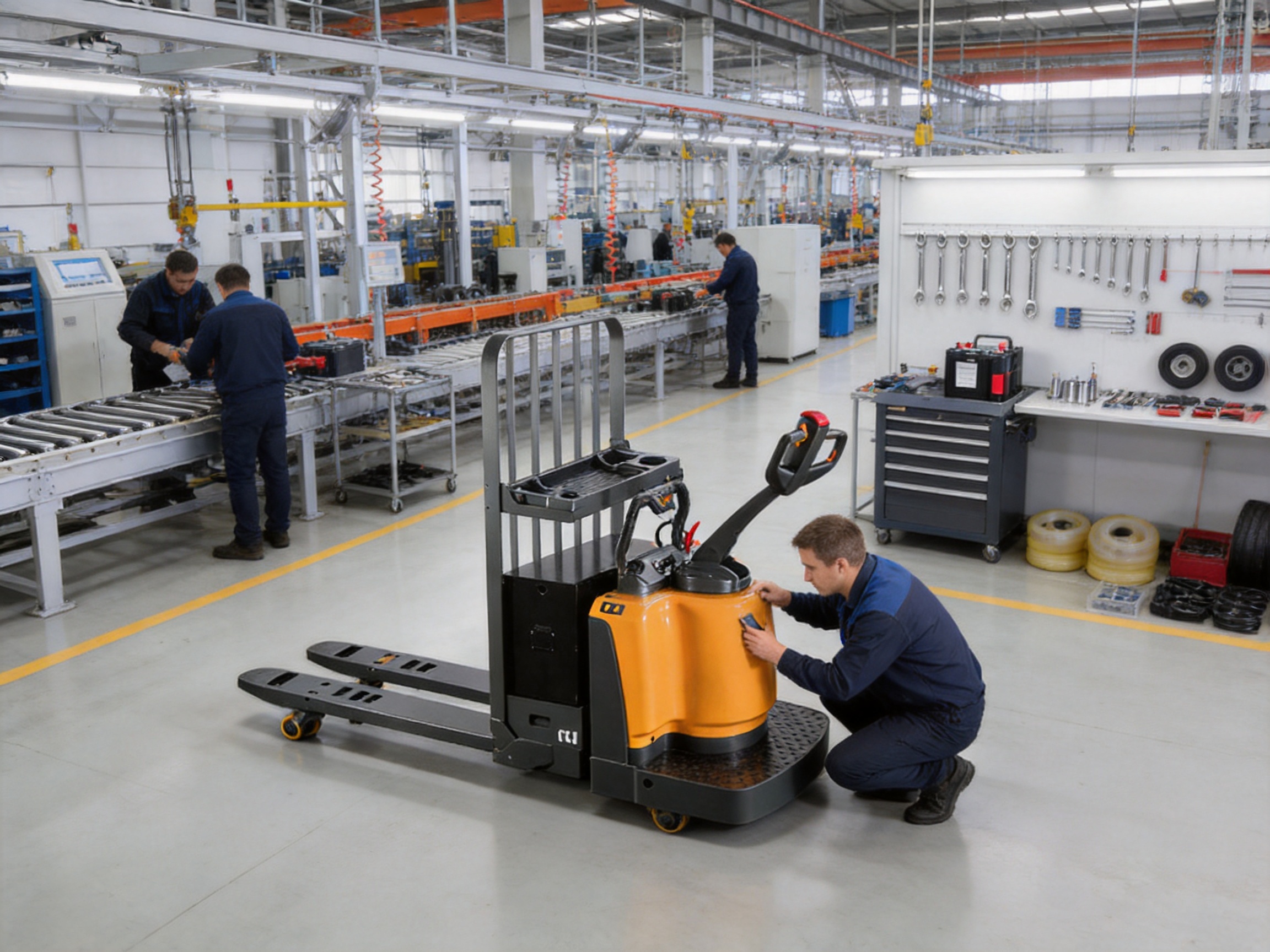
Routine inspection should include the forks, load backrest, tiller, grab bar, wheels, battery, cables, connectors, emergency controls, braking system, and hydraulic components. Operators should inspect the truck before each shift and report unusual noise, vibration, fluid leakage, reduced braking performance, damaged wheels, or control irregularities.
The load backrest has a tilt-down design intended to facilitate battery change-out. Optional battery rollers can further support easier battery handling. Any battery removal procedure should be performed with suitable lifting equipment and according to approved safety procedures.
Battery Care
Battery life depends heavily on charging discipline and operating conditions. Batteries should be charged using compatible equipment, kept clean and secure, and inspected for damage or loose connections. Lead-acid battery service may involve electrolyte and ventilation considerations, while alternative battery technologies require their own specific procedures.
Fleet managers should monitor charging frequency, battery temperature, capacity loss, and operating time. A battery that no longer supports the required work cycle may increase downtime even if the truck itself remains mechanically sound.
Wheel and Fork Maintenance
Polyurethane wheels should be checked for flat spots, cuts, uneven wear, embedded debris, and excessive diameter reduction. Worn wheels can affect ground clearance, stability, steering, and braking distance.
Forks should be inspected for bending, cracks, wear at the heel, damaged tips, and uneven height. Forks are primary load-bearing components and must not be modified or repaired without authorization from a qualified specialist.
Reducing Downtime
The best maintenance strategy combines preventive inspection with accurate operating data. Fleet managers can record operating hours, battery usage, fault codes, tire replacements, brake inspections, and recurring service issues. This information helps identify patterns before they develop into major failures.
Because the PT27R and PT36R use common industrial concepts such as AC drive control, electromagnetic braking, polyurethane wheels, and a battery-electric architecture, trained technicians can establish structured service procedures. Access to approved parts and technical documentation remains essential.
How the Models Compare with Other Equipment Types
Versus Basic Walkie Pallet Trucks
Basic walkie pallet trucks are often compact and cost-effective, but they may not provide the same capacity, travel speed, riding comfort, or long-distance productivity. The PT27R and PT36R add a riding platform, high-capacity construction, and multiple operating modes.
For short movements in small storage rooms, a simpler truck may be sufficient. For large facilities with long travel routes and heavy loads, the end rider design can reduce walking time and improve throughput.
Versus Counterbalanced Forklifts
Counterbalanced forklifts can lift loads to greater heights and handle a wider variety of load types, but they are larger, heavier, and often more expensive to operate for simple horizontal pallet movement. The PT27R and PT36R are not intended to replace high-lift forklifts, but they can perform low-level transport more efficiently in suitable areas.
Using the correct vehicle for each task can reduce unnecessary equipment travel. A warehouse may use reach trucks or counterbalanced forklifts in storage and loading areas while using electric end rider pallet trucks for horizontal movement and order picking.
Versus Internal-Combustion Pallet Equipment
Battery-electric pallet trucks produce no direct exhaust emissions during indoor operation and generally create less noise than internal-combustion vehicles. These characteristics can improve the working environment in enclosed facilities and support corporate emissions-reduction objectives.
Internal-combustion equipment may remain advantageous in severe outdoor conditions, rough terrain, or applications requiring extended refueling flexibility. The PT27R and PT36R are primarily intended for prepared floors, warehouses, docks, production facilities, and related industrial environments.
Implementation Guidance for Buyers
Assess the Load Profile
Before selecting a model, buyers should document typical and maximum pallet weights, load dimensions, load center distances, pallet types, fork entry requirements, and the percentage of loads that are unusually shaped or unstable.
The PT27R may be appropriate when loads are heavy but generally within a 2.7-tonne range. The PT36R may be preferred where 3.6-tonne capacity is required. Capacity selection should be based on the full load chart and configuration rather than on nominal model designation alone.
Measure the Facility
Warehouse planners should measure aisle widths, turning areas, dock approaches, trailer interiors, doorways, ramps, floor transitions, and battery charging spaces. The longer forks and larger turning radius of certain configurations can influence the required operating area.
Traffic separation is also important. Where the trucks operate near pedestrians, site managers should define travel lanes, speed restrictions, crossing points, warning systems, and parking locations.
Plan Battery Infrastructure
Battery charging and change-out areas should be planned before the equipment arrives. Consider the number of shifts, daily operating hours, charging time, spare batteries, ventilation, fire protection, battery transport equipment, and emergency procedures.
The open battery compartment offers flexibility, but compatibility must be confirmed. Battery dimensions, connector type, weight, charging voltage, and truck counterbalance requirements should match the final specification.
Train Operators
Operators should receive training in load capacity, load center, riding position, pedestrian mode, jog operation, side travel, coast mode, braking, ramp use, turning, dock safety, battery charging, and pre-shift inspection.
Training should emphasize that high travel speed does not eliminate the need for controlled driving. Operators must reduce speed in congested areas, maintain clear visibility, keep loads stable, and avoid carrying passengers unless the equipment is specifically designed and approved for that purpose.
Environmental and Workplace Benefits
The electric design of the PT27R and PT36R supports cleaner indoor operation. The absence of direct exhaust emissions can be particularly beneficial in enclosed warehouses and manufacturing areas. Lower local emissions may also simplify indoor air-quality management compared with internal-combustion equipment.
Electric equipment can contribute to lower workplace noise, although the overall sound level depends on tires, floor surfaces, alarms, load conditions, and surrounding activity. The listed sound level at the operator’s ear is approximately 69 dB(A) under the stated measurement standard.
Energy efficiency also depends on correct equipment selection. A truck that completes movements efficiently, avoids unnecessary walking, and reduces duplicate trips may lower energy consumption per pallet moved. The listed energy consumption according to the VDI cycle is approximately 1.83 kWh/h for both models, although real-world consumption will vary with duty cycle and operating conditions.
Environmental performance should be evaluated over the complete life cycle, including battery manufacturing, charging electricity, maintenance, replacement parts, and end-of-life recycling. Proper maintenance and responsible battery handling are important elements of sustainable fleet management.
Frequently Asked Questions
What are the PT27R and PT36R electric pallet trucks designed for?
They are designed for heavy-duty horizontal pallet transport, order picking, loading dock work, cross-docking, warehouse replenishment, manufacturing logistics, and other applications requiring high-capacity electric handling.
What is the difference between the PT27R and PT36R?
The primary difference is rated capacity. The PT27R is rated for 2.7 tonnes, while the PT36R is rated for 3.6 tonnes. The PT36R is also larger in certain dimensions and has a larger turning radius. The final choice should be based on load weight, load center, aisle width, and operating conditions.
Can the operator ride and walk with the same truck?
Yes. The end rider platform supports riding operation for longer travel distances, while the tiller controls, jog button, and side-travel function support walking operation for order picking and close-positioning tasks.
What battery does the equipment use?
The listed configuration uses a 24-volt battery with a nominal capacity of 350 Ah. The battery weight is approximately 320 kilograms. Exact battery compatibility, dimensions, connector arrangement, and charging requirements should be confirmed before purchase.
Are these pallet trucks suitable for outdoor use?
They are primarily intended for warehouses, prepared industrial floors, loading docks, and similar environments. Limited outdoor use may be possible on suitable paved surfaces, but rain, rough terrain, steep ramps, contamination, and extreme temperatures can affect performance and safety.
What type of tires are fitted?
The trucks use polyurethane tires. These are suitable for many indoor industrial floors and provide a balance of durability, rolling efficiency, and floor protection.
What is the maximum lift height?
The listed lift height is approximately 150 millimeters. These are low-lift pallet trucks designed primarily for transporting pallets rather than placing loads into high-level storage positions.
How fast can the trucks travel?
The PT27R is listed with travel speeds of up to 11 km/h laden and 14 km/h unladen. The PT36R is listed with speeds of up to 9.5 km/h laden and 12 km/h unladen. Actual speeds should be controlled according to site conditions, regulations, load, and traffic.
Do the trucks have a battery change-out design?
Yes. The heavy-duty load backrest uses a tilt-down design to facilitate battery change-out, and optional battery rollers are available to make battery replacement easier.
What safety features support operator control?
Important design elements include the ergonomic tiller, grab bar with electronic controls, electromagnetic braking, adjustable tiller height, riding platform, walking controls, and controlled side-travel functions. Safe operation still depends on training, maintenance, load management, and proper site procedures.
Can the fork length be customized?
The product information lists multiple fork length options. Buyers should confirm the required fork length, width, spacing, load center, and overall truck dimensions with the manufacturer before ordering.
What should buyers verify before placing an order?
Buyers should verify capacity, load center, fork dimensions, overall length, turning radius, aisle requirements, battery specifications, charger compatibility, operating temperature, tire type, safety equipment, local certification, warranty coverage, spare parts, and after-sales service.
Conclusion
The PT27R and PT36R electric end rider pallet trucks are designed for warehouse users who need more capability than a basic pedestrian pallet truck can provide. Their combination of 2.7-tonne and 3.6-tonne capacity options, electric drive, riding platform, high travel speed, ergonomic controls, polyurethane tires, and industrial battery configuration makes them suitable for demanding horizontal transport operations.
Their strongest competitive advantage is operational flexibility. An operator can ride across long warehouse routes, walk beside the truck during picking, use the jog function for controlled positioning, and rely on heavy-duty components for dense pallet loads. This flexibility can help reduce unnecessary walking, improve pallet throughput, and support more efficient labor utilization.
The manufacturer’s long experience in forklift engineering, integrated production capability, electric equipment development, international market activity, and broad product portfolio provide a strong foundation for supplying industrial material-handling equipment. Manufacturing quality, however, must be supported by correct application selection, professional maintenance, operator training, and appropriate facility planning.
For distribution centers, manufacturing plants, loading docks, cross-docking facilities, and heavy-goods warehouses, the PT27R and PT36R offer a practical electric solution for high-capacity pallet movement. The best results will be achieved when the selected model, fork configuration, battery system, aisle layout, and operating procedures are matched carefully to the customer’s actual workflow.
References
1. Product technical information for PT27R and PT36R electric pallet trucks, including dimensions, capacities, performance data, battery specifications, and equipment features.
2. Manufacturer information concerning material-handling equipment production, research and development, electric forklift technology, international distribution, and service capability.
3. VDI-based energy consumption information supplied for the stated pallet truck configuration.
4. EN 12053 principles for measuring sound levels at the operator’s ear for industrial trucks.
5. General industrial truck safety practices concerning rated capacity, load center, operator training, battery handling, traffic management, and preventive maintenance.
Product: Electric Pallet Truck PT27R PT36R
For exclusive deals and latest offers, sign up by entering your email address below.
Stay In Touch
ADDRESS : NO.1 ROAD ONE, XINDENG NEW DISTRICT, FUYANG, HANGZHOU, ZHEJIANG, CHINA 311404.
PHONE : +86-571-8688 8355 (AMERICA)
PHONE : +86-571-8886 9363 (EUROPE)
PHONE : +86-571-8688 8377 (ASIA, AFRICA, OCEANIA)
EMAIL : [email protected]
EMAIL : [email protected](PARTS INQUIRY)

