


 中文简体
中文简体 Français
 русский
 Español
 عربى
عربى Deutsch



High-Performance Sit-In Reach Trucks for Efficient Warehouse Operations
Admin 2026-09-15Modern warehouses require more than simple lifting equipment. They need reliable, precise, compact, and energy-efficient machines that can move pallets safely through narrow aisles while supporting increasingly demanding storage strategies. A sit-in reach truck is designed for exactly this environment. It combines the maneuverability of a warehouse truck with the lifting capability required for high-level racking, making it a practical solution for distribution centers, manufacturing plants, cold-storage facilities, retail warehouses, and third-party logistics operations.
The Reach Truck (Sit in) is an electric warehouse vehicle developed for intensive material handling work. It is available in several capacity and mast configurations, covering rated load capacities from 1,600 kg to 2,500 kg in the standard range, with lifting heights extending from approximately 3,000 mm to 10,000 mm depending on the selected model and mast. Its sit-down operating position, electronic steering, AC drive technology, regenerative braking, hydraulic stability, and automatic safety functions are designed to improve productivity while reducing operator fatigue and maintenance requirements.
Zhejiang UN Forklift Co., Ltd. has specialized in material handling equipment since 1978. The company was among the earliest manufacturers in China to develop reach trucks, double-deep reach trucks, and very-narrow-aisle trucks. This product history is important because reach-truck performance depends on much more than motor power. It requires balanced chassis engineering, mast design, hydraulic control, visibility, stability, battery integration, and practical knowledge of warehouse workflows.
The result is a reach truck platform intended to give warehouse operators a dependable combination of capacity, reach, maneuverability, safety, and operating economy. It is suitable for businesses that need to maximize vertical storage without investing in larger aisle widths or more complex automated systems.
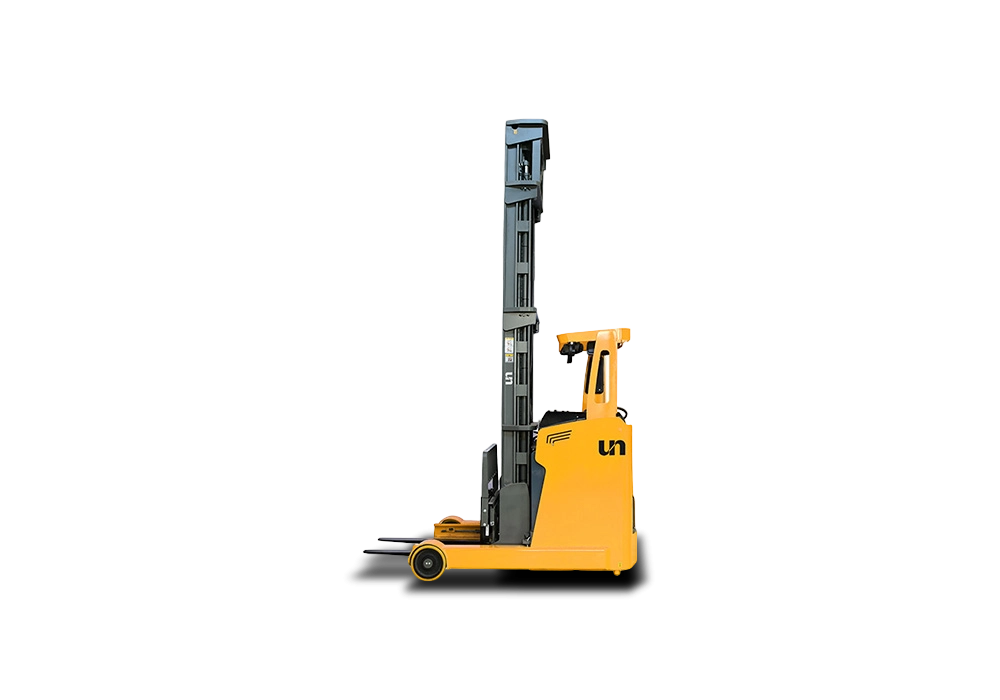
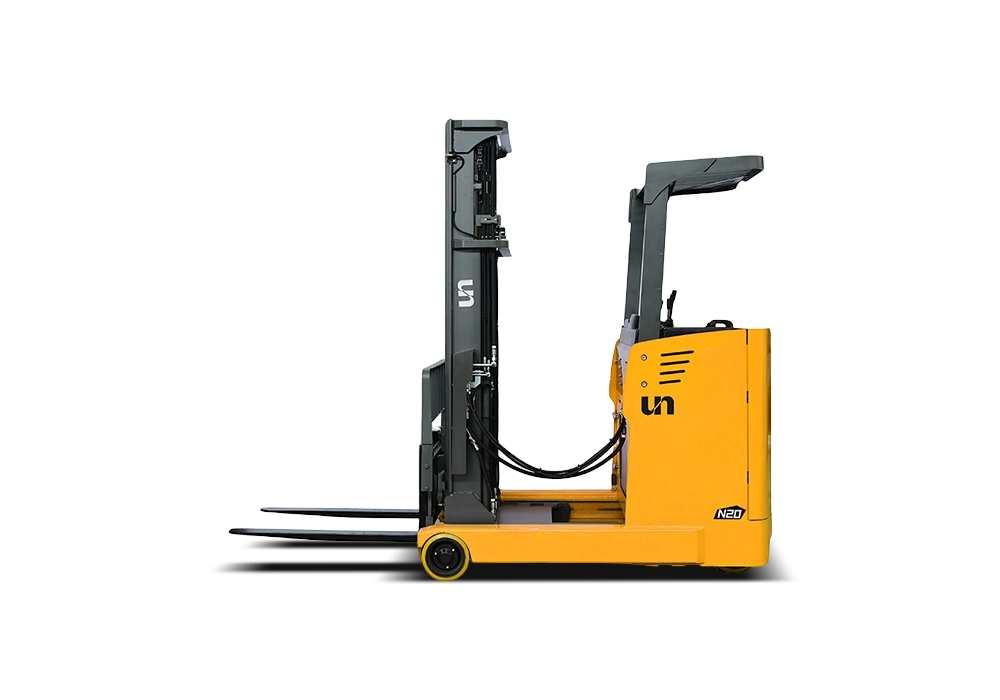
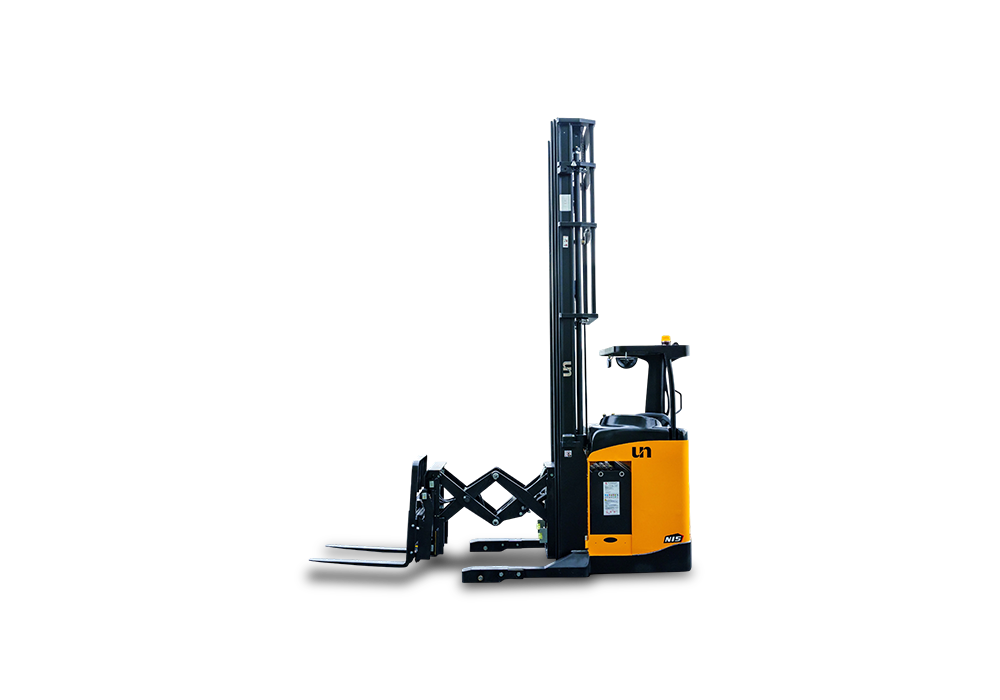
Reach Truck(Sit in)
Product Concept and Warehouse Application
A reach truck is designed to place and retrieve loads in storage racks at considerable height. Unlike a conventional counterbalanced forklift, it does not need a large counterweight extending behind the rear axle. The reach mechanism allows the mast and load to move forward for pallet handling and retract toward the truck during travel. This configuration reduces the space required for operation and enables the machine to work efficiently in narrower warehouse aisles.
The sit-in configuration provides a supported driving position for operators who spend long periods performing repetitive loading and unloading tasks. Instead of standing throughout the working shift, the operator can remain seated in a dedicated ergonomic compartment. This helps reduce leg and back fatigue, particularly in facilities where the truck performs continuous cycles between storage racks, staging areas, production lines, and loading docks.
The truck is suitable for applications including:
● High-bay pallet storage and retrieval.
● Distribution centers with frequent horizontal and vertical travel.
● Manufacturing warehouses supplying production lines.
● Retail and e-commerce fulfillment centers.
● Food, beverage, and packaged-goods warehouses.
● Spare-parts and component storage.
● Temperature-controlled logistics facilities, subject to appropriate configuration.
● Third-party logistics operations handling different pallet sizes and load profiles.
Its design supports both normal single-depth rack operations and demanding high-lift applications. Several mast options are available, including three-stage full-free wide-view masts. Depending on configuration, fork heights range from 4,700 mm to 10,000 mm, while the rated capacity must be selected according to the intended lifting height, load center, mast configuration, and operating conditions.
Capacity and Model Flexibility
Warehouse requirements vary widely. A small parts distribution operation may need a compact 1,600 kg machine, while a heavy pallet operation may require a 2,500 kg version. The product family addresses these different requirements through several model groups.
| Model Group | Rated Capacity | Typical Battery Configuration | Representative Lift Range | Operating Position |
|---|---|---|---|---|
| FBRS16-NQC5 | 1,600 kg | 48 V / 420 Ah or related configuration | Up to approximately 5,500 mm in the listed configuration | Sit-in |
| FBRS18-NQC5 | 1,800 kg | 48 V / 500 Ah or related configuration | Up to approximately 5,500 mm in the listed configuration | Sit-in |
| FBRS20-NQC5 | 2,000 kg | 48 V / 560 Ah or related configuration | Up to approximately 3,000 mm in the listed configuration | Sit-in |
| FBRS25-NQC5 | 2,500 kg | 48 V / 700 Ah | Up to approximately 4,700 mm in the listed configuration | Sit-in |
| FBRS16-N1QC5 | 1,600 kg | 48 V / 560 Ah or related configuration | Up to approximately 8,500 mm | Sit-in |
| FBRS18-N1QC5 | 1,800 kg | 48 V / 700 Ah | Up to approximately 8,500 mm | Sit-in |
| FBRS20-N1QC5 | 2,000 kg | 48 V / 700 Ah | Up to approximately 8,500 mm | Sit-in |
The table illustrates an important point: capacity and lift height are not independent. A higher mast configuration may have a reduced allowable capacity at maximum elevation. This is normal for high-lift equipment because stability, residual capacity, load center, mast structure, and rack clearance must all be considered. Buyers should therefore use the official capacity chart for the exact mast and attachment combination rather than selecting a truck only by its nominal rated capacity.
The standard models provide a practical balance between lifting ability and compact dimensions. The N1 series is intended for higher storage applications, with mast options such as RTFM850, RTFM900, RTFM950, and RTFM1000. These configurations can reach fork heights of 8,500 mm, 9,000 mm, 9,500 mm, and 10,000 mm respectively. At these heights, the correct pallet weight, load center, aisle layout, floor quality, and operator training become especially important.
Efficient Electric Performance
The reach truck uses battery power and AC technology to deliver smooth, controllable performance in warehouse environments. Electric operation offers several advantages over internal-combustion equipment, especially indoors. It produces no direct exhaust emissions during use, creates less noise, and is suitable for facilities where air quality and workplace cleanliness are important.
The drive system incorporates an American Curtis controller and KDS motor technology. AC motors provide continuously variable drive control and support smooth acceleration and deceleration. Because brushless motors do not use conventional brushes that wear during operation, they can reduce routine maintenance demands and help maintain consistent performance over a long service life.
The drive motor is specified at 6.4 kW across the listed models, while the pump motor is specified at 12.5 kW. These values provide a balanced relationship between travel performance and hydraulic lifting capability. Depending on the configuration, travel speed under full load reaches up to 9.5 km/h, while unloaded travel speed reaches up to 10 km/h. Full-load lifting speed ranges from approximately 290 mm/s to 340 mm/s in the listed specifications.
In a warehouse, smoothness is often more valuable than maximum speed. Sudden acceleration, harsh braking, or abrupt hydraulic movement can damage loads, disturb pallet stability, and increase operator fatigue. The AC control system allows the truck to respond progressively to the operator’s commands. This makes it easier to position forks accurately in rack locations and reduces unnecessary shock to the load and mast.
Regenerative Energy Function
The battery regeneration function automatically returns electrical energy to the battery during deceleration or parking conditions. Instead of allowing all kinetic energy to be dissipated as heat through conventional braking, the system recovers a portion of that energy and improves overall electrical efficiency.
Regeneration can be particularly useful in high-cycle warehouse applications. Reach trucks frequently accelerate, decelerate, stop, and reposition while working between rack locations. Recovering energy during these repeated operating phases may help extend working time between charges, reduce energy consumption, and limit brake wear.
Actual energy savings depend on load weight, travel distance, operator behavior, floor conditions, duty cycle, battery age, and charging practices. Nevertheless, regenerative braking is a valuable feature for warehouses seeking to reduce operating costs and improve the sustainability of electric material handling equipment.
Hydraulic and Mast Engineering
The mast is one of the most important structural systems on a reach truck. It must carry the load vertically, remain stable during extension, provide adequate visibility, and withstand repeated cycles under changing load conditions. The product uses high-strength, wear-resistant steel for the mast structure. This material selection supports durability in demanding warehouse service.
Shimadzu hydraulic pumps and valves are used to support the reliability and stability of the hydraulic system. Stable hydraulic control is essential when positioning pallets at height. The operator needs to raise, lower, tilt, and reach the forks in a controlled manner. A responsive hydraulic circuit makes it easier to align with rack beams and pallet openings, especially when working in restricted spaces.
The three-stage full-free wide-view mast is designed to combine high lifting capability with improved visibility. Full free lift allows the forks to rise through part of the mast height without immediately increasing the overall lowered mast height. This is valuable when the truck must place pallets inside containers, railcars, or low-clearance areas, or when it needs to stack a load without extending the mast excessively.
A wide-view mast reduces the visual obstruction between the operator and the load. Visibility is particularly important when handling pallets at height because small alignment errors can cause rack contact, product damage, or unsafe load placement. The mast design is complemented by a strong overhead guard and a comfortable seat, creating a more supportive operating environment.
Available mast specifications include the following examples:
● RTFM470: maximum fork height of approximately 4,700 mm.
● RTFM500: maximum fork height of approximately 5,000 mm.
● RTFM550: maximum fork height of approximately 5,500 mm.
● RTFM600: maximum fork height of approximately 6,000 mm.
● RTFM650: maximum fork height of approximately 6,500 mm.
● RTFM700: maximum fork height of approximately 7,000 mm.
● RTFM750: maximum fork height of approximately 7,500 mm.
● RTFM800: maximum fork height of approximately 8,000 mm.
● RTFM850: maximum fork height of approximately 8,500 mm.
● RTFM900: maximum fork height of approximately 9,000 mm.
● RTFM950: maximum fork height of approximately 9,500 mm.
● RTFM1000: maximum fork height of approximately 10,000 mm.
The capacity chart shows that allowable capacity decreases as lifting height increases. For example, a mast rated at 4,700 mm can support higher capacities than a 10,000 mm mast in the listed range. This is not a weakness of the product; it reflects the basic engineering relationship between vertical lift, load moment, mast deflection, and stability. A professional selection process should identify the heaviest load, its center of gravity, the highest storage position, and the required residual capacity before a model is ordered.
Compact Dimensions and Maneuverability
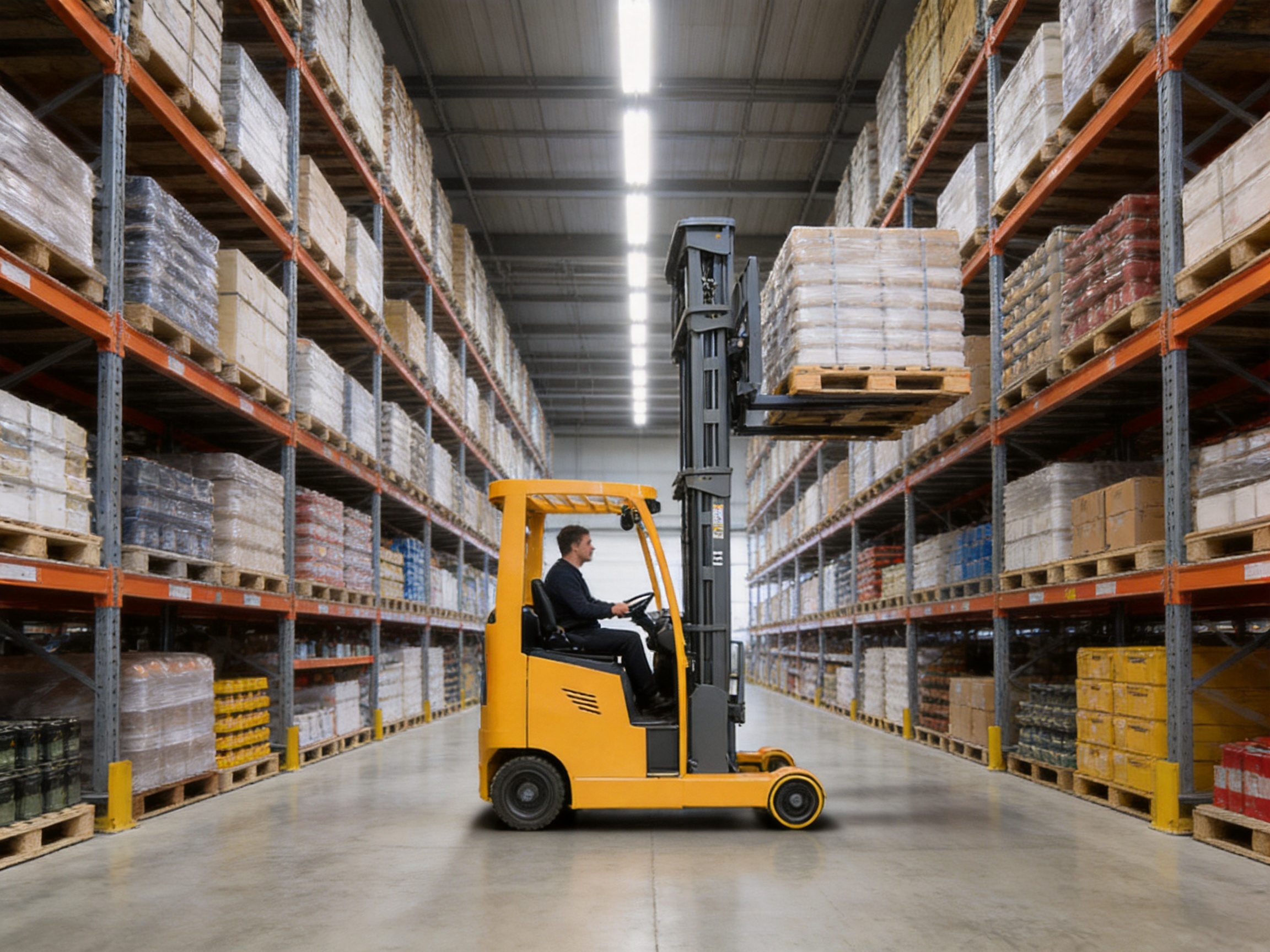
Space utilization is a major reason warehouses choose reach trucks. The listed models have an overall width of approximately 1,270 mm and a turning radius ranging from approximately 1,700 mm to 1,850 mm, depending on capacity and configuration. These dimensions allow the truck to work in relatively narrow aisles compared with many conventional counterbalanced forklifts.
The working aisle width depends on pallet size, pallet orientation, fork dimensions, mast configuration, reach distance, and the required clearance from the racking. The specifications include aisle-width figures for 1,000 mm by 1,200 mm pallets and 800 mm by 1,200 mm pallets. For the listed configurations, working aisle widths are approximately 2,710 mm to 2,900 mm.
For a 1,000 mm by 1,200 mm pallet loaded lengthways, the specified aisle widths include examples such as 2,710 mm for the 1,600 kg configuration, 2,740 mm for the 1,800 kg configuration, 2,760 mm for the 2,000 kg configuration, and 2,865 mm for the 2,500 kg configuration. High-lift N1 configurations have listed aisle widths of approximately 2,835 mm to 2,865 mm.
For an 800 mm by 1,200 mm pallet loaded lengthways, the corresponding values range from approximately 2,745 mm to 2,900 mm. These figures should be treated as reference values rather than universal aisle requirements. Actual warehouse design must account for rack tolerances, floor flatness, pallet condition, operator skill, safety clearances, pedestrian traffic, and local regulations.
The compact chassis is supported by a reach distance of approximately 550 mm to 660 mm, depending on model. A well-designed reach mechanism helps the operator place the load into the rack while keeping the truck body positioned efficiently in the aisle. The wheelbase ranges from approximately 1,450 mm to 1,600 mm, providing a balance between stability and maneuverability.
Comparison with Conventional Forklifts
Compared with a conventional counterbalanced forklift, a sit-in reach truck offers several operational advantages in indoor storage applications:
● It requires less rear counterweight because the reach mechanism supports load handling closer to the truck body during travel.
● It can operate in narrower aisles, allowing warehouses to install additional rack positions within the same floor area.
● It can reach higher storage levels, supporting greater use of building height.
● Its electric drive system is well suited to indoor operations and clean working environments.
● Its seated operator compartment is appropriate for repetitive, high-cycle warehouse work.
● Its electronic steering and controlled hydraulic functions support precise pallet placement.
Compared with basic electric stackers or walkie reach trucks, the sit-in configuration generally offers higher travel comfort, stronger performance, and greater suitability for long shifts. It also provides a more stable driving platform for operations involving heavier pallets and taller racks.
Compared with highly specialized very-narrow-aisle equipment, the reach truck may offer greater flexibility across different areas of a warehouse. It can travel between storage aisles, staging areas, and loading zones without requiring the same level of fixed guidance infrastructure. This makes it an attractive choice for warehouses that need a multipurpose high-lift vehicle rather than a machine dedicated to one aisle system.
Electronic Steering and Operator Ergonomics
The electronic power steering system is designed to reduce steering effort and improve maneuverability. It displays the driving-wheel position in real time and includes an automatic centering function when the truck starts. These features help the operator understand the truck’s orientation and reduce the risk of beginning travel with the steering wheel or drive wheel in an unsuitable position.
Electronic steering is particularly valuable in narrow aisles. A small steering correction can significantly affect the clearance between the mast, pallet, rack, and floor. Light steering effort allows the operator to make precise adjustments without excessive physical strain. It also supports smoother turning and positioning during repetitive pallet cycles.
The sit-in layout includes a comfortable seat and a strong overhead guard. The operator benefits from a supported posture, improved protection, and a control environment designed for repeated driving and lifting tasks. A wide-view mast improves the line of sight toward the forks and load, while real-time steering information assists with vehicle orientation.
Ergonomics can directly influence productivity. When an operator experiences less fatigue, concentration may remain more consistent throughout the shift. Better concentration can contribute to improved pallet placement, fewer minor impacts, and safer interaction with pedestrians and other equipment. Ergonomic design is therefore not only a comfort feature; it is also part of a warehouse’s overall performance and safety strategy.
Safety Features for Controlled Handling
Warehouse safety depends on equipment design, operator training, facility layout, load discipline, and maintenance. The reach truck incorporates several functions intended to support controlled operation, including automatic turning deceleration, automatic parking, electromagnetic braking, steering-wheel positioning information, and a wide-view mast.
Automatic Turning Deceleration
The automatic turning deceleration function reduces travel speed when the truck turns. This helps control lateral forces and supports stability during cornering. Because a reach truck may carry loads at significant height, turning too quickly can create unsafe load movement or increase the risk of instability. Automatic deceleration provides an additional safeguard against excessive cornering speed.
This function does not replace safe operating practices. Operators must still slow down before turns, keep loads within the rated capacity, maintain clear visibility, and follow site-specific traffic rules. However, automatic intervention can help reduce the consequences of an inappropriate speed setting or an unexpected maneuver.
Automatic Parking and Electromagnetic Braking
The automatic parking function helps secure the truck when it stops. The electromagnetic service brake provides controlled braking performance and reduces dependence on mechanical friction components. Together, these systems support safer stopping and may reduce routine service requirements.
Parking procedures should still include lowering the forks, placing the truck in the designated parking area, switching off the vehicle when required, and following battery charging or isolation procedures. Automatic parking is a support system, not a replacement for proper operator behavior.
Structural Protection and Visibility
The overhead guard protects the operator from falling objects within the limits of its design and applicable standards. The mast is manufactured from high-strength steel, while the wide-view arrangement helps the operator observe the load and rack interface. These features are especially important when working with high-bay storage systems where the load may be several meters above floor level.
Safety also depends on rack engineering. Racking must be designed for the actual pallet loads and truck operating conditions. Aisles must provide adequate clearance, floors must support the truck’s wheel loads, and lighting must enable the operator to identify pallet positions and obstacles. A high-quality reach truck performs best when integrated into a properly planned warehouse environment.
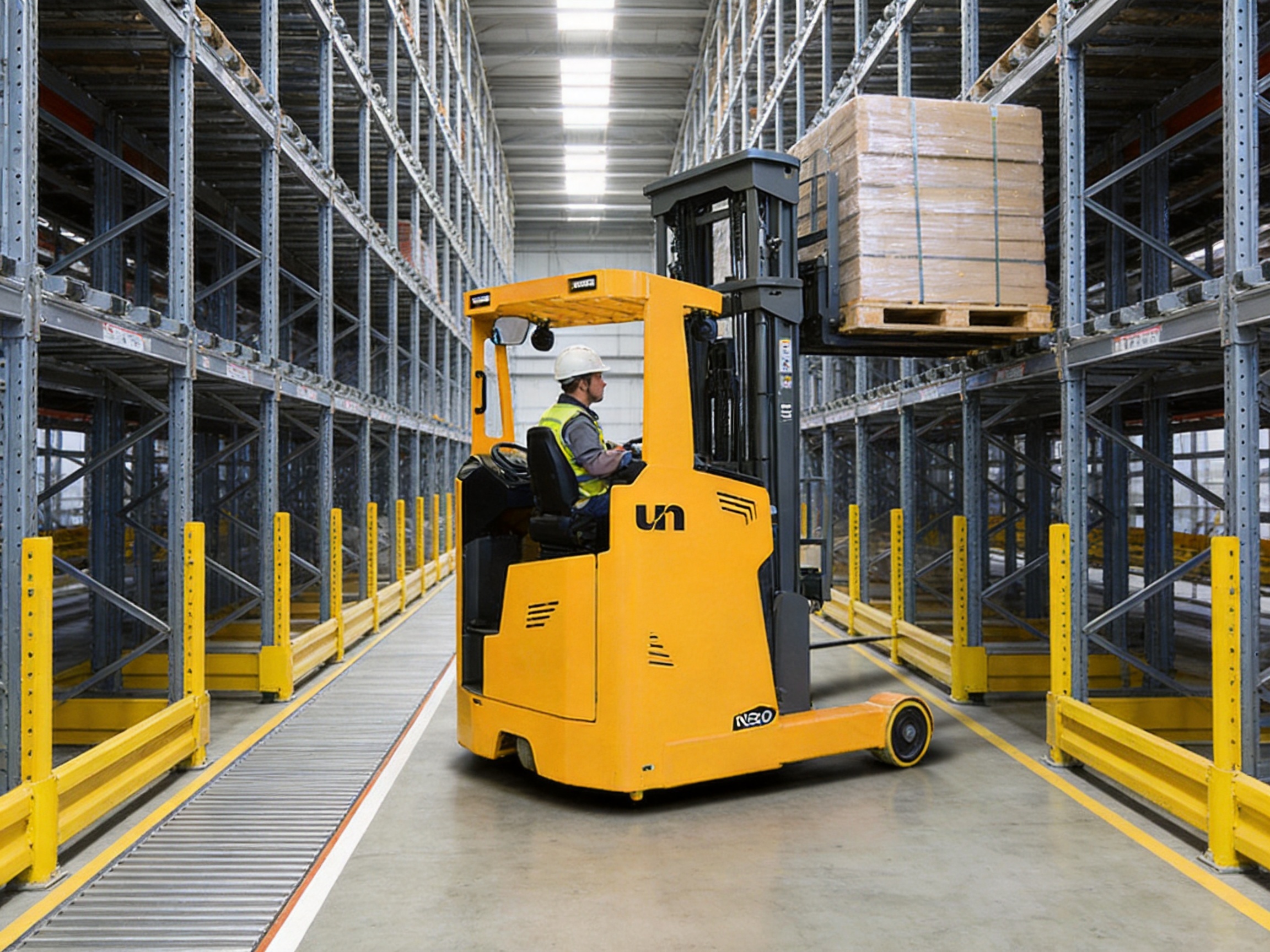
Maintenance Advantages and Service Accessibility
Equipment availability is a key factor in total operating cost. A truck that is technically powerful but difficult to maintain can create unnecessary downtime. The product addresses serviceability through AC motors, a relatively simple structure, maintenance-free components, and a removable maintenance cover.
Maintenance-free AC motors generate less heat and do not require brush replacement. Lower heat generation can support improved efficiency and reduce thermal stress on components. The absence of brushes also reduces the number of wear parts associated with conventional DC drive motors.
The removable maintenance cover provides easier access to the controller and other key components. Technicians can inspect electrical connections, control devices, and service points more efficiently when access panels are designed for practical removal. Easier access can reduce inspection time and make preventive maintenance more convenient.
Routine maintenance should normally include:
● Checking battery condition, connectors, charging behavior, and electrolyte or battery-management requirements as applicable.
● Inspecting forks for cracks, bending, wear, and correct positioning.
● Checking mast rollers, chains, cylinders, hoses, and fastening points.
● Inspecting hydraulic oil level and looking for leaks.
● Testing steering, braking, automatic parking, and turning deceleration functions.
● Checking drive wheels, load wheels, and tire surfaces for wear or damage.
● Inspecting the overhead guard, seat, seat belt, controls, and warning devices.
● Cleaning the battery compartment, cooling areas, sensors, and control interfaces.
● Reviewing diagnostic information from the control system and CAN bus network.
Preventive maintenance intervals should be determined by the operating environment, working hours, load cycles, dust levels, temperature, floor quality, and manufacturer recommendations. A warehouse fleet manager should maintain service records and remove equipment from service if a safety-critical fault is found.
CAN Bus Communication and System Dependability
The truck uses a CAN bus communications network to connect electronic systems and support dependable data exchange. In modern electric material handling equipment, a communication network helps coordinate the controller, drive system, steering system, hydraulic functions, sensors, and safety features.
A well-integrated control network can reduce wiring complexity and improve diagnostic capability. When a system fault occurs, technicians may be able to identify the affected circuit or component more quickly than with a completely isolated control arrangement. Better diagnostics can shorten downtime and assist with preventive maintenance planning.
CAN bus communication also supports consistent interaction between the truck’s operating systems. For example, travel control, regenerative braking, steering position, and safety functions can work together rather than operating as unrelated systems. This integrated approach helps create predictable vehicle behavior in demanding warehouse conditions.
Battery Options and Charging Strategy
The listed reach truck configurations use 48-volt batteries with capacities including approximately 420 Ah, 500 Ah, 560 Ah, 700 Ah, and related variants. Battery selection should be based on the required shift length, operating intensity, charging infrastructure, ambient temperature, and available battery-change procedures.
A larger ampere-hour rating can provide greater energy storage, but it may also increase battery weight, charging time, and equipment cost. The battery must be compatible with the truck’s approved battery compartment, electrical system, and weight requirements. The battery contributes to the overall counterbalancing and stability of the vehicle, so an unapproved substitute should never be installed without technical confirmation.
Warehouses should evaluate the complete energy cycle rather than looking only at battery capacity. Important questions include:
● How many operating hours are required per shift?
● What percentage of the shift involves lifting compared with travel?
● How far does the truck travel between charging opportunities?
● Is opportunity charging available?
● Is a battery replacement area required?
● What charging ventilation and electrical capacity are available?
● How does the facility manage battery inspection and emergency procedures?
Regenerative braking can contribute to energy efficiency, but it does not eliminate the need for correct battery sizing. The most effective solution is a complete analysis of duty cycle, charging schedule, and fleet utilization.
Manufacturing Strength and Engineering Experience
Zhejiang UN Forklift Co., Ltd. operates as an integrated manufacturer covering research and development, production, sales, and service. Founded in 1978, the company occupies approximately 53,400 square meters and has an annual production capacity of about 15,000 units. This scale supports the development of complete material handling product families rather than isolated truck models.
The company’s product range includes 17 varieties, 96 series, and more than 200 specifications. This breadth allows engineering resources, component knowledge, production systems, and service experience to be shared across multiple categories. The company manufactures electric forklifts, internal-combustion forklifts, reach trucks, very-narrow-aisle trucks, and other warehouse equipment.
Its historical involvement in reach-truck development is a significant strength. The company states that China’s first reach forklift and VNA truck were developed at UN. Early experience in these categories provides practical insight into the challenges of high-lift stability, mast visibility, compact turning, electric drive performance, and warehouse productivity.
The company also holds national patents related to electric forklift technologies and has participated in the formulation of Chinese electric forklift industry standards. These activities indicate an emphasis on technical development rather than simple assembly. Engineering experience is especially important for reach trucks because the product must balance multiple competing requirements: high lift, low overall dimensions, high residual capacity, smooth control, compact turning, operator visibility, and structural durability.
Integrated Production Approach
An integrated manufacturing organization can coordinate product design, component selection, assembly, testing, and after-sales feedback more effectively. Design engineers can receive information from production teams and service personnel, while manufacturing departments can apply standardized processes across different models.
Production quality depends on many stages, including steel preparation, mast fabrication, welding, machining, painting, electrical assembly, hydraulic installation, battery integration, software configuration, and final inspection. Consistent control at each stage is necessary to achieve reliable truck performance.
For a reach truck, mast alignment and hydraulic installation require particular care. Small deviations can affect fork movement, load stability, or smoothness. Electrical connections and controller programming must also be verified because modern trucks rely heavily on electronic communication and coordinated control. Final testing should examine travel, lifting, lowering, steering, braking, reach movement, safety functions, and load-handling behavior.
The company’s worldwide sales and service network includes partners in Europe, South America, North America, Africa, and Asia. For international buyers, this network can support parts supply, technical communication, warranty coordination, and operator or service training. Availability of local support is an important factor when comparing equipment suppliers because the cost of downtime can exceed the initial difference in purchase price.
Advantages in Competitive Warehouse Environments
The sit-in reach truck competes with a range of warehouse vehicles, including stand-up reach trucks, counterbalanced electric forklifts, walkie stackers, and VNA trucks. Its competitive advantages arise from the combination of characteristics rather than from one isolated specification.
High Storage Density
The compact width, turning radius, and reach function support narrower aisle operation than many conventional forklifts. By using vertical space more effectively, a warehouse may increase pallet positions without expanding its building footprint. This can be especially valuable in areas where land and construction costs are high.
Broad Capacity Range
The product family covers multiple capacities and mast heights. Buyers can choose a truck closer to the actual application instead of using one oversized machine for every task. Correct sizing may improve energy efficiency, maneuverability, and purchase economics.
Precise Electric Control
AC drive technology, electronic steering, regenerative braking, and coordinated hydraulic control support smooth operation. These functions can help reduce product damage and improve cycle consistency compared with less advanced systems.
Operator Comfort
The sit-in layout, comfortable seat, electronic steering, overhead guard, and wide-view mast are suited to long working shifts. Reduced physical effort can support more consistent performance throughout the day.
Reduced Maintenance Burden
Brushless AC motors, maintenance-free components, CAN bus diagnostics, and accessible service covers can reduce maintenance complexity. Lower maintenance requirements can improve fleet availability when supported by a suitable preventive maintenance program.
Safety-Oriented Control
Turning deceleration, automatic parking, electromagnetic braking, mast visibility, and steering-wheel positioning information provide multiple layers of operational support. These features complement, rather than replace, operator training and site safety procedures.
Manufacturer Capability
A long manufacturing history, dedicated reach-truck development experience, broad product range, technical patents, production capacity, and international service coverage provide a stronger foundation than a supplier focused only on trading or basic equipment assembly.
Recommended Selection Process
Before purchasing a sit-in reach truck, warehouse managers should collect accurate information about the application. The following process can reduce the risk of selecting a truck that is either underpowered or unnecessarily expensive.
Step One: Define the Load
Record the heaviest pallet weight, average pallet weight, pallet dimensions, load shape, packaging quality, and center of gravity. Do not assume that all pallets are identical. Irregular or unstable loads may require attachments, longer forks, load backrests, or reduced operating speeds.
Step Two: Define the Height
Measure the actual required fork height, not merely the top beam height. Consider pallet height, clearance above the load, rack beam dimensions, sprinkler systems, ceiling obstructions, and the required free lift. Select a mast that provides sufficient reach while maintaining the necessary residual capacity.
Step Three: Measure the Aisle
Measure clear aisle width at floor level and at mast height. Consider rack protectors, columns, fire equipment, pedestrian barriers, pallet overhang, and floor irregularities. Use the relevant pallet dimensions and orientation when reviewing the truck’s working aisle data.
Step Four: Review the Floor
Reach trucks operating at high elevation require a stable, reasonably level floor. Uneven surfaces can affect mast behavior, load stability, steering, and wheel wear. Check floor load ratings and identify expansion joints, slopes, ramps, and damaged areas.
Step Five: Analyze the Duty Cycle
Estimate operating hours, travel distance, lift cycles per hour, average load, peak periods, and charging opportunities. These factors determine the appropriate battery capacity and fleet quantity.
Step Six: Confirm Safety and Training Requirements
Confirm local regulations, operator licensing, rack inspection requirements, pedestrian controls, emergency procedures, battery charging rules, and maintenance responsibilities. The truck should be introduced as part of a complete warehouse safety system.
Step Seven: Plan Service Support
Ask about spare-parts availability, technician response time, warranty coverage, diagnostic support, maintenance documentation, and operator training. A supplier’s after-sales capability should be evaluated before the purchase order is issued.
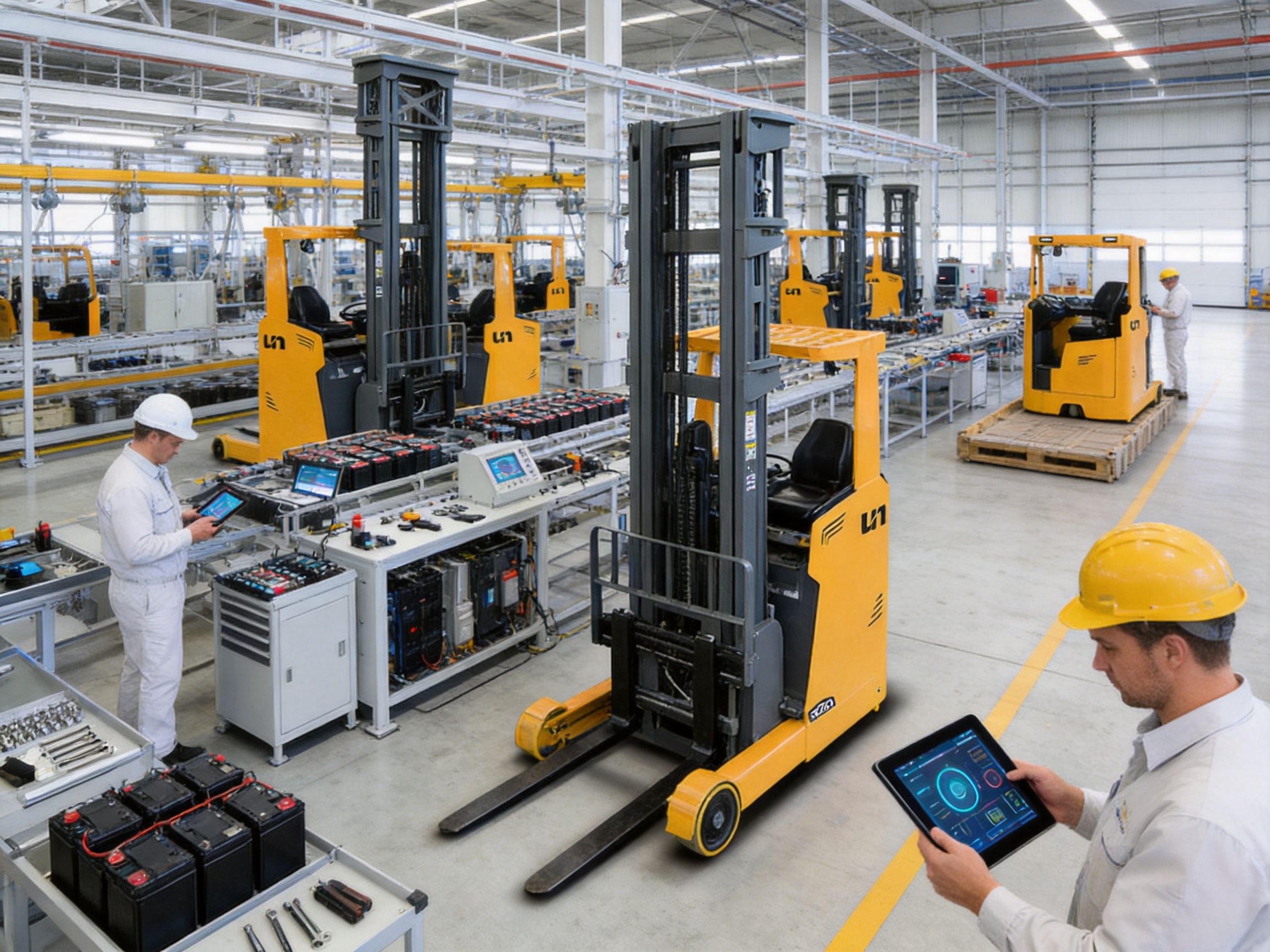
Operational Best Practices
Proper operation is essential to achieving the expected performance and service life of a reach truck. Operators should complete pre-shift inspections and report faults immediately. The inspection should cover forks, mast, chains, hydraulic hoses, wheels, battery, steering, brakes, warning devices, seat belt, overhead guard, and visible structural damage.
Loads must be centered on the forks and kept within the rated capacity for the actual lift height and load center. Operators should avoid turning at excessive speed, traveling with elevated loads, carrying unstable pallets, or entering aisles with insufficient clearance. When visibility is obstructed, the operator should use an approved travel method or assistance according to site procedures.
At high lift heights, operators should approach racks slowly and avoid sudden mast or reach movements. The truck should be positioned squarely before inserting the forks into a pallet. After the load is secured, it should be retracted and lowered to a safe travel position before moving through the warehouse.
Battery charging should be performed only in designated areas using approved equipment. Charging connectors should be inspected, and damaged cables should be removed from service. The battery compartment should be kept clean and dry, and personnel should follow the relevant procedures for the specific battery technology.
Fleet managers should monitor impact events, fault codes, maintenance frequency, battery performance, and operator feedback. These data points can reveal training needs, floor problems, rack damage, or unsuitable operating practices before they become major safety or cost issues.
Frequently Asked Questions
What is a sit-in reach truck?
A sit-in reach truck is an electric warehouse forklift with a seated operator position and a reach mechanism for placing and retrieving pallets in racking. It is designed for high-density indoor storage and can work in narrower aisles than many conventional counterbalanced forklifts.
What lifting capacities are available?
The listed product range includes capacities of approximately 1,600 kg, 1,800 kg, 2,000 kg, and 2,500 kg. The correct capacity depends on the model, mast, load center, lift height, attachment, and operating conditions.
How high can the truck lift?
Available mast configurations range from approximately 4,700 mm to 10,000 mm in the detailed mast range. Some standard configurations are listed at 3,000 mm, 4,700 mm, 5,500 mm, and 8,500 mm. Capacity may decrease at greater lift heights, so the official residual-capacity chart must be consulted.
What battery voltage does the truck use?
The listed models use 48-volt batteries. Available capacities include approximately 420 Ah, 500 Ah, 560 Ah, and 700 Ah, depending on the model and configuration.
Is the truck suitable for narrow aisles?
Yes. The truck is designed for warehouse applications requiring compact maneuverability. Listed working aisle widths are approximately 2,710 mm to 2,900 mm for the specified pallet examples, but the actual requirement depends on pallet dimensions, orientation, rack layout, and operating clearances.
What is the benefit of AC drive technology?
AC drive technology provides smooth and continuously variable travel control. Brushless AC motors can improve efficiency and reduce maintenance because they do not require conventional brush replacement.
How does regenerative braking work?
During deceleration or parking, the system can recover part of the vehicle’s kinetic energy and return it to the battery. This may improve energy efficiency and reduce brake wear, especially in high-cycle applications.
Does the truck include safety functions for turning?
Yes. The listed product includes an automatic turning deceleration function that reduces speed during turns. It also includes automatic parking and electromagnetic braking. These features support safe operation but do not replace operator training or site safety procedures.
Why is a wide-view mast important?
A wide-view mast improves the operator’s line of sight toward the forks, pallet, and rack. Better visibility can support more accurate pallet placement and reduce the risk of contact with racking or nearby loads.
Is the truck easy to maintain?
The truck is designed with maintenance-free AC motors, simple structural elements, maintenance-free components, CAN bus communication, and a removable maintenance cover. These features can make inspections and access to important components more convenient.
What should be checked before ordering?
Buyers should confirm maximum load, load center, lift height, residual capacity, pallet dimensions, aisle width, mast height, battery capacity, floor conditions, operating hours, charging facilities, attachments, local safety requirements, and after-sales support.
Can the truck be used for outdoor work?
The product is primarily intended for warehouse and indoor intralogistics applications. Limited outdoor use may be possible under suitable conditions, but buyers should confirm the approved operating environment, surface quality, weather protection, tire configuration, and manufacturer recommendations before using it outdoors.
Conclusion
The Reach Truck (Sit in) provides a practical solution for warehouses that need high-level pallet handling, efficient aisle utilization, and comfortable operation. Its combination of 1,600 kg to 2,500 kg capacity options, high-lift mast configurations, compact dimensions, AC drive technology, regenerative braking, electronic steering, hydraulic control, and safety-oriented functions makes it suitable for a broad range of material handling tasks.
The product’s advantages are strengthened by the manufacturing capabilities of Zhejiang UN Forklift Co., Ltd. The company’s long history, experience in reach-truck and VNA development, broad product portfolio, engineering patents, production capacity, integrated manufacturing structure, and international service network provide a solid foundation for professional warehouse equipment supply.
Compared with conventional forklifts, the sit-in reach truck can help increase storage density and improve indoor operating efficiency. Compared with simpler warehouse trucks, it offers greater comfort, higher lifting capability, stronger performance, and more advanced electronic control. Its true value is achieved when the selected configuration matches the warehouse’s loads, racks, aisles, floor, duty cycle, and maintenance strategy.
For organizations seeking to improve vertical space utilization while maintaining dependable day-to-day handling performance, a properly selected sit-in reach truck can become an important part of a safe, efficient, and cost-conscious intralogistics operation.
References
1. Product technical specifications for the Reach Truck (Sit in), including model data, dimensions, performance ratings, battery configurations, and mast options.
2. Zhejiang UN Forklift Co., Ltd. product and company information supplied for technical and manufacturing background.
3. General principles of powered industrial truck operation, warehouse traffic management, and operator safety.
4. General engineering practices for forklift residual capacity, load center evaluation, mast selection, and high-bay storage planning.
5. General maintenance practices for electric forklifts, traction batteries, AC drive systems, hydraulic systems, and warehouse equipment.
Product: Reach Truck(Sit in)
For exclusive deals and latest offers, sign up by entering your email address below.
Stay In Touch
ADDRESS : NO.1 ROAD ONE, XINDENG NEW DISTRICT, FUYANG, HANGZHOU, ZHEJIANG, CHINA 311404.
PHONE : +86-571-8688 8355 (AMERICA)
PHONE : +86-571-8886 9363 (EUROPE)
PHONE : +86-571-8688 8377 (ASIA, AFRICA, OCEANIA)
EMAIL : [email protected]
EMAIL : [email protected](PARTS INQUIRY)

