


 中文简体
中文简体 Français
 русский
 Español
 عربى
عربى Deutsch



Compact 2.5-Ton Rough-Terrain Forklift: Performance, Safety, and Manufacturing Excellence
Admin 2026-08-06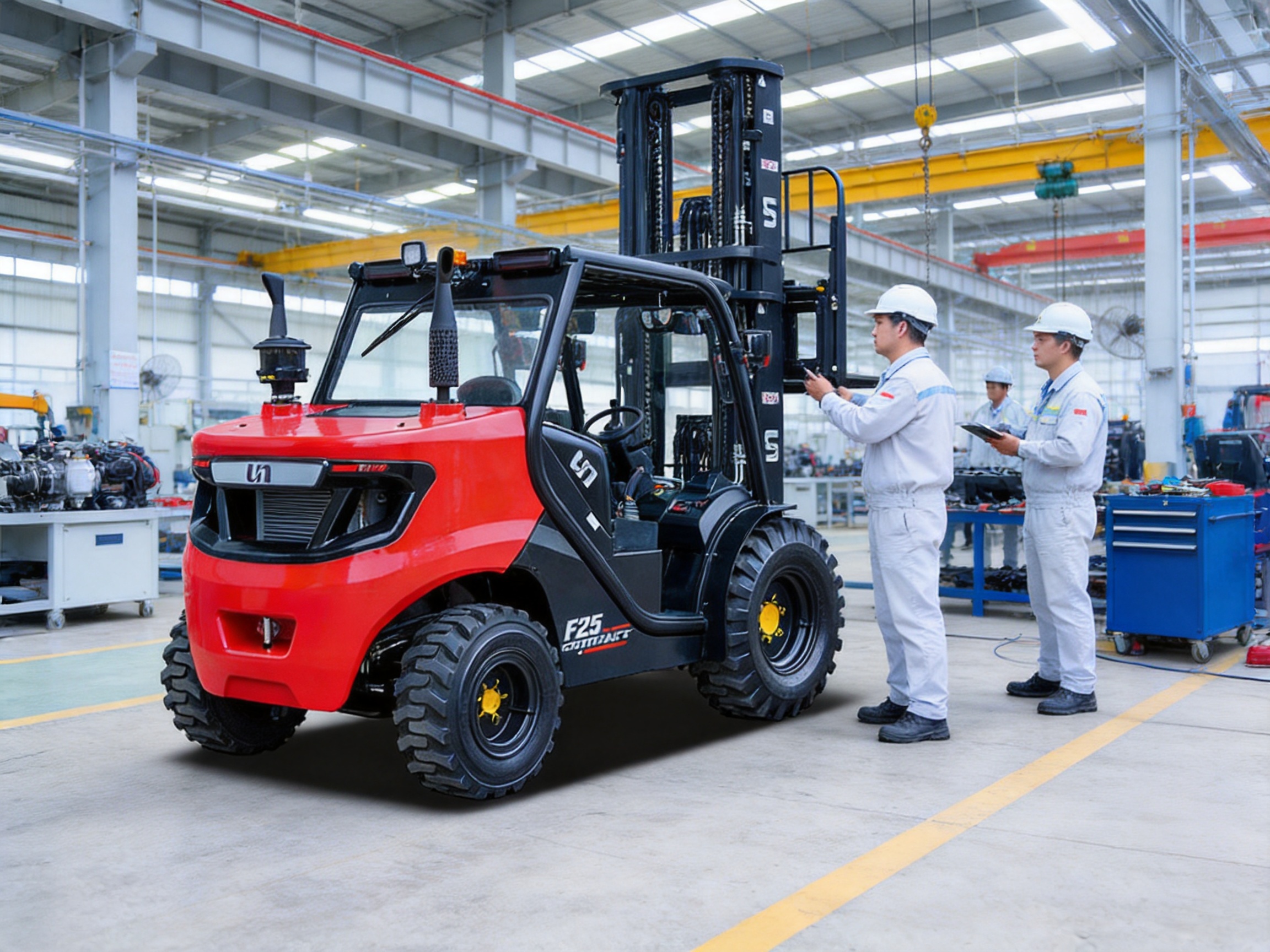
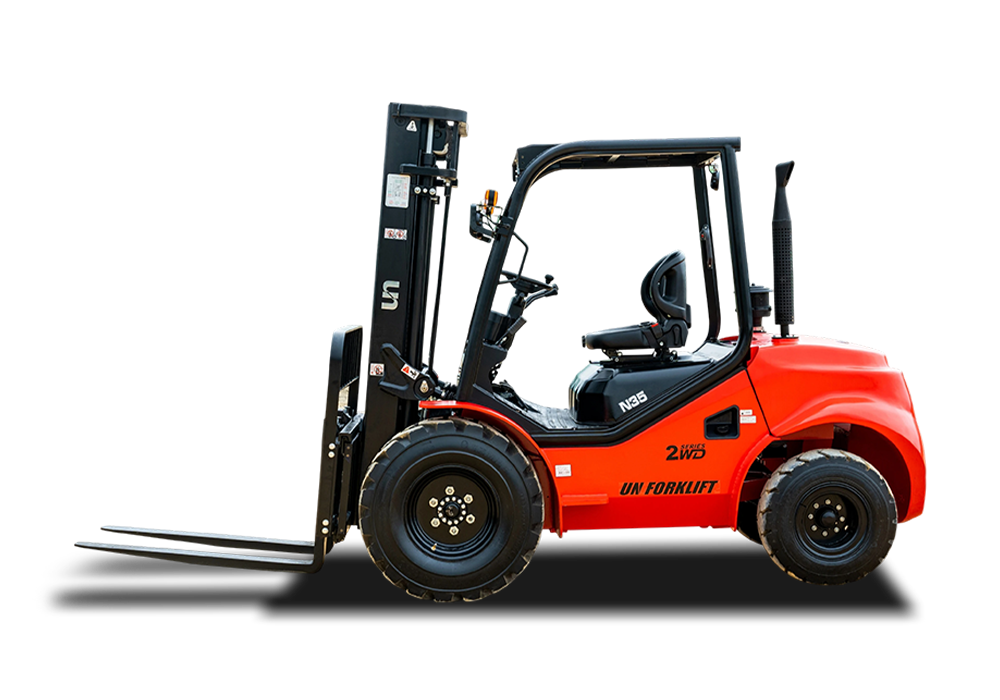
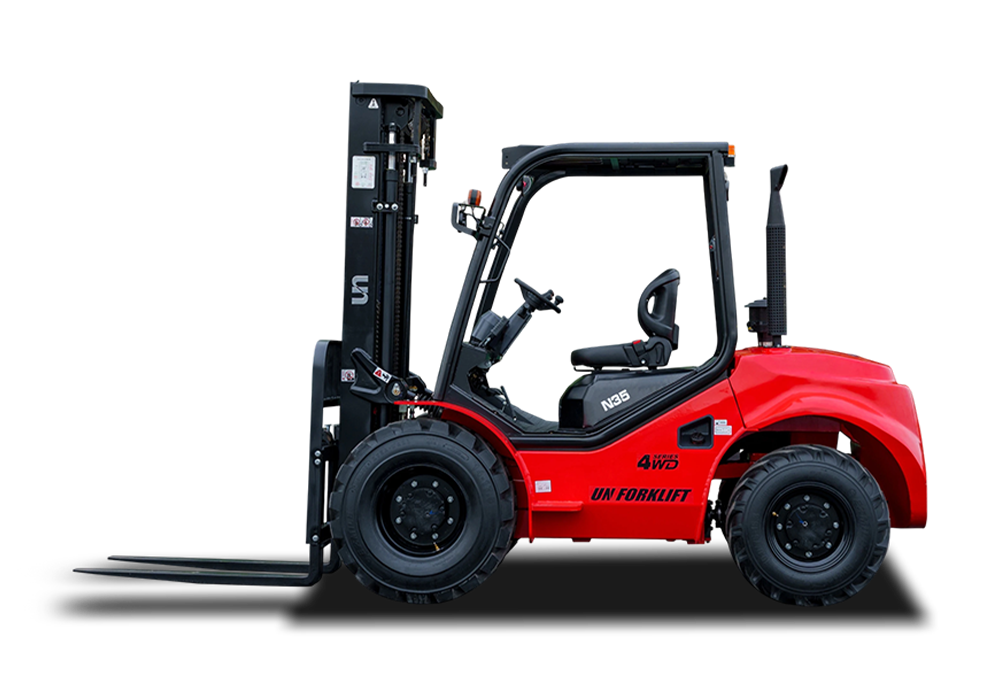
Outdoor material handling demands more than lifting capacity. A forklift working on construction sites, farms, industrial yards, stations, ports, basements, and unfinished surfaces must combine traction, stability, maneuverability, visibility, and reliable control. It must also fit into areas where a conventional rough-terrain forklift may be too large. The F Series 2.5T 2WD and 4WD Rough Terrain Forklift is designed for precisely this balance: strong off-road capability in a compact package suitable for height- and space-limited environments.
With a rated load capacity of 2,500 kilograms and a 500-millimeter load center, this diesel-powered forklift is positioned as a versatile solution for businesses that need to move palletized goods, construction materials, agricultural products, equipment, and other heavy loads across mixed terrain. Its hydrostatic transmission, selectable two-wheel-drive and four-wheel-drive modes, high ground clearance, compact dimensions, and practical operator protection make it suitable for demanding applications where ordinary warehouse forklifts cannot perform effectively.
1. The Need for a Compact Rough-Terrain Forklift
Traditional indoor forklifts are optimized for smooth concrete floors, narrow aisles, and predictable operating conditions. Their tires, ground clearance, steering systems, and chassis layouts are usually not intended for loose gravel, mud, sloped ground, uneven pavement, or outdoor construction areas. A conventional forklift may lose traction, suffer damage to its undercarriage, or become difficult to control when it leaves the warehouse.
Large rough-terrain forklifts address many of these problems, but they can introduce another challenge: size. A large machine may be difficult to maneuver between buildings, inside workshops, beneath low structures, around agricultural facilities, or through restricted access points. It may also require a wider turning area and more storage space. For contractors and operators who work in several locations, a machine that offers off-road strength without excessive bulk can deliver greater overall productivity.
The F Series compact design addresses this market gap. It combines the elevated clearance, robust tires, and traction required for outdoor work with dimensions that remain manageable in confined locations. The result is a forklift that can transition between outdoor and semi-indoor operations without requiring a separate machine for every work area.
Its compact configuration is particularly valuable for users who frequently move between construction sites, warehouses, production plants, loading areas, service yards, and agricultural facilities. Instead of choosing between an indoor forklift with limited terrain capability and a large off-road forklift with restricted maneuverability, operators can use one machine that is designed to perform across a broader range of conditions.
2. Core Product Profile
The forklift is powered by diesel and offers a rated capacity of 2,500 kilograms. Its 500-millimeter load center follows a common industrial handling standard and provides a clear basis for evaluating load stability. The rated lift height is 3,300 millimeters, while the mast lowered height is listed at 2,360 millimeters. These dimensions allow the machine to handle common pallet-stacking and loading operations while remaining suitable for many low-clearance work areas.
The overall width is approximately 1,450 millimeters, and the overhead guard height is approximately 1,990 millimeters. With a wheelbase of about 1,900 millimeters and a turning radius of approximately 3,380 millimeters, the forklift is designed to deliver a useful combination of longitudinal stability and maneuverability. The total machine weight is listed at approximately 4,230 kilograms.
The standard fork dimensions are 1,070 millimeters in length, 122 millimeters in width, and 40 millimeters in thickness. These forks are suitable for many common pallets and industrial loads. The fork carriage width is approximately 1,200 millimeters, supporting stable load engagement while maintaining the compact proportions of the machine.
| Specification | Value |
|---|---|
| Rated load capacity | 2,500 kg |
| Load center | 500 mm |
| Rated lift height | 3,300 mm |
| Mast lowered height | 2,360 mm |
| Overhead guard height | 1,990 mm |
| Overall width | 1,450 mm |
| Wheelbase | 1,900 mm |
| Turning radius | Approximately 3,380 mm |
| Total weight | Approximately 4,230 kg |
| Transmission | Hydrostatic transmission |
| Drive modes | 2WD and 4WD |
| Fuel tank capacity | 50 liters |
These figures should always be reviewed together with the applicable load chart, attachment specifications, ground conditions, and local safety requirements. The actual lifting capacity may change depending on lift height, load center, attachment weight, mast configuration, and operating conditions.
3. Hydrostatic Transmission and Drive Control
One of the most important technical advantages of the F Series is its hydrostatic transmission. Instead of relying on a conventional stepped mechanical transmission, hydrostatic drive transfers engine power through hydraulic components. This arrangement supports stepless speed regulation and allows the operator to make smooth changes in travel speed without repeatedly shifting through multiple gears.
Stepless control is especially helpful when the forklift is approaching a pallet, positioning a load, traveling across an uneven surface, or operating near people and structures. The operator can adjust movement more precisely, reducing sudden acceleration and minimizing unnecessary drivetrain shock. In applications requiring frequent forward and reverse changes, hydrostatic operation can also help simplify the driving process.
The forklift provides both two-wheel-drive and four-wheel-drive modes. A one-button switching system enables the operator to select the drive configuration according to the terrain and task. Two-wheel drive can be used when the surface is firm and traction demand is moderate. Four-wheel drive can be selected when the machine encounters loose soil, gravel, mud, slopes, wet ground, or other conditions where additional traction is needed.
This selectable approach offers an important advantage over machines designed around only one drive mode. Permanent four-wheel drive can provide excellent traction, but it may not always be necessary on firm surfaces. A fixed two-wheel-drive system can be efficient on hard ground but may be limited when conditions deteriorate. The ability to select the appropriate mode helps the operator balance traction, maneuverability, and operating efficiency.
The listed travel speed is approximately 19 kilometers per hour in two-wheel drive and 10 kilometers per hour in four-wheel drive under full-load conditions. Without a load, the listed speeds are approximately 21 kilometers per hour in two-wheel drive and 12 kilometers per hour in four-wheel drive. These values provide practical mobility between work zones while preserving controlled movement during heavy-load handling.
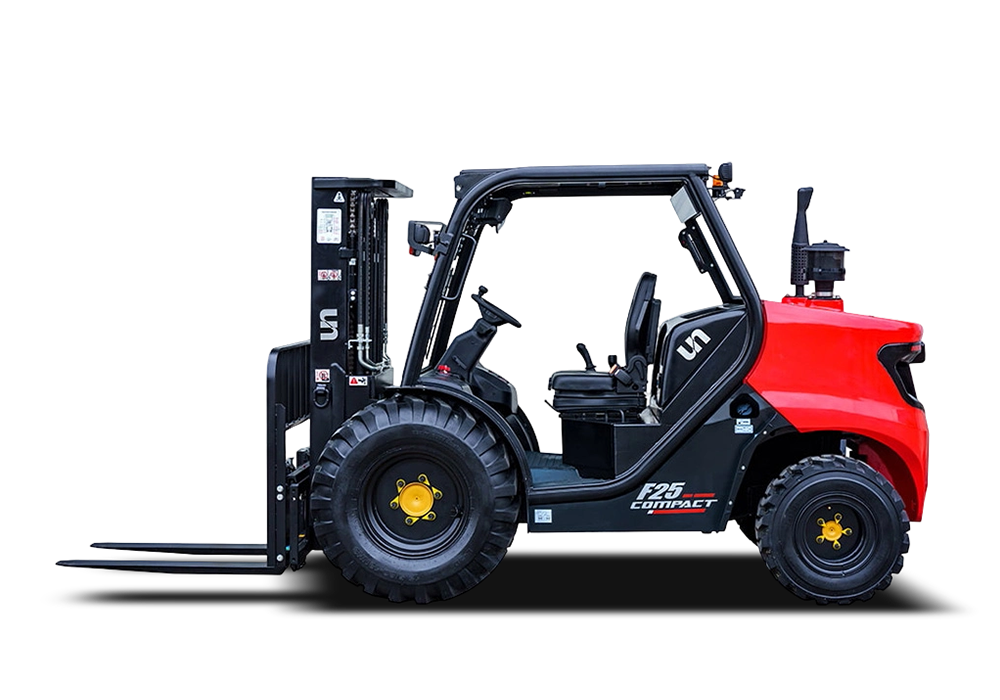
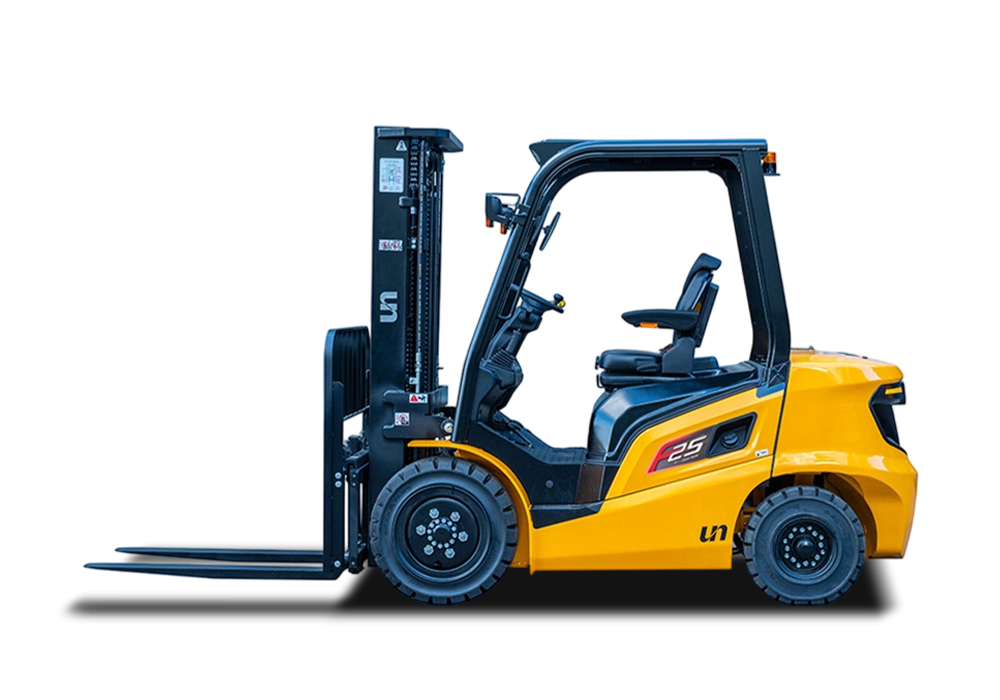
F Series 2.5T 2WD&4WD Rough Terrain Forklift(Compact)
4. Off-Road Capability and Chassis Design
Rough-terrain performance depends on more than engine power. A forklift must have sufficient clearance, appropriate tires, a stable chassis, effective steering, and a structure capable of absorbing repeated impacts. The F Series provides approximately 300 millimeters of ground clearance below the mast and approximately 310 millimeters at the center of the wheelbase. This clearance helps reduce the risk of the chassis contacting raised ground, construction debris, ruts, or uneven surfaces.
The front tires are specified as 12.5/80-18 NHS 14PR, while the rear tires are specified as 27x10-12 NHS. These industrial pneumatic tires are intended to support outdoor operation and provide a larger contact profile than many standard warehouse forklift tires. Their construction is suitable for applications where the machine must travel over surfaces that may contain loose aggregate, compacted soil, rough pavement, or minor obstacles.
The maximum gradeability is listed at 50 percent under the stated full-load and no-load conditions. Gradeability is influenced by surface friction, tire condition, load distribution, slope length, moisture, and operating technique. Nevertheless, the specification demonstrates that the forklift is engineered for challenging gradients rather than flat indoor floors alone.
Maximum drawbar pull is listed at 38 kilonewtons with a full load and 30 kilonewtons without a load in the supplied specification. This traction capability is valuable when moving across inclines or starting from a stationary position on difficult terrain. It also supports the movement of loads over surfaces where rolling resistance is higher than on smooth concrete.
The chassis must maintain stability while the machine travels over uneven ground and carries an elevated load. The forklift’s wheelbase, counterweight, mast assembly, axle arrangement, and load center are designed as an integrated system. Operators should still keep loads low during travel, drive at an appropriate speed, avoid sudden steering movements, and follow the manufacturer’s load chart and operating instructions.
Compared with many standard industrial forklifts, the F Series offers greater ground clearance and more suitable tire equipment for outdoor work. Compared with larger rough-terrain models, its compact width and shorter overall proportions can make it easier to position in restricted spaces. This combination is one of its principal competitive strengths.
5. Engine Options and Power Delivery
The product information identifies engine configurations based on recognized industrial diesel platforms. One configuration uses a Yanmar 4TNE98 engine meeting a Euro 3 emission level, while another configuration is identified with a D24 engine meeting a Euro 5 emission level. The feature description also references Yanmar Stage III and Hyundai Stage V engine solutions. Engine availability may vary according to market, regulatory requirements, and customer configuration.
The listed engine power figures are approximately 43.7 kilowatts and 48.2 kilowatts. Rated engine speeds are listed at approximately 2,300 revolutions per minute and 2,600 revolutions per minute, while the stated torque values provide the low-speed pulling force required for off-road work. Engine displacement is listed at approximately 3,318 cubic centimeters for the larger configuration and 2,392 cubic centimeters for the other configuration.
For a rough-terrain forklift, engine selection must support more than high travel speed. The power unit must deliver dependable torque at low and medium engine speeds, operate reliably under changing loads, and work effectively with the hydraulic and hydrostatic systems. The F Series powertrain is configured to support lifting, driving, steering, and traction demands in a single integrated machine.
Emission compliance is increasingly important for contractors, logistics companies, rental fleets, and industrial users. A machine configured with a higher-emission-standard engine can be better suited to markets with strict environmental rules. The availability of different engine solutions allows the product to be adapted to different regional requirements rather than forcing every customer into one specification.
Diesel power remains valuable for outdoor operations because it supports long working periods, rapid refueling, and strong continuous performance. In locations without convenient charging infrastructure, a diesel rough-terrain forklift can offer greater operational flexibility than an electric alternative. The 50-liter fuel tank further supports extended work cycles between refueling operations.
6. Hydraulic Performance and Load Handling
Load handling accuracy depends on the hydraulic system, mast design, operator controls, and overall machine stability. The F Series has a listed operating pressure of approximately 18.5 megapascals. The lifting speed is approximately 0.4 meters per second with a full load and 0.5 meters per second without a load.
These values support productive loading and unloading cycles without placing excessive emphasis on speed alone. A forklift used in construction or agriculture must lift smoothly and maintain control as the load rises. Smooth hydraulic movement can reduce load sway, improve positioning, and help protect fragile materials.
The lowering speed is specified as no more than approximately 0.6 meters per second with a full load and at least approximately 0.3 meters per second without a load, according to the supplied data. Operators should use the controls progressively and maintain awareness of the load’s center of gravity throughout the lifting and lowering process.
The load-sensing steering system is another important feature. A load-sensing hydraulic arrangement can provide steering assistance in response to demand, helping allocate hydraulic flow efficiently. The result is a steering system that can support responsive control without unnecessarily consuming available hydraulic power.
For users comparing the F Series with basic rough-terrain forklifts, the combination of hydrostatic travel, load-sensing steering, and controlled hydraulic lifting provides a more refined operating experience. It can reduce the effort required for repetitive handling and allow the operator to make more precise movements in restricted work zones.
7. Operator Visibility and Ergonomics
Operator comfort directly affects productivity and safety. Rough-terrain work often involves vibration, repeated starts and stops, uneven surfaces, changing weather, and long operating periods. A poorly designed operator station can increase fatigue, reduce concentration, and make precise handling more difficult.
The F Series includes a semi-closed cabin configuration. A semi-closed cabin offers a degree of protection from wind, dust, and weather while maintaining a practical relationship with the outside environment. Depending on the selected configuration, additional cabin options may be available for customers requiring greater enclosure or climate control.
The fully suspended cabin is designed to reduce vibration and shock transmitted from the chassis to the operator. This is especially useful when traveling across gravel, rough pavement, compacted soil, or uneven construction surfaces. The suspension seat further supports operator comfort by reducing vibration and helping to alleviate fatigue.
The seat may be equipped with an operator presence system as an option. Such systems are intended to help prevent certain machine functions from being used when the operator is not correctly seated. The availability and exact operation of this feature should be confirmed for the selected market configuration.
Spacious legroom allows the operator to change position more naturally and access the controls without unnecessary restriction. A wide-view mast improves visibility toward the forks and load, while a wide-angle rearview mirror supports awareness of the surrounding work area. These features are particularly valuable when the forklift is working near buildings, vehicles, stored materials, or pedestrians.
The overhead guard height of approximately 1,990 millimeters contributes to the compact profile of the machine. Operators must confirm that the selected forklift configuration can safely pass through the lowest clearance in the intended work area. The compact height can be an advantage in workshops, stations, basements, and other locations where taller equipment cannot operate.
Compared with many larger rough-terrain forklifts, the compact F Series can provide a clearer fit for restricted environments. Compared with small indoor forklifts, it offers more substantial ground clearance and outdoor-oriented tires. This balance allows operators to maintain productivity when work conditions change throughout the day.
8. Safety and Reliability Features
Safety is built into the product through a combination of structural protection, control systems, visibility aids, and emergency functions. The semi-closed cabin and overhead guard help protect the operator from weather and falling objects within the limits of the applicable safety standard. The suspended seat and cabin are intended to reduce the effects of vibration during travel.
An emergency disconnect switch is provided to enable rapid interruption of the machine’s power system when required. A lockable disconnect switch can completely shut off the power, helping prevent unauthorized operation and supporting safe maintenance procedures. Operators and maintenance personnel should use these switches in accordance with the official operating manual and site safety rules.
The electronic parking brake provides one-button control and is designed for precise engagement. This arrangement can make parking procedures simpler and reduce the risk of incomplete brake application. As with every parking system, the operator should stop on a suitable surface, lower the forks, place the controls in the required position, and follow the manufacturer’s instructions.
LED front and tail working lights improve illumination in low-light conditions. Lighting is important for early morning operations, evening shifts, warehouses with limited natural light, and construction sites where visibility may change rapidly. A rear camera display is also available to improve rearward awareness when reversing or maneuvering in confined areas.
Safety features are most effective when combined with operator training. The machine should be inspected before each shift, including tires, forks, mast components, hydraulic lines, steering, brakes, lights, mirrors, alarms, and safety switches. Loads should be secured and within the rated capacity. Travel routes should be evaluated for slopes, overhead obstacles, soft ground, and pedestrian traffic.
The F Series supports a safer operating environment by giving the operator better information and more predictable control. Hydrostatic speed regulation helps reduce abrupt movement, the camera and mirrors assist visibility, and the parking and disconnect systems provide additional control over machine status.
9. Maintenance-Oriented Design
Ease of maintenance has a direct effect on fleet availability. A forklift that is difficult to inspect or service may spend more time out of operation and require greater labor input. The F Series includes design features intended to provide service access while preserving the compact structure of the machine.
The 90-degree seat folding backrest allows technicians or operators to access components beneath the seat more conveniently. This can simplify routine inspection and service tasks in the engine, hydraulic, electrical, or transmission areas. A forward-tilting overhead guard is available as an option, providing additional access to upper components where the configuration permits.
Routine maintenance should include checking engine oil, coolant, hydraulic oil, fuel filters, air filters, battery connections, tire pressure, wheel fasteners, mast rollers, chains, forks, and hydraulic hoses. The correct service intervals, fluid grades, tightening torques, and inspection methods must be taken from the official maintenance documentation.
Hydrostatic systems require clean hydraulic fluid and proper filtration. Contamination can affect pumps, motors, valves, and control performance. Operators should avoid opening hydraulic circuits in dirty environments and should use approved replacement filters and fluids. Any sign of leakage, unusual noise, delayed travel response, or abnormal heating should be investigated promptly.
Rough-terrain tires also deserve special attention. Uneven wear may indicate incorrect pressure, axle alignment issues, excessive load, or unsuitable operating conditions. Damaged tires can reduce traction and stability, particularly on slopes or loose ground. Regular inspection helps preserve the machine’s performance and reduces the risk of unexpected downtime.
The maintenance-oriented design gives the F Series an advantage over machines that prioritize compactness without considering service access. Good access can reduce inspection time, improve fault detection, and help fleet managers maintain consistent operating reliability.
10. Applications Across Multiple Sites
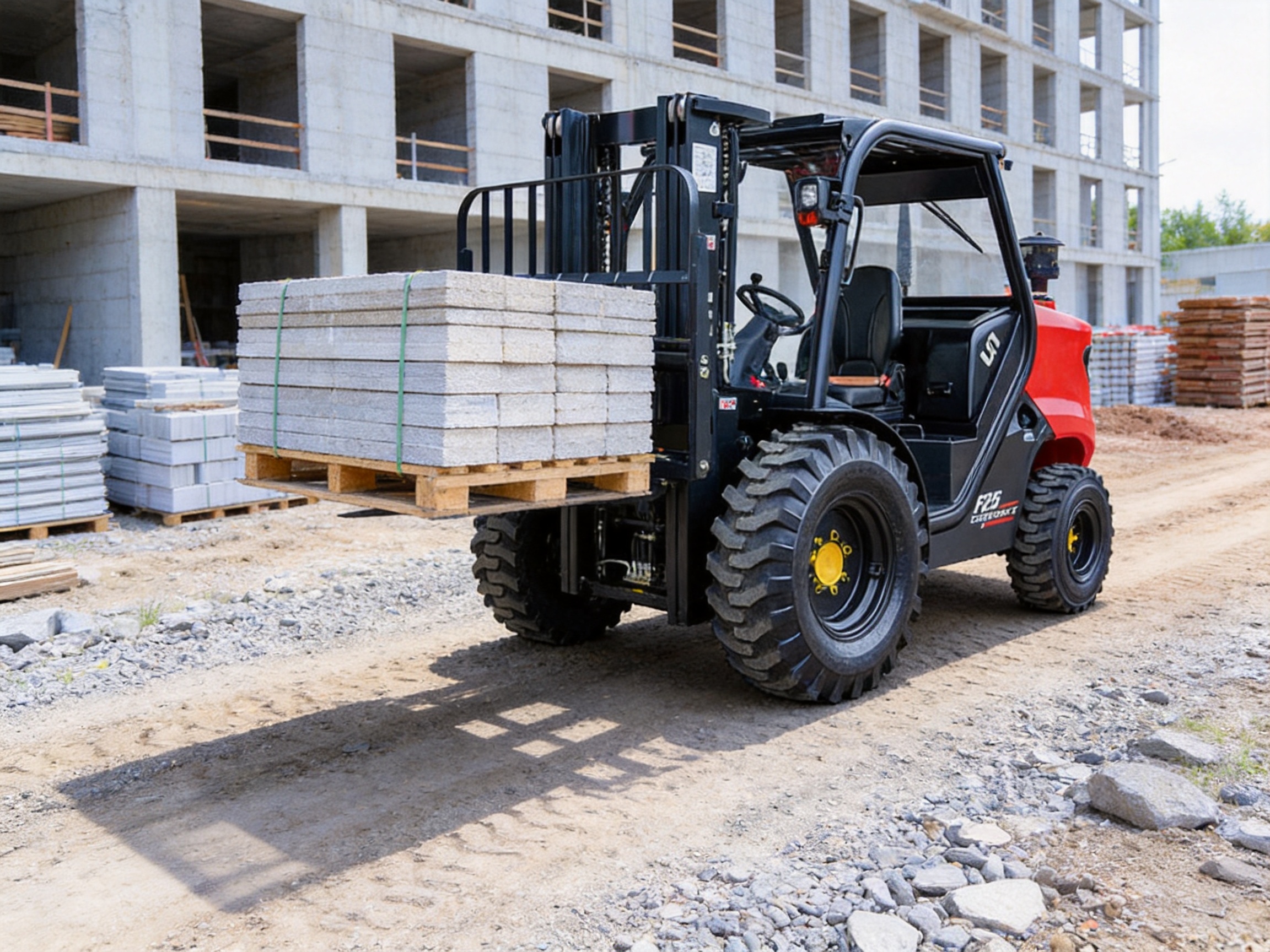
The forklift is designed for multiple-site application rather than one narrowly defined duty. In construction, it can transport bricks, steel components, pipes, timber, cement products, tools, and packaged materials across unfinished surfaces. Its high ground clearance, pneumatic tires, and four-wheel-drive mode help it operate where ordinary warehouse equipment may be unsuitable.
In agriculture, the machine can move feed, fertilizer, seed, produce, containers, and equipment between storage buildings and outdoor work areas. Agricultural surfaces can change significantly with weather, and the ability to select four-wheel drive can provide useful traction when conditions become wet or soft.
In rescue and emergency support operations, a compact rough-terrain forklift can help move supplies, barriers, generators, construction materials, and other heavy equipment. The machine’s ability to travel across imperfect ground and work in restricted locations can be important when access routes are temporary or congested.
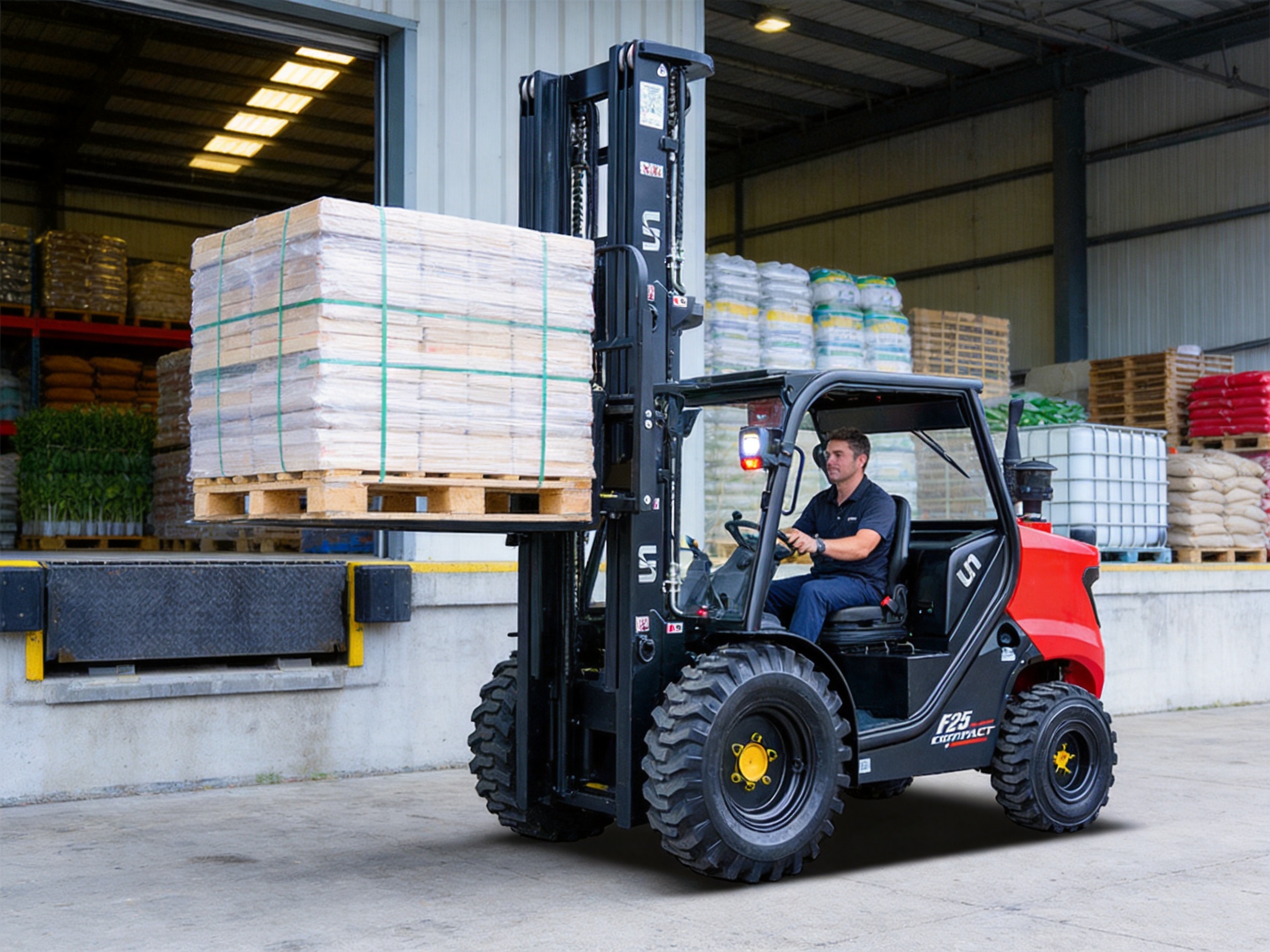
Factories and warehouses may also benefit from the forklift when outdoor yards, loading docks, storage areas, and production spaces are connected. The compact dimensions allow it to move through areas that may be inaccessible to a larger off-road forklift, while the rough-terrain equipment provides a higher level of flexibility than a typical indoor model.
Other suitable environments include basements with appropriate ventilation, stations, wharves, harbors, service yards, and material storage areas. Diesel operation requires strict attention to ventilation and emissions regulations in enclosed or semi-enclosed spaces. Customers should verify local rules before using the machine indoors or underground.
11. Competitive Advantages
The product competes in a category where buyers commonly compare capacity, drive configuration, dimensions, engine performance, reliability, safety, and purchase cost. Its main competitive advantage is the way these characteristics are combined rather than the presence of one isolated feature.
Compact dimensions with genuine off-road capability
Many small forklifts are designed primarily for indoor surfaces and do not provide sufficient clearance or traction for outdoor operations. Many larger rough-terrain forklifts can handle difficult ground but require more space to turn and maneuver. The F Series is positioned between these two groups, offering a 2.5-ton capacity in a compact chassis with outdoor-oriented tires and selectable 2WD and 4WD operation.
Flexible drive selection
The one-button transition between two-wheel drive and four-wheel drive gives the operator a practical response to changing terrain. This is more adaptable than a fixed drive arrangement and can help the machine move efficiently between firm surfaces and difficult ground.
Precise hydrostatic control
Hydrostatic transmission supports stepless speed regulation and smooth forward and reverse operation. In comparison with basic mechanical systems, this can make close positioning and low-speed handling easier, especially when loading materials near structures or other equipment.
Improved operator environment
The suspended cabin, suspension seat, wide-view mast, wide-angle mirror, spacious legroom, LED lights, and rear camera display create an operator station designed for extended and varied work. These features help distinguish the machine from basic utility forklifts that may provide limited protection or visibility assistance.
Adaptable engine configurations
Multiple engine and emission configurations support regional requirements. Customers can select a suitable power unit based on local regulations, fuel availability, service support, and expected operating conditions. This adaptability is useful for international distributors and fleet operators working across different markets.
Service access and fleet practicality
The folding seat backrest and optional tilting overhead guard support routine access. A design that considers maintenance can help reduce downtime over the machine’s working life and provide better value than a product judged only by its initial purchase price.
12. Manufacturing Strength and Engineering Capability
The manufacturer, Zhejiang UN Forklift Co., Ltd., is an established material handling equipment producer integrating research and development, production, sales, and service. Founded in 1978, the company operates from a facility covering approximately 53,400 square meters and has an annual production capacity of approximately 15,000 units.
This scale provides several advantages in product development and manufacturing. A broad production base can support dedicated engineering teams, specialized assembly areas, quality-control systems, component testing, and structured after-sales processes. It also allows the manufacturer to respond to different market requirements across internal combustion, electric, warehouse, and specialized forklift categories.
The company offers a broad portfolio covering multiple product varieties, series, and specifications. Such product breadth encourages the development of shared engineering knowledge in areas including mast design, hydraulic systems, steering systems, counterweight structures, electrical control, operator protection, and powertrain integration.
The manufacturer’s history includes involvement in the development of reach forklift and very-narrow-aisle truck technology. It also holds national patents related to electric forklift technologies and has participated in the formulation of electric forklift industry standards in China. These activities demonstrate experience beyond simple assembly and indicate a continuing investment in engineering and product development.
The company also supplies internal combustion forklifts for international markets and has developed products intended to meet higher emission requirements. Its experience as an original equipment supplier for recognized industrial companies further indicates familiarity with production consistency, technical documentation, customer audits, and quality expectations.
13. Advanced Production Processes
A modern forklift requires coordinated manufacturing processes because its performance depends on the accuracy of many connected systems. The chassis, mast, counterweight, axles, hydraulic components, engine, transmission, electrical systems, and operator protection structure must work together under dynamic loads.
Heavy structural components are typically manufactured through controlled cutting, forming, welding, machining, and surface-treatment processes. The quality of weld preparation, joint penetration, dimensional accuracy, and post-weld inspection affects the durability and alignment of the chassis and mast. Consistent fixtures and process controls help maintain repeatability between units.
Mast production requires particular attention to straightness, roller alignment, chain routing, fork carriage fit, and hydraulic cylinder installation. Small dimensional deviations can affect lifting smoothness, load stability, and component wear. A disciplined assembly process helps ensure that the mast performs consistently throughout its rated operating range.
Painting and surface protection are also important for a machine intended for outdoor work. Proper cleaning, preparation, coating, and curing can improve resistance to moisture, dust, corrosion, and general environmental exposure. A durable finish protects both appearance and the underlying structure, especially when the forklift is used in construction, agriculture, ports, or outdoor storage yards.
Powertrain integration requires the engine and hydrostatic transmission to be installed with correct alignment, mounting, cooling, hydraulic, electrical, and control connections. Factory testing can identify abnormal vibration, leakage, overheating, control irregularities, or inconsistent travel response before delivery to the customer.
Hydraulic testing is essential for a forklift because lifting, lowering, steering, and attachment functions depend on controlled fluid pressure and flow. Inspection may include pressure verification, leakage testing, control response evaluation, and functional testing under representative loads. These checks support stable lifting performance and help protect the operator and load.
Electrical and safety systems require their own verification. Emergency disconnect switches, parking brake controls, lighting, camera displays, operator presence systems, and other safety-related functions should be tested during production and final inspection. A reliable manufacturing process treats these components as essential operating systems rather than optional accessories.
14. Quality Control and Product Validation
Product quality is best established through multiple inspection stages rather than a single final check. Incoming component inspection helps verify that engines, tires, hydraulic parts, steel components, electrical devices, and other assemblies meet specified requirements. In-process inspection then confirms that manufacturing steps are completed correctly.
Dimensional checks can verify the alignment of the mast, axle, chassis, fork carriage, and protective structures. Torque control helps ensure that critical fasteners are tightened correctly. Visual and non-destructive inspection methods may be applied to structural welds according to internal procedures and applicable standards.
Functional testing evaluates the complete machine. The forklift can be checked for starting performance, travel response, steering, braking, lifting, lowering, mast tilt, parking brake operation, emergency disconnection, lighting, camera function, and instrument performance. Testing under simulated or actual load conditions provides additional information about stability and hydraulic response.
Durability validation may include repeated lifting cycles, braking tests, steering tests, vibration evaluation, thermal checks, and operation on different surfaces. The exact methods vary according to the manufacturer’s quality system and the destination market. The objective is to confirm that the machine can perform consistently rather than merely operate once under ideal conditions.
Documentation is another important part of manufacturing strength. Clear specifications, manuals, parts information, maintenance schedules, load charts, and safety instructions help distributors and end users operate the forklift correctly. For international customers, documentation and technical support are especially important because local operators may require training and service guidance.
15. Environmental and Energy Considerations
Diesel rough-terrain forklifts remain important for applications requiring long working hours, high traction, and rapid refueling. At the same time, customers increasingly consider fuel consumption, emissions, noise, maintenance, and total environmental impact when selecting equipment.
The manufacturer has developed new-energy forklift products, including diesel-to-lithium-ion conversion solutions and standard lithium-ion battery forklifts. Although the F Series model described here is diesel-powered, this broader development direction demonstrates an effort to address changing energy requirements across the material handling industry.
For the diesel forklift itself, efficient operation depends on selecting the correct drive mode, avoiding unnecessary idling, maintaining proper tire pressure, servicing filters and fluids, and matching the machine to the application. Hydrostatic control can support smooth operation, while the appropriate engine configuration can help satisfy regional emission rules.
Customers should evaluate the complete operating cycle rather than focusing only on fuel type. A diesel machine may be the most practical option for remote construction or agricultural work, while an electric forklift may be better for indoor applications with charging infrastructure. The manufacturer’s broad product portfolio allows users to select equipment according to the actual duty cycle.
16. Buying Considerations for Fleet Operators
Before purchasing the forklift, fleet managers should identify the heaviest planned load, the load center, the required lift height, the narrowest operating area, the steepest slope, the surface conditions, and the number of working hours per day. These factors determine whether the 2.5-ton capacity and compact dimensions are appropriate.
The customer should also confirm the engine and emission configuration available in the target country. The product information includes different engine references and emission levels, so the final quotation should clearly state the engine model, regulatory compliance, accessories, cabin configuration, lighting package, tire specification, and warranty terms.
Attachment requirements should be reviewed carefully. Side shifters, fork positioners, clamps, buckets, rotators, and other attachments change the machine’s effective capacity and may alter the load center. The attachment weight must be included in the capacity calculation, and the manufacturer should approve the selected attachment and mounting interface.
Site access is another important consideration. The overall width, overhead guard height, mast lowered height, turning radius, and overall length should be compared with doors, ramps, aisles, loading platforms, and storage areas. A compact forklift can be highly productive only when its dimensions are compatible with the actual worksite.
After-sales support should be evaluated alongside the initial purchase price. Access to filters, tires, hydraulic components, engine parts, technical manuals, service technicians, and operator training can have a major effect on long-term ownership cost. The manufacturer’s worldwide sales and service network, supported by partners in Europe, South America, North America, Africa, and Asia, is intended to provide international customer support.
17. Recommended Operating Practices
Operators should complete a pre-shift inspection before starting work. The inspection should include the forks, mast chains, hydraulic cylinders, hoses, tires, wheel nuts, steering, brakes, lights, mirrors, camera, seat, seat belt, emergency disconnect, parking brake, and warning devices. Any defect that may affect safety should be reported and corrected before the machine is used.
Loads should be centered on the forks and positioned as close to the mast as practical. The operator should verify the load weight and dimensions before lifting. Loads that are unusually long, high, unstable, or liquid-filled may require special handling procedures or an approved attachment.
During travel, the forks should be kept low while maintaining adequate ground clearance. The operator should reduce speed on slopes, uneven ground, wet surfaces, and blind corners. Four-wheel drive should be selected when additional traction is needed, but drive mode selection does not eliminate the need for controlled speed and careful route planning.
When parking, the operator should lower the forks fully, place the controls in the required neutral or park position, apply the electronic parking brake, switch off the engine, and remove the key or secure the machine according to site procedures. On slopes, additional precautions may be required. Maintenance should be performed only by trained personnel using appropriate isolation procedures.
18. Q&A
What is the rated capacity of the forklift?
The rated load capacity is 2,500 kilograms at a 500-millimeter load center, subject to the applicable load chart and configuration. Actual capacity can vary with lift height, attachment weight, load position, mast type, and operating conditions.
Is the forklift suitable for outdoor construction work?
Yes. The forklift is designed for rough-terrain applications and includes high ground clearance, pneumatic industrial tires, selectable four-wheel drive, strong drawbar pull, and a diesel powertrain. It is suitable for construction, agriculture, rescue, yards, and other outdoor operations when used within its rated limits.
Can it operate in a warehouse?
It can work in suitable warehouses and industrial facilities, particularly where the floor and ventilation conditions are appropriate. The compact width and approximately 1,990-millimeter overhead guard height can help it operate in restricted areas. Customers must verify clearance, emissions regulations, floor capacity, and ventilation before indoor use.
What is the benefit of two-wheel drive and four-wheel drive?
Two-wheel drive is appropriate for firm surfaces and can support efficient movement and maneuverability. Four-wheel drive provides additional traction on loose, wet, sloped, or uneven terrain. The operator can select the mode according to the working conditions.
What type of transmission does it use?
The forklift uses a hydrostatic transmission with stepless speed regulation. This supports smooth travel, precise low-speed control, and convenient forward and reverse operation.
What engine options are available?
The supplied information identifies configurations using Yanmar and other industrial diesel engine platforms, including engine options associated with Euro 3, Euro 5, Stage III, and Stage V requirements. Availability depends on the destination market and final customer specification.
How high can the forklift lift?
The listed rated lift height is 3,300 millimeters. Other mast configurations may be available depending on the project requirements, and the selected mast should be confirmed before ordering.
How does the forklift support operator comfort?
The product includes a suspended cabin, suspension seat, spacious legroom, wide-view mast, wide-angle rearview mirror, and other ergonomic features. These systems are intended to reduce vibration, improve visibility, and support comfortable operation during long shifts.
What safety equipment is included?
Safety-related features include an emergency disconnect switch, lockable power disconnect, electronic parking brake, LED front and tail lights, rear camera display, semi-closed cabin, and optional operator presence technology. The final equipment list depends on the selected configuration.
Is maintenance access convenient?
The 90-degree seat folding backrest allows access to components below the seat. A forward-tilting overhead guard is available as an option to improve access to upper components. Regular maintenance must follow the official service schedule and use approved parts and fluids.
What industries can use this model?
Potential applications include construction, agriculture, rescue operations, manufacturing, warehousing, stations, wharves, harbors, storage yards, and other complex work environments. The best application depends on the site, load, surface, operating hours, and local regulations.
Where can customers obtain more information?
Customers should contact the manufacturer or an authorized distributor for current specifications, pricing, engine availability, attachments, load charts, delivery schedules, service support, and market-specific compliance information.
19. Conclusion
The F Series 2.5-ton compact rough-terrain forklift is designed for operators who need more versatility than a conventional warehouse forklift can provide, but who do not want the size and restricted maneuverability of a very large off-road machine. Its combination of 2WD and 4WD operation, hydrostatic transmission, high ground clearance, pneumatic tires, diesel power, compact dimensions, and practical operator protection creates a balanced solution for mixed indoor and outdoor material handling.
Its competitive value comes from integration. The machine does not rely on a single headline specification. Instead, it brings together useful capacity, controlled travel, strong traction, ergonomic design, safety systems, service access, and adaptable engine configurations. These characteristics make it suitable for contractors, agricultural businesses, industrial operators, rental fleets, logistics companies, and organizations that require dependable handling across changing sites.
The manufacturer’s long industrial history, integrated research and development capability, broad product portfolio, international service network, and experience with both internal combustion and new-energy equipment provide additional support for the product. Controlled structural fabrication, hydraulic testing, powertrain integration, functional inspection, and ongoing engineering development contribute to a more complete manufacturing foundation.
For buyers, the final decision should be based on the complete application: load chart, lift height, terrain, clearance, attachment, operating hours, emission requirements, service availability, and total cost of ownership. When properly configured and operated, the compact rough-terrain forklift offers a practical way to improve mobility, productivity, and equipment utilization across demanding work environments.
References
1. Product specification materials for the F Series 2.5T 2WD and 4WD Compact Rough Terrain Forklift.
2. Manufacturer technical information concerning hydrostatic transmission, selectable drive modes, load-sensing steering, operator protection, and maintenance access.
3. Manufacturer company profile and corporate history, including production capacity, research and development activities, product portfolio, and international service network.
4. General principles of industrial truck capacity evaluation, load centers, mast stability, attachment selection, and safe material handling.
5. General guidance on rough-terrain forklift operation, pre-shift inspection, slope travel, load positioning, and workplace safety.
6. General engineering practices for forklift structural fabrication, hydraulic testing, drivetrain integration, quality inspection, and preventive maintenance.
Product: F Series 2.5T 2WD&4WD Rough Terrain Forklift(Compact)
For exclusive deals and latest offers, sign up by entering your email address below.
Stay In Touch
ADDRESS : NO.1 ROAD ONE, XINDENG NEW DISTRICT, FUYANG, HANGZHOU, ZHEJIANG, CHINA 311404.
PHONE : +86-571-8688 8355 (AMERICA)
PHONE : +86-571-8886 9363 (EUROPE)
PHONE : +86-571-8688 8377 (ASIA, AFRICA, OCEANIA)
EMAIL : [email protected]
EMAIL : [email protected](PARTS INQUIRY)

