


 中文简体
中文简体 Français
 русский
 Español
 عربى
عربى Deutsch



Gas Forklift Guide: Performance, Fuel Options, Emissions, and Buying Tips
Admin 2026-09-03A regional distribution center in Ohio replaced three aging diesel forklifts with LPG models in early 2026. The operations manager noticed three changes immediately: cold-start hesitation disappeared, the indoor staging area no longer smelled of diesel exhaust, and refueling still took under five minutes per shift. That experience mirrors a broader pattern across the material handling industry. Gas forklifts, especially those running on LPG, remain a practical first choice for operations that need real lifting capacity without the charging downtime of electric trucks.
For loads in the 1.5 to 5.0 ton range, a gas forklift often delivers the best combination of purchase price, daily running cost, and uptime. The engine is less complex than an electric drivetrain, the fuel system is simpler than modern diesel aftertreatment, and the refueling routine takes minutes. The real question is not whether gas makes sense for your fleet, but which gas model, fuel type, and emissions package fits your site and duty cycle.
What a Gas Forklift Actually Includes
A gas forklift is an internal combustion truck powered by liquefied petroleum gas (LPG, typically propane), gasoline, or compressed natural gas (CNG). LPG dominates the market because it is stored as a liquid under moderate pressure, converts to vapor through a regulator, and leaves fewer carbon deposits than gasoline. Gasoline models still serve regions where petrol is inexpensive and LPG filling points are scarce. CNG forklifts exist but carry heavy high-pressure tanks that reduce maneuverability, so they remain uncommon.
The powertrain resembles a small vehicle engine: cylinders, spark plugs, and a governor that holds engine speed steady while the hydraulic pump lifts the load. That constant-speed operation is a detail worth understanding. It gives the operator smooth, predictable lifting and lowering, and it keeps a three-way catalytic converter at a stable temperature, which keeps emissions consistent shift after shift.
Where a Gas Forklift Beats Diesel and Electric
Three variables separate the power-source decision: uptime, exhaust exposure, and duty cycle. Gas forklifts win on uptime because refueling takes three to five minutes, while battery charging takes one to eight hours. They win on exhaust exposure because LPG produces far less particulate matter and odor than diesel, making it acceptable near loading docks and inside ventilated warehouses. They win on duty cycle because a single cylinder runs a 2.5-ton truck for roughly six to eight hours of continuous work, and swapping an empty cylinder for a full one is faster than filling a diesel tank.
| Criterion | Gas (LPG) | Diesel | Electric |
|---|---|---|---|
| Refueling or charging time | 3-5 minutes | 5-10 minutes | 1-8 hours |
| Point-of-use emissions | Low to moderate | High | Zero tailpipe |
| Indoor operation | With ventilation | Not recommended | Yes |
| Typical capacity range | 1.5-5.0 tons | 1.5-10.0 tons | 1.3-5.0 tons |
| Duty cycle | Continuous | Continuous | Battery limited |
| Noise level | Moderate | High | Low |
| Upfront purchase cost | Medium | Medium | High |
Diesel still leads for heavy outdoor work above 5.0 tons and for sites with established diesel refueling infrastructure. Electric leads for indoor-only facilities with light duty cycles and a strict zero-emission requirement. Gas holds the middle because it combines liquid-fuel refueling speed with combustion that is cleaner than diesel. Our side-by-side review of the differences between gas and electric forklifts covers the cost and duty-cycle data in more detail.
Emissions, Ventilation, and Indoor-Use Rules
LPG burns cleaner than diesel, but cleaner does not mean zero. The exhaust still contains carbon monoxide, carbon dioxide, and trace hydrocarbons. Many jurisdictions set the occupational exposure limit for CO near 50 parts per million as an eight-hour time-weighted average, so ventilation is not optional when gas forklifts work indoors. A room with open dock doors may be sufficient; a sealed storage area usually is not.
Modern gas forklifts attack emissions at the source in three ways. A closed-loop fuel system with an oxygen sensor keeps the air-fuel mixture near the stoichiometric ratio. A three-way catalytic converter then removes most of the remaining CO, hydrocarbons, and NOx. And because the engine runs at governed speed, it avoids the rich idle mixtures that older propane trucks produced. If you plan indoor use, confirm that the model carries an emission certification for your region, and check CO levels periodically with a portable monitor.
Noise is a second indoor consideration. An LPG truck at full lift is noticeably quieter than a diesel of the same capacity, which matters on long shifts in enclosed docks, but it is still louder than an electric truck. Facilities with noise-sensitive work areas should account for that difference when planning routes.
Fuel Supply and Storage Requirements
Gasoline, diesel, and CNG forklifts are most practical when refilling stations are conveniently available. The same logic applies to LPG, but with one advantage: the fuel is portable. A forklift cylinder can be swapped in the aisle, so a permanent fueling station is optional for small fleets.
- LPG cylinders must meet regional pressure-vessel standards and be inspected on a fixed schedule; never use a cylinder with visible corrosion or a damaged collar.
- Bulk tanks make economic sense for fleets above five or six trucks, but local codes require separation distances from building openings, drains, and ignition sources.
- Cylinder exchange programs let smaller operations avoid owning a tank altogether; the supplier swaps empty cylinders on a daily or weekly route.
- Gasoline requires standard fuel storage practice: approved safety cans, spill containment, and fire-rated cabinets when stored indoors.
Outdoor use is where gas forklifts show their full strength. They handle rain, dust, and temperature swings better than electric trucks, though extreme cold can reduce LPG vaporization. A liquid-withdrawal system or a tank heater solves most low-temperature problems. Fleet managers often find that a single fueling routine for both indoor and outdoor shifts simplifies scheduling, which is one of the main operational benefits of gas forklifts.
Maintenance and Total Cost of Ownership
Gas forklifts sit between diesel and electric on maintenance. They have more moving parts than an electric motor but fewer than a modern diesel with a particulate filter and selective catalytic reduction system. Predictable intervals are the real advantage.
- Engine oil and filter every 250-500 hours, depending on duty and fuel. LPG burns clean, so oil stays usable for the full interval.
- Spark plugs and air filters are the two components operators check most often; both are inexpensive and quick to replace.
- The vaporizer-regulator and fuel solenoid deserve an annual inspection, since a leaking regulator is the most common gas-specific failure point.
- A valve clearance check every 1,000 hours keeps the engine quiet and prevents gradual power loss.
- Cooling system maintenance matters more than owners expect, because an overheated regulator can deliver liquid rather than vapor to the mixer.
On total cost, gas forklifts typically beat electric on purchase price and beat diesel on fuel and emissions hardware. The trade-off appears when electricity is very cheap and the duty cycle is light, because then the lower energy cost of electric can offset the higher purchase price over a five-year horizon.
How to Match a Gas Forklift to Your Operation
Start with the heaviest load you actually lift, not the average. Add the weight of the attachment and the mast, then choose a rated capacity that leaves a 20 to 25 percent safety margin. Next, verify the mast height against your door openings and racking, because a tall mast is often the limiting factor in a low warehouse.
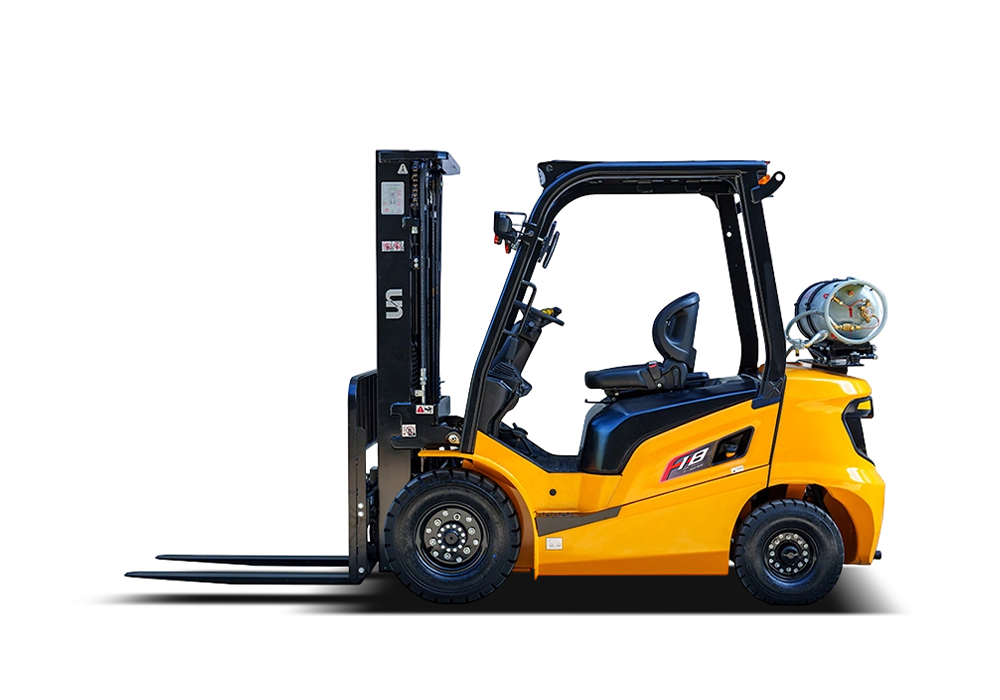
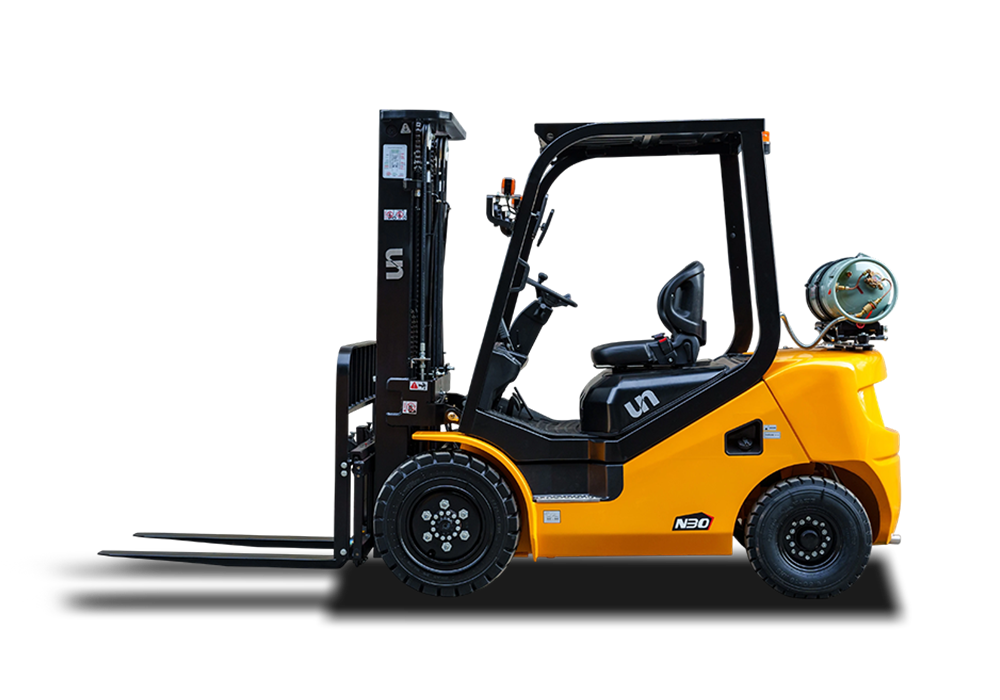
Tire type is the next decision. Pneumatic tires suit gravel yards, uneven docks, and outdoor storage areas. Cushion tires suit smooth concrete floors and give a lower ride height plus a tighter turning radius. For mostly indoor facilities, UN Forklift offers the cushion-tire F-series 2.0-3.2t LPG forklift, which reduces tire wear and improves stability during tight maneuvers.
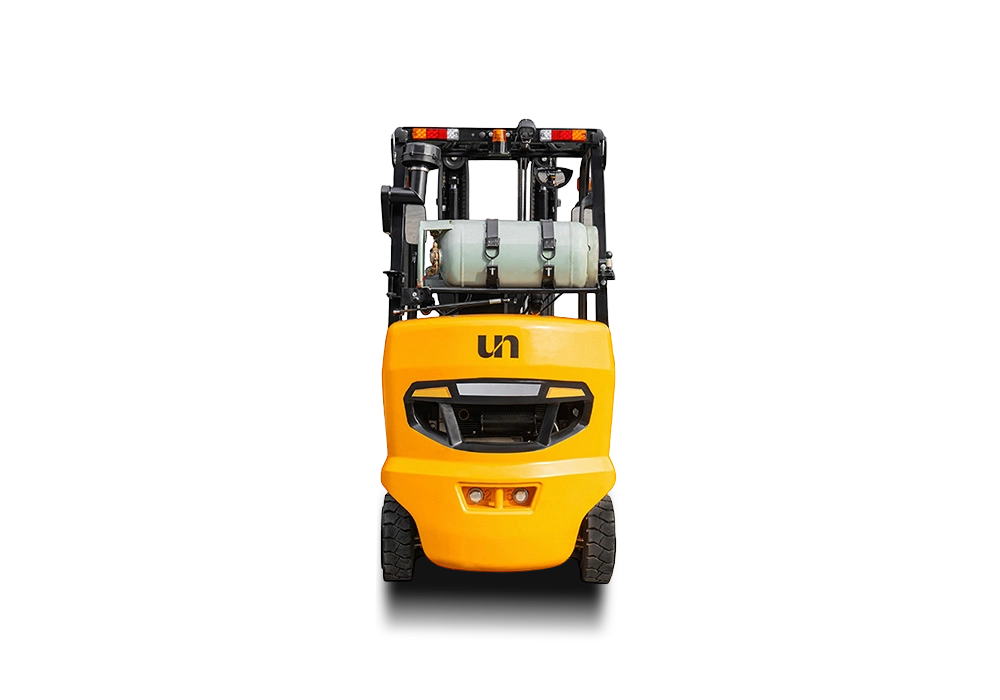 Wholesale F Series 2.0T-3.2T LPG&Gasoline Forklift(Cushion Tire) Factory, SuppliZhejiang UN Forklift Co., Ltd. is China wholesale F Series 2.0T-3.2T LPG&Gasoline Forklift(Cushion Tire) suppliers and factory,The F seri...View Product →
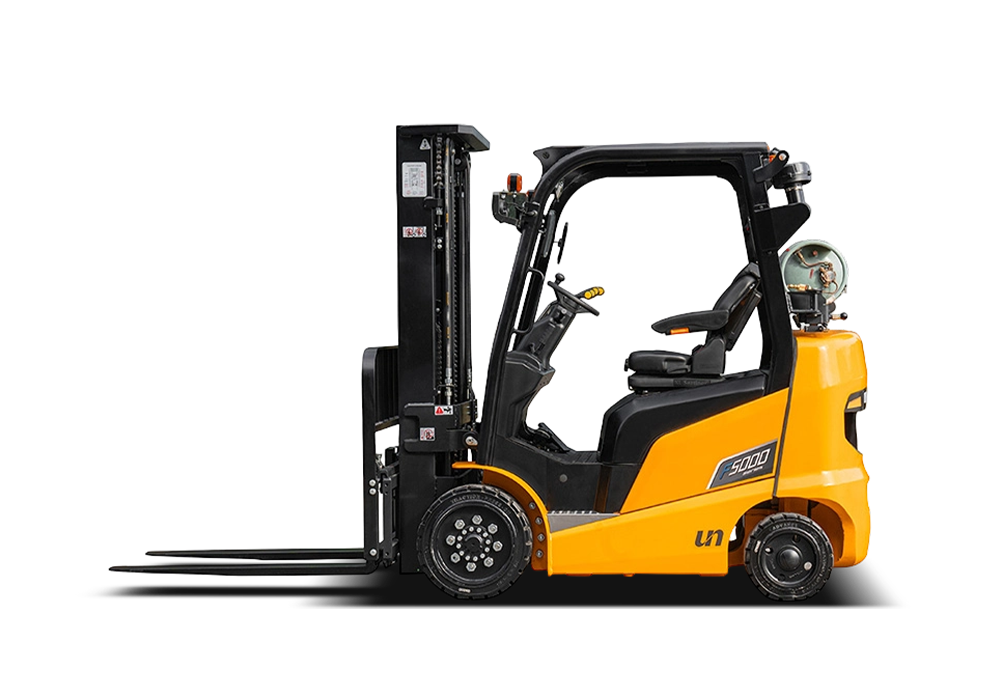
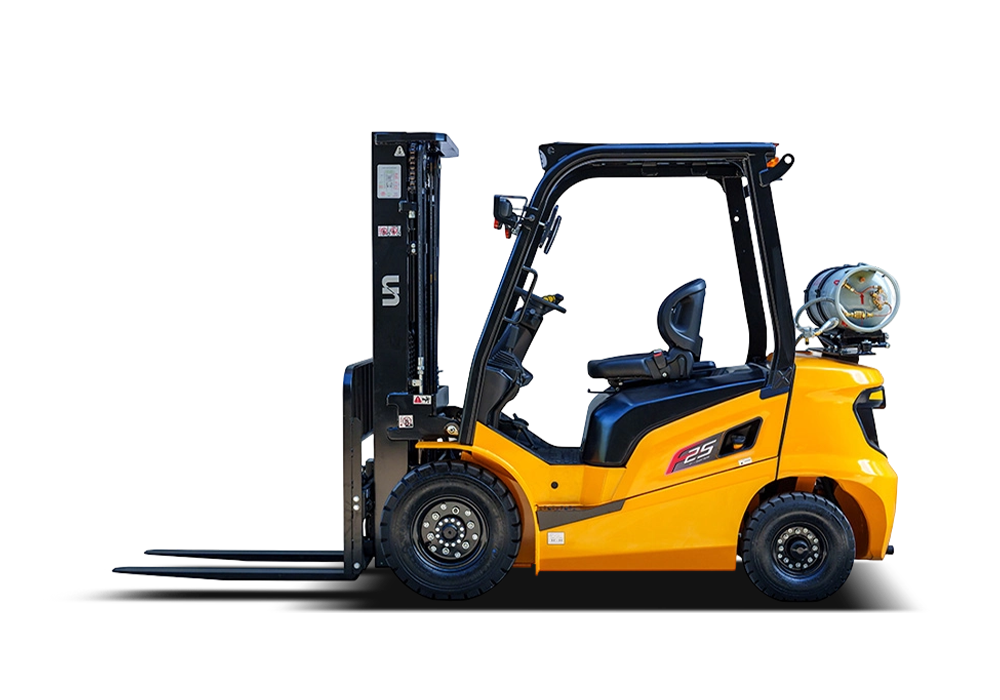
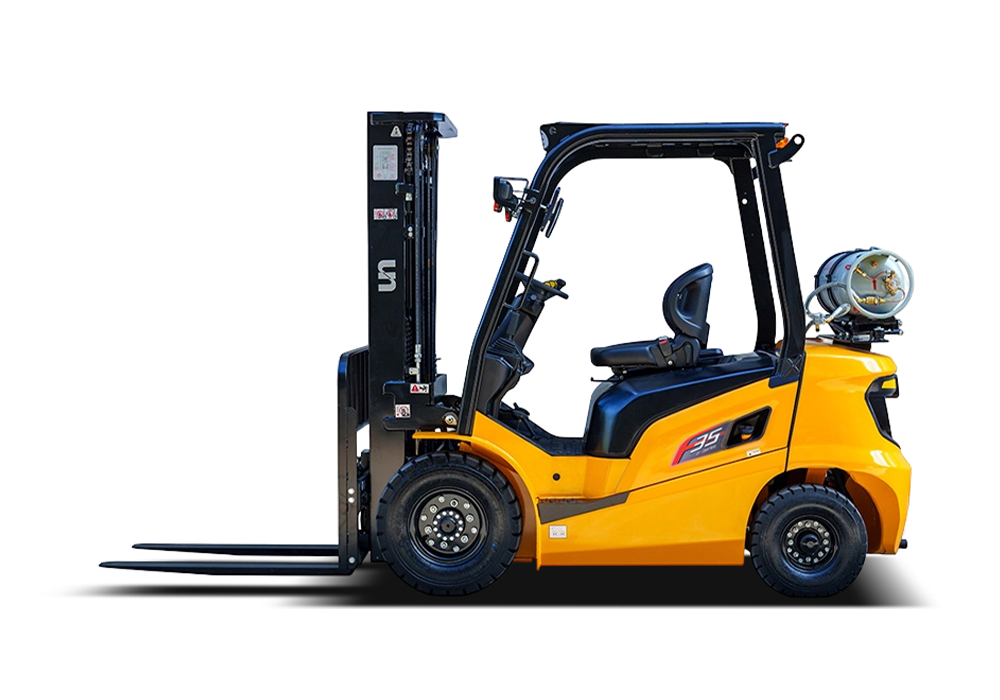
Finally, confirm the gradeability rating if your site has ramps, and check the fuel-tank mounting position for easy cylinder access. In terms of capacity, the F-series 2.0-2.5t LPG gasoline forklift is a practical fit for mixed indoor-outdoor work in food and beverage distribution, where operators want quick refueling and a compact turning radius. For heavier pallet loads and higher stacking duties, the F-series 3.0-3.5t LPG gasoline forklift adds reserve engine power and a larger cooling package for sustained operation.
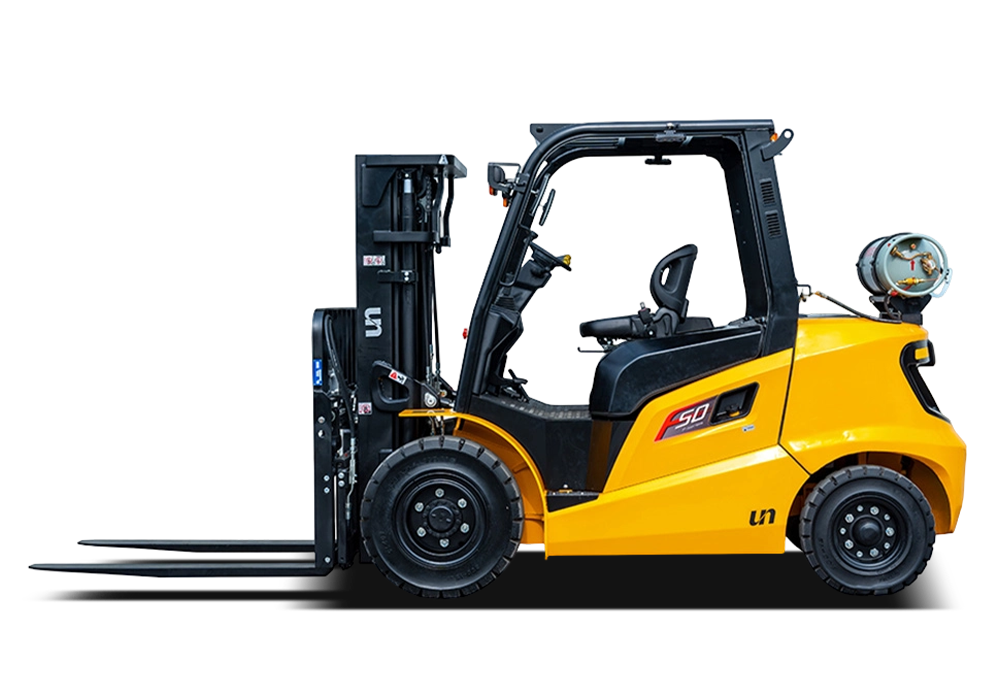
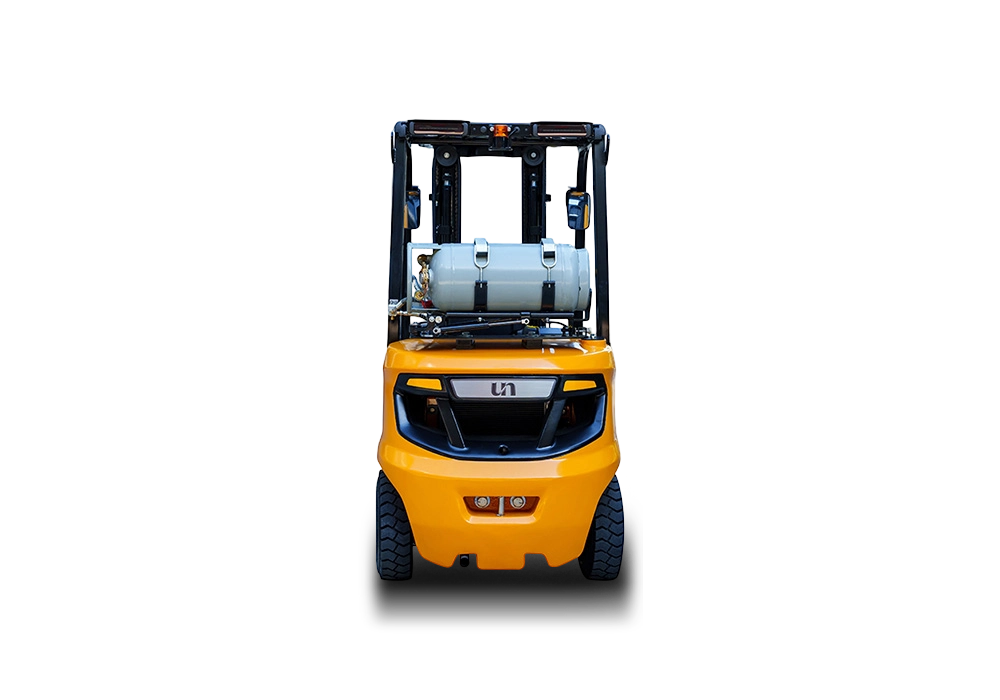 Wholesale F Series 3.0T-3.5T LPG&Gasoline Forklift Factory, Suppliers - ZhejiangZhejiang UN Forklift Co., Ltd. is China wholesale F Series 3.0T-3.5T LPG&Gasoline Forklift suppliers and factory, After years of optimiza...View Product →Wholesale F Series 2.0T-2.5T LPG&Gasoline Forklift Factory, Suppliers - ZhejiangZhejiang UN Forklift Co., Ltd. is China wholesale F Series 2.0T-2.5T LPG&Gasoline Forklift suppliers and factory, After years of continuo...View Product →
A gas forklift remains the right default for many operations because it couples the availability of liquid fuel with emissions low enough for covered workspaces. The key is to match the unit to the actual site: confirm emissions hardware for indoor use, plan the fuel supply route, and size the capacity with a safety margin. Done that way, an LPG truck will usually earn its keep faster than either a diesel or an electric alternative on cost per pallet moved.
For exclusive deals and latest offers, sign up by entering your email address below.
Stay In Touch
ADDRESS : NO.1 ROAD ONE, XINDENG NEW DISTRICT, FUYANG, HANGZHOU, ZHEJIANG, CHINA 311404.
PHONE : +86-571-8688 8355 (AMERICA)
PHONE : +86-571-8886 9363 (EUROPE)
PHONE : +86-571-8688 8377 (ASIA, AFRICA, OCEANIA)
EMAIL : [email protected]
EMAIL : [email protected](PARTS INQUIRY)

