


 中文简体
中文简体 Français
 русский
 Español
 عربى
عربى Deutsch



Heavy-Duty Diesel Forklifts for High-Capacity Material Handling
Admin 2026-09-09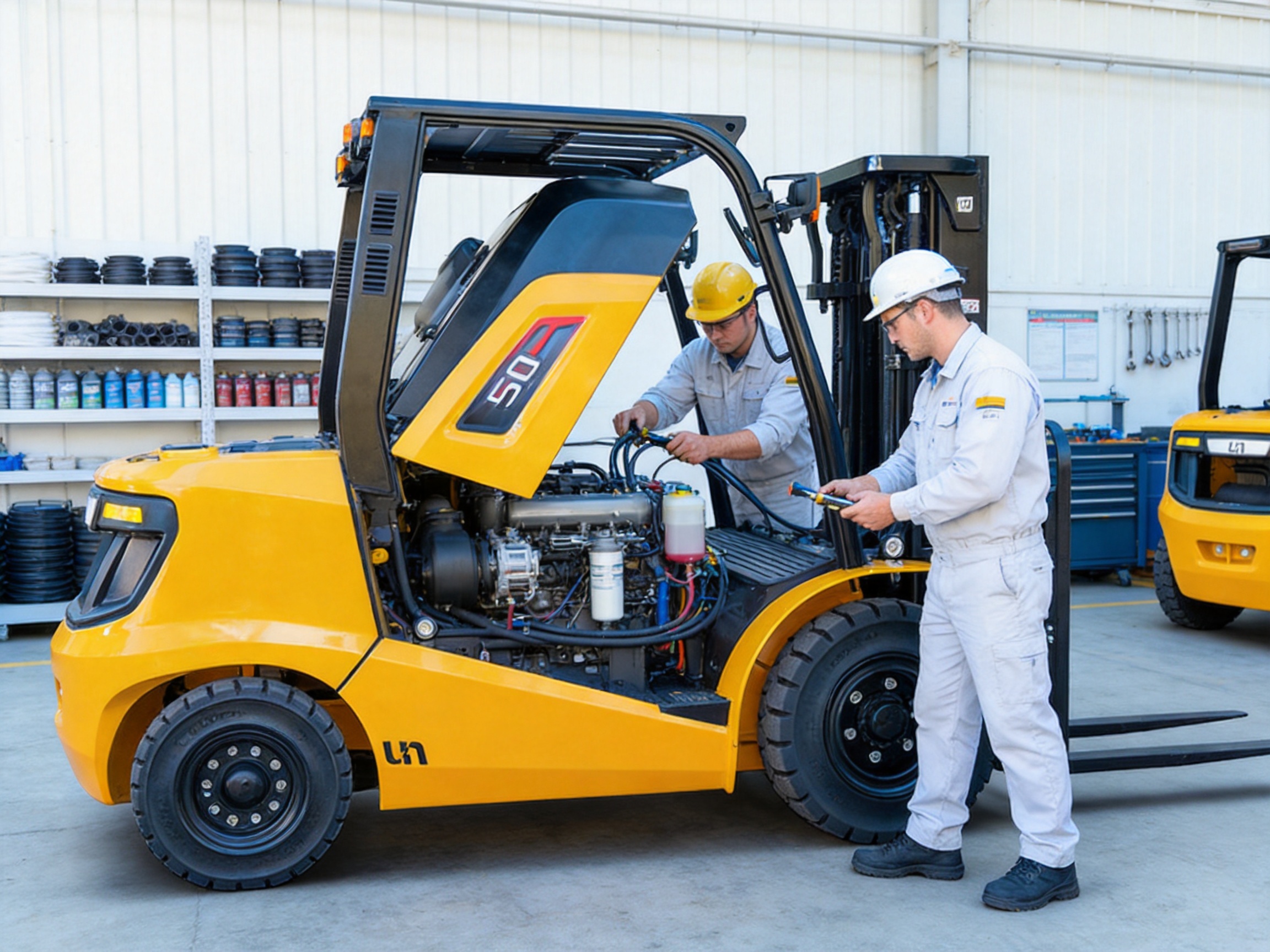
Heavy-duty material handling requires more than a powerful engine and a high rated capacity. A forklift used in manufacturing plants, distribution centers, construction supply yards, timber operations, metal-processing facilities, and outdoor logistics must deliver dependable performance under demanding conditions. It must lift substantial loads safely, travel efficiently, remain stable on uneven working surfaces, and provide operators with a comfortable and productive workplace. At the same time, fleet owners expect reasonable fuel consumption, durable components, simplified maintenance, and reliable technical support throughout the machine’s working life.
The F Series 4.0T–5.0T diesel forklift has been developed to meet these requirements. Designed for intensive internal-combustion applications, the range combines a robust chassis, high-output diesel power, hydraulic efficiency, stability-focused construction, and a comprehensive operator environment. The listed models include the FD45T, FD50T, and FD55T, with rated capacities of 4,500 kg, 5,000 kg, and 5,500 kg respectively at a 500 mm load center. This makes the series suitable for businesses that need more lifting capability than a standard warehouse forklift while still requiring maneuverability and practical operating dimensions.
Manufactured by Zhejiang UN Forklift Co., Ltd., the series benefits from decades of experience in forklift research, production, sales, and service. The company’s development history, manufacturing scale, broad product portfolio, and international supply capabilities provide a strong foundation for producing industrial vehicles for varied markets. The result is a diesel forklift platform intended not only to move heavy loads, but also to support long-term productivity, safety, and operating value.
Designed for Demanding Industrial Applications
Heavy-duty forklifts work in environments where operating conditions are often more difficult than those found in a clean indoor warehouse. Loads may be dense, oversized, irregularly shaped, or difficult to position. Travel routes may include ramps, rough yards, loading docks, and areas exposed to dust, moisture, temperature changes, or debris. In these circumstances, a forklift must maintain its performance over repeated work cycles without excessive downtime.
The F Series addresses these demands through a combination of structural strength and responsive operating systems. The 4.5-ton, 5.0-ton, and 5.5-ton configurations provide flexibility for different load requirements. Fleet managers can select a model that matches their typical payload while retaining a common platform for training, maintenance, and spare-parts planning. This is particularly useful for companies operating several forklifts across production, storage, and loading areas.
The forklifts are powered by diesel engines and use hydraulic transmission systems. Diesel power remains a practical choice for heavy-duty applications because it offers strong torque, extended operating endurance, and fast refueling compared with battery-charging systems. For operations that run multiple shifts or work outdoors, a diesel forklift can avoid long charging interruptions and maintain a high level of availability.
The rated lift height in the standard specification is 3,000 mm, with a free lift height of 150 mm. The mast has a forward and rearward tilt angle of 6 degrees and 12 degrees. These characteristics help operators position loads accurately while maintaining control during stacking, loading, and unloading operations. Optional mast configurations and attachments may be selected according to the application, provided that the final capacity and stability requirements are properly evaluated.
Performance Advantages in Comparison with Conventional Heavy-Duty Forklifts
Many forklifts in the same capacity class offer sufficient lifting power but do not provide the same balance between speed, hydraulic response, structural durability, and operator comfort. A high-capacity machine that moves slowly, turns with difficulty, or requires frequent maintenance may create hidden costs even when its purchase price is attractive. The F Series is designed to compete through total operating performance rather than through rated capacity alone.
Powerful and Durable Diesel Operation
The listed specifications identify the Mitsubishi S6S engine as the power unit. This six-cylinder diesel engine has a rated output of 52 kW at 2,300 revolutions per minute, a rated torque of 248 N·m at 1,700 revolutions per minute, a displacement of 4.996 liters, and a fuel tank capacity of 110 liters. These characteristics give the forklift the reserve power needed for demanding travel, ramp operation, and repeated lifting cycles.
The engine’s torque characteristics are especially important in heavy-load handling. When a forklift starts from a stationary position with several tons on the forks, or climbs a gradient while towing or carrying a load, low-speed torque helps maintain smooth and confident movement. The specified maximum gradeability is 33 percent with a full load and 28 percent without a load. These figures demonstrate that the forklift is intended for industrial environments where level warehouse floors are not the only operating surface.
The engine platform is also suitable for markets that require reliable, serviceable diesel technology. Its conventional configuration allows qualified maintenance personnel to perform routine inspections, filter replacements, fluid checks, and engine servicing using established procedures. The company also identifies Mitsubishi and Kubota engine options as part of its broader product engineering capability, allowing configurations to be matched to market requirements and customer preferences.
High-Speed Ratio Floating Transmission
The F Series uses a high-speed ratio floating transmission to improve travel performance and work efficiency. A floating transmission arrangement helps accommodate operating movement and reduces unnecessary stress on connected components. In daily operation, this can contribute to smoother power delivery, improved driving response, and reduced mechanical shock.
The specified travel speed is 25 km/h with a full load and 26 km/h without a load. For a forklift in the 4.5-ton to 5.5-ton class, this is a useful productivity advantage. Faster travel between the loading point and storage location can shorten cycle times, especially in yards, manufacturing plants, and large distribution facilities. At the same time, speed must always be adapted to load height, surface condition, pedestrian traffic, visibility, and site rules. The forklift’s performance capacity should support productivity without replacing responsible operator control.
Dual-Pump Flow Merging and Load Sensing
Hydraulic performance has a direct effect on lifting speed, attachment response, fuel use, and operator productivity. The F Series incorporates a dual-pump flow-merging system. By combining hydraulic flow when appropriate, the system can improve lifting and attachment response while reducing wasted energy. This is particularly valuable during operations that require simultaneous or repeated hydraulic functions.
The load-sensing system further improves hydraulic efficiency by adjusting system output according to actual demand. Instead of continuously supplying more hydraulic flow than the function requires, the system can help reduce unnecessary energy loss. Lower hydraulic energy waste can support improved fuel economy and reduce heat generation within the hydraulic circuit. Over extended operating periods, these improvements may contribute to lower operating costs and more consistent performance.
Compared with a basic hydraulic arrangement, flow merging and load sensing provide a more refined response. Operators can benefit from smoother control when positioning loads, working with attachments, or performing repetitive stacking tasks. Fleet owners can benefit from a system designed to use power more intelligently rather than relying solely on higher engine output.
Strong Steering Axle and Reduced Turning Radius
Manoeuvrability is a major consideration for a heavy forklift. A machine with a large counterweight and high rated capacity naturally requires careful chassis design to remain stable while turning. The F Series uses an integrated large-turning-cast steering axle. According to the product information, this design increases axle strength by 30 percent and reduces the turning radius.
The listed outside turning radius is 2,930 mm for the FD45T and FD50T, and 2,980 mm for the FD55T. These dimensions help the forklifts work effectively in industrial areas where space is valuable. The minimum aisle width for pallets is listed as 4,690 mm for the smaller configurations and 4,750 mm for the largest configuration, subject to pallet size, load dimensions, mast selection, operator technique, and site layout.
A stronger steering axle is also important when the machine works on uneven ground or carries loads near its maximum rated capacity. Steering components are exposed to repeated impacts, turning forces, and changes in surface condition. Increasing axle strength can support durability and help the forklift maintain predictable handling over a long service life.
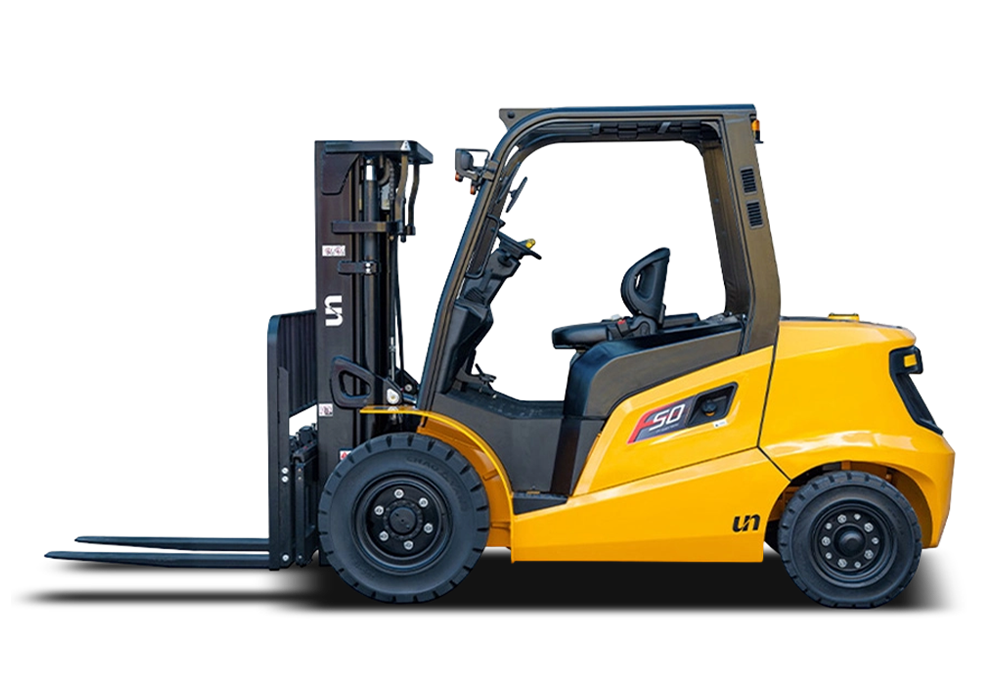
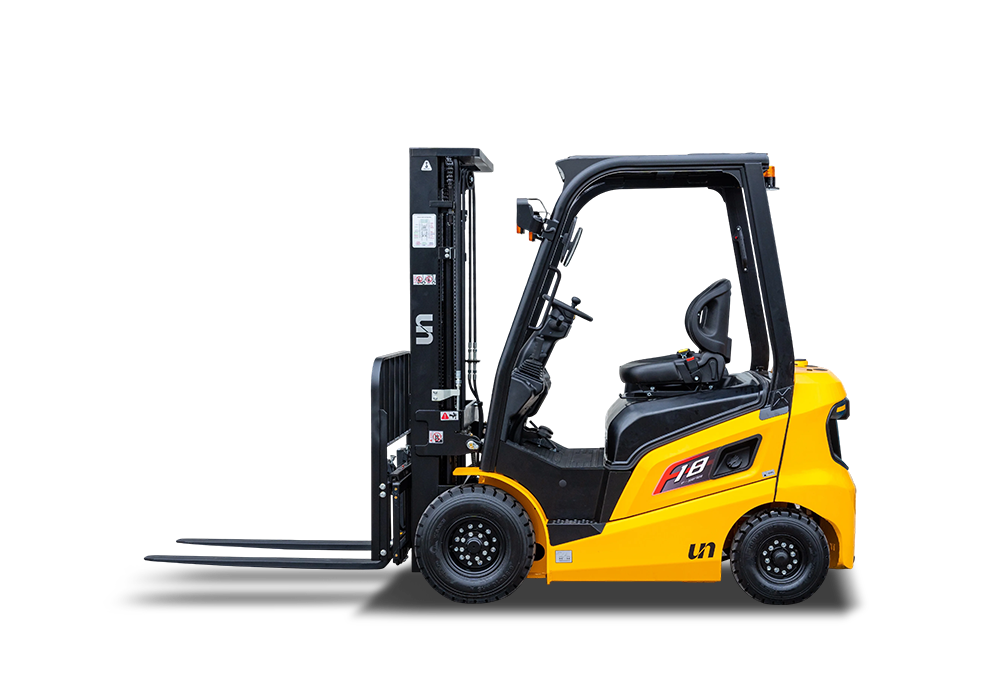
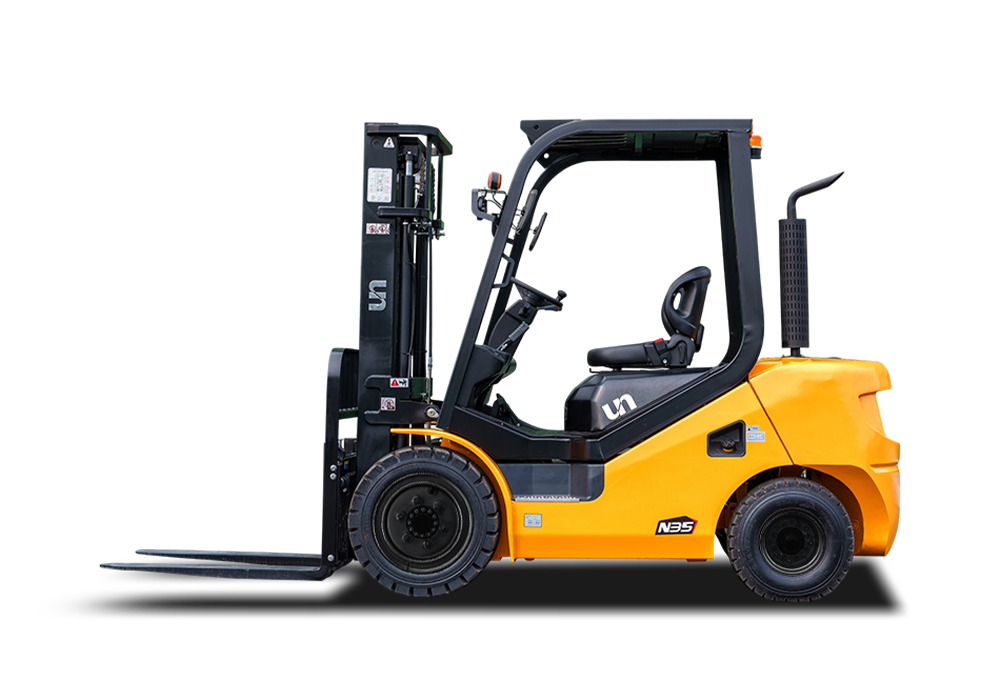
F Series 4.0T-5.0T Diesel Forklift
Safety and Reliability Built into the Machine
Heavy-load operation requires a safety approach that considers the entire vehicle rather than a single protective device. Stability, visibility, braking, structural protection, electrical reliability, hydraulic control, and operator behavior all contribute to safe operation. The F Series incorporates several features intended to support safe and dependable daily use.
Durable Overhead Guard Construction
The stamped overhead guard is designed to provide increased durability and reliability. The overhead guard protects the operator from falling objects and provides a strong protective structure above the driving position. Stamped construction can offer a consistent shape, strong structural characteristics, and clean integration with the forklift frame.
The standard overhead guard height is listed as 2,370 mm, with an alternative figure of 2,260 mm shown in parentheses. Actual clearance should always be confirmed before operating inside a building, container, trailer, doorway, or low-ceiling area. A forklift’s mast height, load backrest, overhead guard, and load itself must all be considered when planning travel routes.
Waterproof Connectors and Joints
Industrial forklifts may be exposed to water, dust, oil, cleaning activities, and changing weather conditions. Electrical connectors and joints are potential points of failure if they are not properly protected. The F Series uses waterproof treatment for key connectors and joints, helping reduce the risk of moisture-related electrical problems.
This design is valuable for outdoor yards, food and beverage logistics, manufacturing environments, and facilities where equipment is frequently washed or exposed to humidity. Waterproofing does not eliminate the need for inspection. Operators and technicians should still check for damaged wiring, loose connectors, corrosion, and contamination during scheduled maintenance. However, protective connector design provides an additional layer of reliability in demanding conditions.
Optional Operator Presence System
An optional OPS, or operator presence system, can help prevent unintended forklift startup. The system is intended to ensure that operating functions are not activated when the operator is not properly positioned at the controls. This type of interlock can reduce the likelihood of accidental movement during entry, exit, or temporary dismounting.
Safety systems work best when combined with formal operator training, seat belt use, pedestrian controls, speed management, load assessment, and routine inspection. The OPS option is therefore a useful part of a wider site safety program rather than a substitute for safe working procedures.
Braking and Parking Control
The forklift features a suspended pedal-type braking system designed to provide smooth braking and reduce vibration. Smooth braking is important when carrying tall, fragile, or unstable loads because abrupt deceleration may cause load movement. Reduced pedal vibration can also improve operator comfort during long shifts.
The ratchet-type handbrake is designed to reduce operating force. A parking brake that is easy to engage correctly supports safer parking practices, particularly on ramps or during loading operations. As with all braking systems, performance depends on regular inspection of brake components, correct adjustment, suitable tires, and responsible operating speed.
Operator-Centered Ergonomics and Productivity
Operator comfort is closely connected to productivity and safety. A driver who experiences excessive vibration, limited visibility, awkward control positioning, or physical fatigue may work more slowly and may be more likely to make an error. The F Series incorporates several ergonomic improvements intended to create a more usable driving environment.
Wide-View Mast
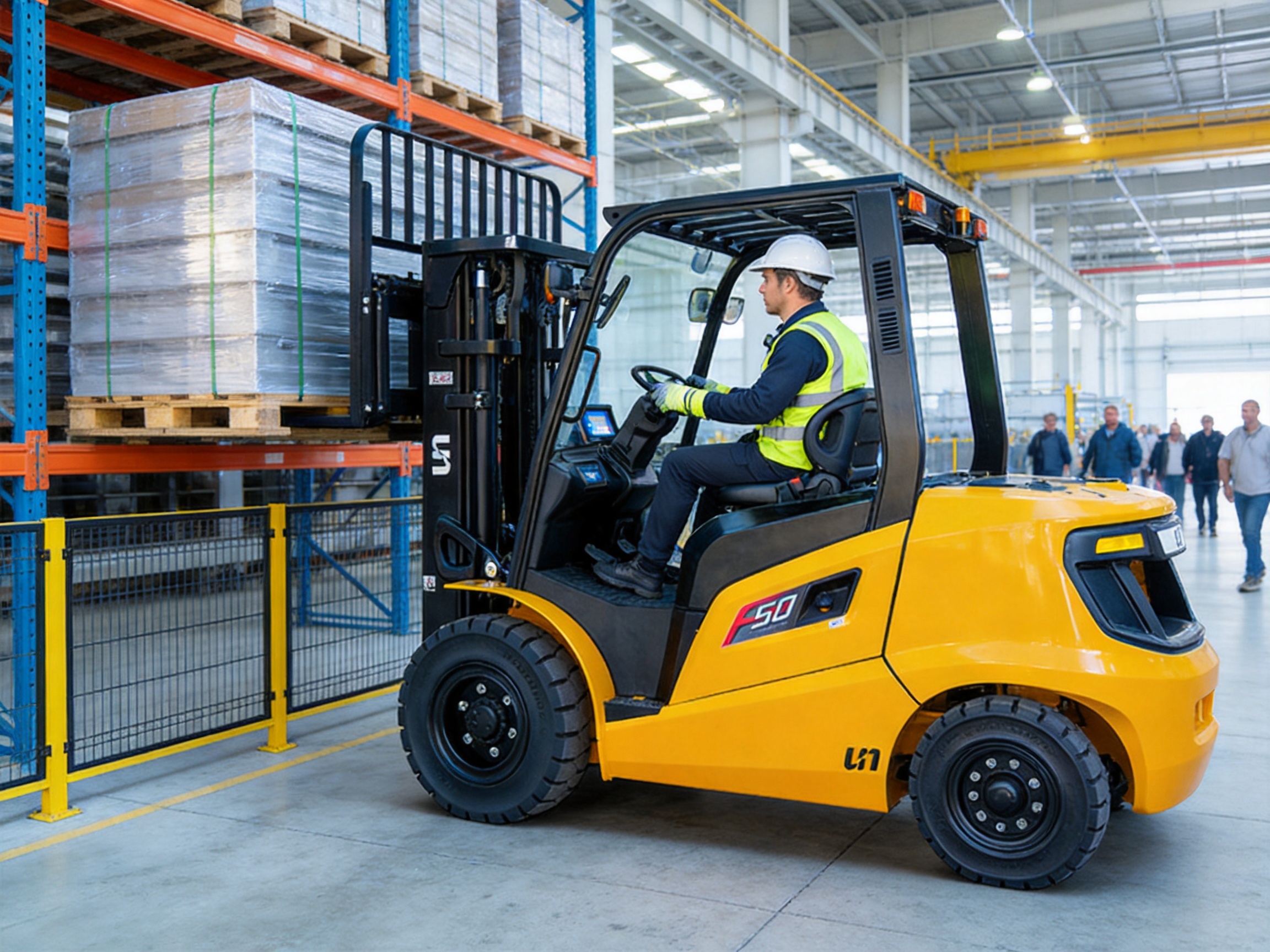
The wide-view mast provides a broader forward view than a design that uses heavier or more obstructive structural elements in the operator’s sightline. Improved visibility helps the operator identify pallet openings, rack positions, pedestrians, load edges, and obstacles. It is particularly useful when the forklift is positioning a load at height or maneuvering in a busy production environment.
Visibility remains dependent on the load size, mast height, backrest, attachment, lighting, and travel direction. Operators should travel in reverse when the load blocks forward visibility, use spotters when required, and follow site-specific traffic rules. The wide-view mast supports these practices by giving the operator a clearer view whenever the load and operating conditions permit.
Adjustable Steering Column and Compact Steering Wheel
The adjustable steering column allows the driver to select a more suitable steering position. Different operators have different body sizes, clothing, preferred postures, and working habits. Adjustment helps reduce awkward shoulder and wrist positions and can make repeated turning maneuvers less tiring.
The smaller steering wheel is intended to make operation more effortless. A compact wheel can reduce the movement required for steering inputs, which is useful in applications involving frequent directional changes. The design should also make it easier for the operator to maintain control while looking toward the load or travel path.
Vibration Reduction
The steering axle uses rubber damping to absorb impacts and improve ride smoothness. In addition, four shock-absorbing mounts are used to reduce overall vehicle vibration. These features are valuable when the forklift operates on concrete joints, outdoor pavement, loading ramps, or other surfaces that transmit impact into the chassis.
Reduced vibration can improve comfort during long shifts and help the operator maintain concentration. It may also reduce stress on selected components, instruments, and connections. Tire condition and inflation remain important because tires form the primary interface between the forklift and the ground. The specified front tires are 300-15-18PR, while the rear tires are 7.00-12-12PR.
Enlarged Operating Space
An enlarged operating space gives the driver more room to enter, exit, adjust position, and operate the pedals and controls. This can be especially useful for heavy-duty forklifts, which may be used for extended shifts and in industrial environments where operators wear protective clothing.
A spacious operator compartment can also support better posture. When the driver can sit comfortably and maintain clear access to the controls, fatigue may be reduced. In practical terms, a comfortable operator is more likely to perform careful load assessments, maintain awareness of surroundings, and use smooth control inputs throughout the workday.
Maintenance Efficiency and Reduced Downtime
Maintenance access is one of the most important factors in the long-term value of an industrial vehicle. Even a reliable forklift requires daily inspections, periodic service, lubrication, filter replacement, fluid checks, and occasional repairs. If service points are difficult to reach, small maintenance tasks can be postponed and minor problems can develop into major failures.
Wide Engine Hood Opening
The engine hood opens to an angle of 80 degrees, providing technicians with broad access to the engine compartment. This makes it easier to inspect belts, hoses, filters, wiring, fluid reservoirs, and other service items. A wide opening can also reduce the time required for routine maintenance and improve the quality of visual inspections.
Technicians should follow the recommended service procedures and ensure that the hood is securely supported before working in the engine compartment. The engine must be switched off, the parking brake engaged, and the forklift positioned safely before maintenance begins.
Detachable Side Panels
Detachable left and right side panels provide additional access to internal components. Side access is useful for inspections that do not require the entire engine hood to be opened. It can also help technicians reach hydraulic, electrical, cooling, and transmission-related components more efficiently.
Easy panel removal supports preventive maintenance. A technician can identify oil seepage, loose fasteners, damaged hoses, or abnormal wear before these conditions affect productivity. For fleet operators, simpler access may reduce labor time and make it more practical to maintain a consistent inspection schedule.
Pin-Mounted Floor Plates
The front and rear floor plates are pin-mounted and detachable. This arrangement provides access to areas beneath the operator compartment and around the drivetrain. Floor plates that can be removed without complex disassembly help technicians examine braking, transmission, hydraulic, and control components more conveniently.
Good maintenance design is especially valuable in multi-shift operations. A forklift that can be inspected and serviced efficiently can return to work sooner, helping reduce downtime and improve fleet availability.
Counterweight Cover Access
The rear counterweight cover provides easier access to the radiator for maintenance. The cooling system is essential for heavy-duty diesel operation because high-load work generates substantial heat. Radiator inspection and cleaning are particularly important in dusty outdoor environments, where debris can restrict airflow.
Accessible radiator maintenance helps technicians keep cooling performance within the intended range. Operators should monitor warning indicators, report overheating symptoms promptly, and avoid continuing to work with a compromised cooling system. Proper cooling-system care protects the engine and supports consistent performance during demanding cycles.
Capacity, Dimensions, and Operating Configuration
The F Series includes three listed models that cover a useful portion of the heavy-duty forklift market. The FD45T is rated at 4,500 kg, the FD50T at 5,000 kg, and the FD55T at 5,500 kg. All three models use a 500 mm load center in the supplied specifications. The actual safe capacity depends on the load center, mast height, attachment, load shape, and operating conditions, so the capacity plate must always be followed.
| Specification | FD45T | FD50T | FD55T |
|---|---|---|---|
| Power type | Diesel | Diesel | Diesel |
| Rated load capacity | 4,500 kg | 5,000 kg | 5,500 kg |
| Load center | 500 mm | 500 mm | 500 mm |
| Length to fork face without fork | 3,265 mm | 3,265 mm | 3,315 mm |
| Overall width | 1,520 mm | 1,520 mm | 1,520 mm |
| Turning radius | 2,930 mm | 2,930 mm | 2,980 mm |
| Travel speed, full load/no load | 25/26 km/h | 25/26 km/h | 25/26 km/h |
| Total weight | 6,510 kg | 6,920 kg | 7,280 kg |
| Engine model | S6S | S6S | S6S |
The common overall width of 1,520 mm helps simplify fleet planning. When a company operates multiple variants, shared dimensions can make it easier to plan travel routes, loading areas, parking locations, and service bays. The FD55T has a slightly longer length and larger turning radius, reflecting its higher capacity and increased structural requirements.
The listed wheelbase is 2,100 mm for all three models. A carefully selected wheelbase contributes to stability while avoiding unnecessary loss of maneuverability. The front tread is 1,232 mm and the rear tread is 1,190 mm. Ground clearance at the bottom of the mast is 140 mm, which supports operation on industrial surfaces while still requiring operators to avoid severe obstacles and unsafe terrain.
The standard lowered mast height is 2,250 mm, and the mast extended height with backrest is listed as 4,250 mm for some configurations and 4,405 mm for others. These dimensions should be considered when planning storage, transport, doorway access, and overhead clearances. The fork sizes include 1,070 mm by 150 mm by 50 mm and 1,070 mm by 150 mm by 55 mm, depending on model and configuration.
Technical Specifications at a Glance
| Category | Specification | Value |
|---|---|---|
| Lift performance | Rated lift height | 3,000 mm |
| Lift performance | Free lift height | 150 mm |
| Lift performance | Mast tilt angle | 6 degrees forward and 12 degrees rearward |
| Performance | Lifting speed, full load/no load | 580/620 mm per second for FD45T and FD50T; 530/580 mm per second for FD55T |
| Performance | Lowering speed | 300–600 mm per second |
| Performance | Maximum drawbar pull, full load/no load | 41/25 kN |
| Performance | Maximum gradeability, full load/no load | 33/28 percent |
| Power | Rated output | 52 kW at 2,300 revolutions per minute |
| Power | Rated torque | 248 N·m at 1,700 revolutions per minute |
| Power | Displacement | 4.996 liters |
| Power | Fuel tank | 110 liters |
| Transmission | Type | Hydraulic |
| Transmission | Forward/reverse stages | 2/1 |
| Hydraulics | Attachment operating pressure | 23.5 MPa |
| Electrical system | Battery | 24 V/90 Ah |
The specifications demonstrate that the range is designed as a complete industrial work platform rather than a basic lifting vehicle. The hydraulic attachment pressure of 23.5 MPa supports the use of suitable attachments when properly configured. Potential applications include fork extensions, clamps, rotating devices, bale handlers, paper roll clamps, and specialized industrial tools. Any attachment must be approved for the forklift, correctly installed, and included in the revised capacity assessment.
Advanced Manufacturing and Engineering Strengths
Product performance depends heavily on how a forklift is designed, manufactured, tested, and supported. Zhejiang UN Forklift Co., Ltd. integrates research and development, production, sales, and service. Founded in 1978, the company has built experience across internal-combustion forklifts, electric forklifts, reach trucks, warehouse equipment, and other material handling products.
The company occupies approximately 53,400 square meters and has an annual production capacity of about 15,000 units. This scale can provide several manufacturing advantages. It supports dedicated production resources, repeatable assembly procedures, quality management systems, supplier coordination, parts planning, and engineering experience shared across product families. A manufacturer with a broad product portfolio can also identify common component improvements and apply lessons from different applications to new forklift platforms.
Research and Development Capability
The company’s history includes the development of China’s first reach forklift and very-narrow-aisle truck. It also holds national patents related to electric forklift technology and has participated in the formulation of Chinese electric forklift industry standards. Although the F Series is a diesel forklift, this wider research background is relevant because modern forklift design increasingly combines mechanical engineering with electronic controls, energy management, ergonomics, and system integration.
Experience in multiple forklift categories can improve the manufacturer’s understanding of stability, steering, hydraulic control, operator positioning, warehouse flow, and fleet requirements. These principles are transferable across internal-combustion and electric platforms. The company’s continuing development of new-energy forklifts, including diesel-to-lithium-ion and standard lithium-ion models, also demonstrates an awareness of changing environmental and operating requirements.
Production Consistency and Component Integration
Heavy-duty forklifts require accurate integration of the mast, frame, counterweight, steering axle, transmission, hydraulic system, engine, braking system, electrical network, and operator compartment. A weakness in any one area can reduce the value of the entire machine. The F Series emphasizes integrated design through features such as the large turning-cast steering axle, dual-pump hydraulic flow merging, load sensing, damping mounts, and accessible service panels.
Consistent manufacturing is particularly important for fleets that purchase multiple units. Shared design principles and standardized service procedures can simplify operator training and technician familiarization. The common use of the S6S engine across the listed FD45T, FD50T, and FD55T models may also help fleet managers organize maintenance knowledge and parts requirements, subject to the final market configuration.
Testing and Quality Focus
A heavy-duty forklift should be evaluated under conditions that represent its intended use. Relevant testing areas include rated-load lifting, braking, steering, transmission response, mast stability, hydraulic leakage, overheating resistance, vibration, noise, electrical reliability, and endurance. Manufacturing quality is not limited to the appearance of the finished machine; it includes dimensional accuracy, weld integrity, fastening quality, hydraulic cleanliness, wiring protection, and final functional testing.
The F Series’ safety and maintenance features indicate attention to the conditions that influence field reliability. Waterproof connectors protect electrical systems, a durable overhead guard supports operator protection, accessible panels simplify service, and a reinforced steering axle addresses stress in a high-load operating system. Together, these design decisions support a practical quality philosophy centered on the full life cycle of the forklift.
Applications Across Industry
Manufacturing Plants
Manufacturing facilities often need to move raw materials, components, finished products, dies, molds, coils, machinery parts, and packaged goods. The 4.5-ton to 5.5-ton capacity range is suitable for many applications where standard warehouse forklifts are insufficient. Diesel power is particularly useful when materials must be transported between indoor production areas and outdoor storage yards.
The wide-view mast and responsive hydraulic system can help operators position loads beside production lines or beneath lifting equipment. The forklift’s dimensions should be compared with factory aisle widths and door clearances before purchase. Adequate ventilation must also be provided when diesel equipment is used indoors.
Construction Material Distribution
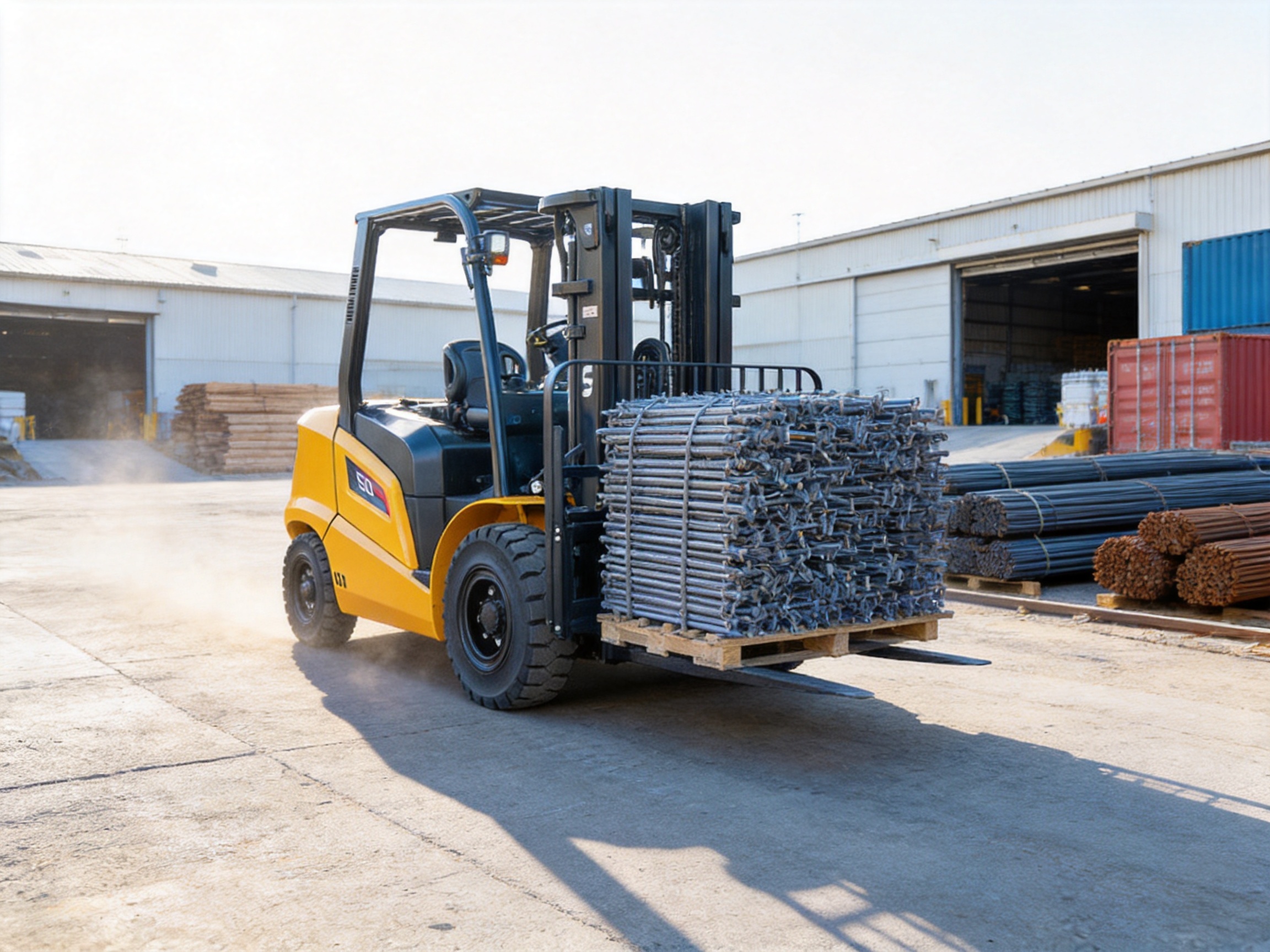
Construction suppliers handle concrete products, steel sections, bricks, timber, pipes, tiles, panels, and other heavy or irregular materials. These loads may be stored outdoors and may be exposed to dust, rain, uneven ground, and frequent loading activity. The F Series’ gradeability, diesel torque, durable chassis, and strong steering axle make it suitable for these challenging conditions when the surface and load are within the machine’s operating limits.
Attachments may be used to handle specialized products, but capacity must be recalculated whenever an attachment changes the load center or adds significant weight. Operators should also account for load stability, packaging quality, wind conditions, and the possibility of shifting materials.
Ports, Freight Terminals, and Logistics Yards
Freight terminals require rapid movement between trucks, storage zones, staging areas, and loading docks. A travel speed of up to 26 km/h without a load can support efficient movement across larger sites. The 110-liter fuel tank can also help extend working intervals between refueling operations, depending on duty cycle and fuel consumption.
In these environments, visibility, braking, tire condition, and steering response are essential. The F Series provides a combination of wide-view mast design, suspended braking pedals, rubber-damped steering, and a reinforced steering axle to support controlled operation. Site managers should establish separate pedestrian routes, loading-zone procedures, and speed limits for safe fleet use.
Metal, Steel, and Foundry Operations
Metal and steel facilities often handle dense loads that occupy relatively little volume. Such loads can create high demands on the mast, forks, tires, counterweight, and hydraulic system. The FD45T, FD50T, and FD55T capacities allow customers to select a machine appropriate to their usual load range, while the robust diesel drivetrain supports repetitive high-load cycles.
In foundries and hot-work areas, additional protective equipment and special configurations may be required. Heat exposure, sparks, abrasive dust, and specialized attachments should be discussed with the supplier before ordering. The standard specifications should not be assumed to cover every extreme application without an engineering review.
Paper, Timber, and Packaging Industries
Paper rolls, timber bundles, and packaging materials often require attachments that distribute pressure carefully. The hydraulic system’s attachment operating pressure and flow capabilities provide a foundation for compatible tools, but attachment selection must be based on the actual product and handling method.
Operator visibility and smooth hydraulic control are particularly valuable when handling cylindrical or flexible loads. Sudden movements may damage products or compromise stability. The F Series’ flow-merging and load-sensing systems can support precise operation when the attachment and hydraulic circuit are correctly matched.
Total Cost of Ownership Considerations
The purchase price is only one part of forklift economics. Total cost of ownership includes fuel, tires, scheduled maintenance, unplanned repairs, operator productivity, downtime, depreciation, training, and residual value. A forklift that works efficiently and remains available can produce greater value than a lower-priced machine that requires frequent service or limits productivity.
The F Series supports cost management through several design features. The diesel engine provides extended operating capability for high-utilization applications. Hydraulic flow merging and load sensing are intended to reduce energy loss. Easy engine, radiator, side-panel, and floor-plate access can shorten maintenance procedures. Waterproof connectors may reduce moisture-related electrical problems, while vibration damping can help protect the operator and selected vehicle systems from unnecessary impact.
Fuel economy will vary according to load, travel distance, idle time, tire pressure, operator behavior, surface condition, attachment use, and maintenance quality. Fleet managers should monitor fuel consumption by operating cycle rather than relying solely on brochure data. Preventing excessive idling, maintaining correct tire pressure, keeping the radiator clean, and training operators in smooth acceleration and braking can have a significant effect on real-world cost.
Maintenance planning should include daily inspections, periodic lubrication, engine oil and filter changes, hydraulic inspections, transmission checks, brake testing, tire inspection, mast and chain examination, fork inspection, and electrical-system checks. A structured maintenance schedule helps identify wear before it causes a production stoppage.
How the Forklift Supports Sustainable Operation
Diesel forklifts remain important for high-capacity and outdoor applications, but responsible operation requires attention to emissions, fuel consumption, noise, and maintenance. The product information identifies Mitsubishi and Kubota engine options with low-emission characteristics, high performance, and durability. Customers should select the engine and emissions configuration required for their destination market.
Efficient hydraulic control can contribute to lower energy waste, while a properly maintained engine can operate more cleanly and efficiently than a poorly maintained one. Reducing idle time, matching the forklift capacity to the load, and avoiding unnecessary travel are practical ways to lower fuel use. In applications where indoor emissions or local regulations make diesel unsuitable, the manufacturer’s broader range of electric and lithium-ion forklifts may provide alternative solutions.
Sustainability also includes product longevity. Extending the useful life of a forklift reduces the need for early replacement and spreads manufacturing impacts over more operating hours. Durable structural components, service access, replaceable wear parts, and technical support all contribute to a longer productive life when the forklift is maintained correctly.
Selection Guidance for Fleet Managers
The first step in selecting an F Series forklift is to understand the actual load profile. Customers should record the heaviest load, average load, load dimensions, load center, lifting height, attachment weight, and frequency of operation. A forklift should not be selected solely because its nominal capacity matches the load. The capacity at the required lift height and load center is the more important reference.
The working environment should also be assessed. Important factors include indoor or outdoor use, floor condition, gradients, operating temperature, dust, moisture, available aisle width, doorway height, trailer access, pedestrian traffic, and shift pattern. The FD55T may provide additional capacity, but its larger total weight, length, and turning radius must be compatible with the site.
Fuel and service infrastructure should be reviewed before deployment. The facility should have a suitable refueling area, spill-control procedures, ventilation, trained maintenance personnel, and access to approved replacement parts and lubricants. If the forklift will work in regulated markets, the customer should confirm engine emissions compliance, safety certification, lighting requirements, and any local equipment standards.
Finally, the fleet manager should consider the operator. A machine that is powerful but difficult to use may not deliver its full potential. The F Series’ adjustable steering column, compact steering wheel, enlarged operating space, vibration reduction, wide-view mast, and low-effort controls are intended to support a more comfortable and productive working environment.
Recommended Operating Practices
Operators should complete a pre-shift inspection before using the forklift. This inspection should include tires, forks, mast chains, hydraulic hoses, fluid levels, brakes, steering, lights, warning devices, seat belt, overhead guard, battery, fuel system, and visible leaks or damage. Any serious defect should be reported and corrected before the machine is returned to service.
Loads should be centered on the forks and kept as close to the mast as practical. Operators should avoid exceeding the rated capacity, lifting loads with an unknown center of gravity, or traveling with an unstable or poorly secured load. The mast should be tilted according to the load and travel condition, and the forks should be carried at a safe travel height.
When traveling on a slope, the load should generally face uphill, and turning across a slope should be avoided where conditions are unsafe. Speed should be reduced at intersections, blind corners, ramps, wet surfaces, and areas shared with pedestrians. The operator should maintain a clear view and use a spotter when the load or environment obstructs visibility.
Parking should be carried out in an approved location with the forks lowered, controls neutralized, the parking brake engaged, and the engine shut down according to site procedures. The optional OPS system can support safe control practices, but it should be viewed as one component of a complete safety program.
Q&A
What is the rated capacity of the F Series range?
The listed models are rated at 4,500 kg for the FD45T, 5,000 kg for the FD50T, and 5,500 kg for the FD55T. The supplied specifications use a 500 mm load center. Actual capacity depends on lift height, attachment, load center, and configuration, so the official capacity plate must always be followed.
Is the forklift suitable for outdoor work?
Yes. The diesel powertrain, high gradeability, durable chassis, heavy-duty tires, and strong steering axle make the range suitable for many outdoor industrial applications. The site should still be assessed for terrain, drainage, gradients, dust, temperature, overhead clearance, and local safety requirements.
What engine is used?
The listed configuration uses a Mitsubishi S6S engine with six cylinders, 52 kW rated output, 248 N·m rated torque, and 4.996 liters of displacement. The manufacturer also identifies Mitsubishi and Kubota engines as available technologies within its forklift product range. Final engine availability should be confirmed for the intended market and configuration.
How fast can the forklift travel?
The specified travel speed is 25 km/h with a full load and 26 km/h without a load. Actual site speed should be controlled according to the load, surface, visibility, pedestrian traffic, and local regulations.
How does the hydraulic system improve productivity?
The dual-pump flow-merging system is designed to improve hydraulic work efficiency and reduce energy loss. Load sensing adjusts hydraulic demand according to the function being used. Together, these features can support smoother lifting and attachment operation while using power more efficiently.
What maintenance features are included?
The engine hood opens to 80 degrees, the left and right side panels are detachable, the front and rear floor plates are pin-mounted, and the rear counterweight cover provides access to the radiator. These features are intended to simplify inspection, cleaning, servicing, and troubleshooting.
Does the forklift include an operator presence system?
An OPS system is identified as an option. It is designed to help prevent unintended forklift startup when the operator is not properly positioned. Customers should confirm whether the system is included in the selected configuration and should continue to use comprehensive operator training and site safety procedures.
What types of attachments can be used?
Compatible attachments may include clamps, fork extensions, rotating devices, bale handlers, paper roll handlers, and other tools. The attachment must be approved for the forklift and correctly matched to its hydraulic capacity, weight, dimensions, and load center. The rated capacity must be recalculated when an attachment is installed.
How should customers choose between the FD45T, FD50T, and FD55T?
Selection should be based on the heaviest regular load, the required safety margin, lift height, attachment use, travel environment, and available space. The FD45T is suitable for loads up to the 4.5-ton class, the FD50T for the 5-ton class, and the FD55T for the 5.5-ton class, subject to the official capacity chart and operating conditions.
What makes the manufacturer suitable for international customers?
Zhejiang UN Forklift Co., Ltd. has operated since 1978 and integrates research, manufacturing, sales, and service. It has an approximately 53,400-square-meter facility, annual production capacity of about 15,000 units, a broad range of forklift products, and an international sales and service network. These capabilities can support customers seeking equipment, parts, technical assistance, and fleet solutions across different regions.
Conclusion
The F Series 4.0T–5.0T diesel forklift range is engineered for businesses that need substantial lifting capacity, reliable diesel performance, and practical long-term serviceability. The listed FD45T, FD50T, and FD55T models cover rated capacities from 4,500 kg to 5,500 kg, while maintaining a common industrial design philosophy.
Its key advantages include a powerful six-cylinder diesel engine, high-speed ratio floating transmission, dual-pump flow merging, load sensing, strong cast steering axle, wide-view mast, vibration reduction, low-effort controls, durable overhead guard, waterproof connectors, optional operator presence protection, and accessible maintenance points. These features help the forklift compete not only through lifting capacity, but also through productivity, operator usability, reliability, and total cost of ownership.
The manufacturer’s long history, engineering background, production scale, broad material-handling portfolio, and international service network provide additional confidence for fleet owners. From manufacturing and construction materials to freight yards, metal processing, timber, paper, and general industrial logistics, the F Series offers a robust platform for demanding work.
As with any heavy-duty forklift, the final purchasing decision should be based on a detailed review of the load chart, site conditions, attachment requirements, emissions regulations, service support, and operator training needs. When correctly configured and maintained, the F Series can provide a durable and efficient solution for high-capacity material handling.
References
1. Zhejiang UN Forklift Co., Ltd., F Series 4.0T–5.0T Diesel Forklift Product Specifications.
2. Zhejiang UN Forklift Co., Ltd., Internal-Combustion Forklift Product Information and Technical Features.
3. Mitsubishi Heavy Industries Engine and Turbocharger Technical Documentation, S6S Diesel Engine Series.
4. International Organization for Standardization, Industrial Trucks Safety and Stability Principles.
5. International Labour Organization, Workplace Safety Guidance for Materials Handling Equipment.
6. Occupational safety guidance for powered industrial truck operation, inspection, training, and load handling.
7. General engineering principles for hydraulic load sensing, forklift stability, preventive maintenance, and industrial fleet management.
Product: F Series 4.0T-5.0T Diesel Forklift

For exclusive deals and latest offers, sign up by entering your email address below.
Stay In Touch
ADDRESS : NO.1 ROAD ONE, XINDENG NEW DISTRICT, FUYANG, HANGZHOU, ZHEJIANG, CHINA 311404.
PHONE : +86-571-8688 8355 (AMERICA)
PHONE : +86-571-8886 9363 (EUROPE)
PHONE : +86-571-8688 8377 (ASIA, AFRICA, OCEANIA)
EMAIL : [email protected]
EMAIL : [email protected](PARTS INQUIRY)

