


 中文简体
中文简体 Français
 русский
 Español
 عربى
عربى Deutsch



How a Compact 4-Ton Diesel Forklift Delivers Heavy-Duty Productivity
Admin 2026-08-14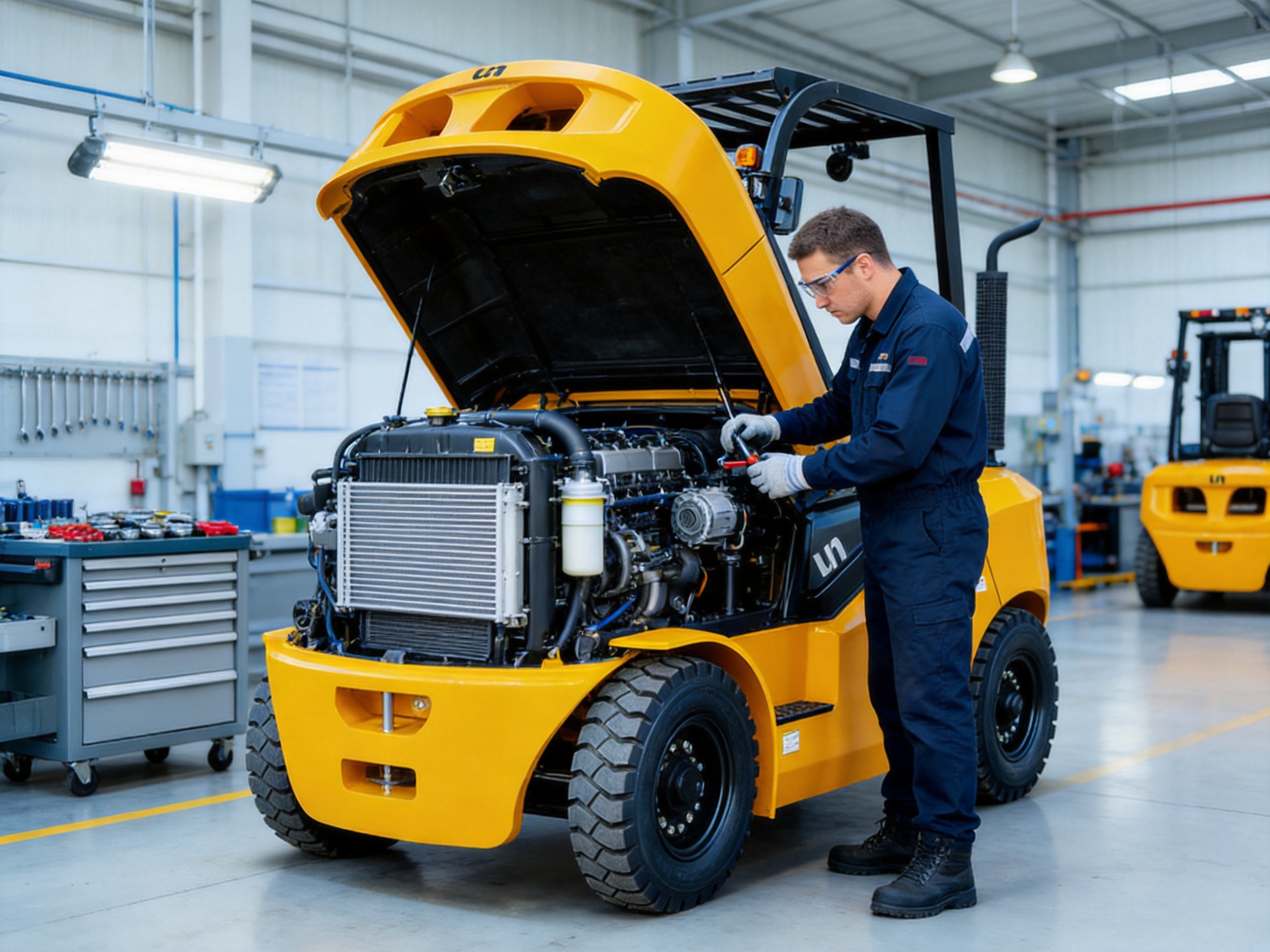
Modern material-handling operations require equipment that can combine lifting strength, maneuverability, durability, operator comfort, and manageable operating costs. A forklift that performs well in only one of these areas may create limitations elsewhere. High capacity can come with excessive size, compact dimensions can reduce stability, and powerful engines can increase fuel consumption or maintenance requirements. The N Series Mini 4.0T Diesel Forklift is designed to address these challenges with a compact heavy-duty platform that combines a 3.5-ton chassis concept with a rated load capacity of 4,000 kilograms.
This configuration gives warehouse operators, industrial plants, construction suppliers, logistics companies, and outdoor storage facilities access to a high-capacity lift truck without requiring the working space normally associated with larger forklifts. Its design focuses on practical productivity: sustained power output, reliable handling, efficient maintenance access, clear visibility, and flexible configuration options.
Manufactured by Zhejiang UN Forklift Co., Ltd., the forklift represents the company’s experience in internal combustion forklift development and material-handling equipment production. The manufacturer has operated since 1978 and integrates research and development, manufacturing, sales, and service. Its product portfolio covers internal combustion forklifts, electric forklifts, warehouse equipment, and specialized material-handling machines.
The following article examines the technical characteristics, engineering advantages, manufacturing strengths, safety systems, maintenance design, mast options, and application value of this compact 4-ton diesel forklift.
1. Product Positioning and Core Design Concept
The N Series Mini 4.0T Diesel Forklift is positioned in the diesel forklift category covering approximately 1.5 to 5.0 tons. Its rated capacity is 4,000 kilograms at a 500-millimeter load center. This rating makes it suitable for demanding applications involving heavy pallets, steel products, machinery components, building materials, packaged goods, and industrial raw materials.
The “Mini” designation refers primarily to the compact chassis concept rather than a reduction in working capability. The forklift is engineered to provide the capacity of a larger industrial truck while maintaining dimensions that support operation in restricted yards, production areas, loading zones, and warehouse aisles. The standard overall width is approximately 1,410 millimeters, while the wheelbase is approximately 1,900 millimeters.
A compact wheelbase can help reduce turning requirements and improve movement around loading docks or production lines. The listed outside turning radius is approximately 2,675 to 2,740 millimeters depending on the configuration. These dimensions should be evaluated against the actual operating environment, but they demonstrate the design objective: provide high-capacity lifting in a relatively space-efficient package.
The forklift uses a diesel power system and a hydraulic transmission configuration. Standard performance data includes a travel speed of up to 20 kilometers per hour without load, a lifting speed of approximately 450 millimeters per second at full load, and a maximum gradeability of 20 percent at full load. These characteristics support both short-distance warehouse movement and outdoor transport across industrial yards.
Its design is especially relevant to businesses that need more than a conventional 2.5- or 3-ton truck but do not want to move immediately to a much larger 5-ton forklift. The 4-ton rating creates a practical middle position between maneuverability and lifting strength.
2. Capacity, Stability, and Heavy-Duty Handling
The most important feature of this model is its 4,000-kilogram rated load capacity. A rated capacity must always be considered together with the load center, mast height, attachment type, and operating conditions. For the standard specification, the rated load center is 500 millimeters. This makes the forklift appropriate for many conventional palletized loads and industrial handling tasks.
The use of a chassis designed around a lower capacity class while achieving a higher rated capacity reflects an emphasis on structural optimization. Instead of simply increasing every component’s size, the engineering approach focuses on the relationship between the frame, axles, counterweight, mast, hydraulic system, and powertrain. This can help create a forklift that is strong enough for heavy loads while retaining useful proportions.
For comparison with conventional competitors, a truck in this capacity range may be physically larger, have a wider turning envelope, or require greater aisle clearance. The N Series Mini concept offers a potential advantage where the customer needs 4-ton performance but must work around fixed columns, narrow loading zones, production equipment, or restricted outdoor lanes.
The standard fork dimensions are approximately 1,070 millimeters long, 150 millimeters wide, and 50 millimeters thick. These dimensions provide a robust load-supporting surface for industrial pallets and other heavy-duty loads. When specialized attachments are installed, the actual rated capacity must be recalculated. The supplied specifications indicate that a separated side shifter may reduce capacity by 200 kilograms, while an integrated side shifter may reduce capacity by 100 kilograms.
Stability also depends on the mast arrangement. The standard data lists a 3,000-millimeter rated lift height, a 150-millimeter free lift height, and a mast tilt angle of 6 degrees forward and 12 degrees backward. These specifications support common loading and stacking tasks while allowing the operator to adjust the load position during pickup, transport, and placement.
The forklift’s front tires are listed as 250-15-16PR, with rear tires listed as 6.50-10. Tire selection contributes to load support, traction, shock absorption, and service life. In outdoor or demanding industrial applications, the high-ply-rating front tires can provide a useful foundation for repeated heavy-load cycles.
3. Engine Choices and Sustained Power Output
The forklift can be configured with different diesel engines, including Xinchai and Isuzu options in the supplied specifications. The engine choices include the Xinchai A498BPG-521, Xinchai 4D32G31-066, and Isuzu 4JG2, depending on the model configuration. The listed rated outputs range from approximately 36.8 kilowatts to 46 kilowatts.
Multiple engine options can be valuable for international customers because requirements vary by market, fuel preference, emissions expectations, service capability, and purchasing policy. A fleet operator may prefer a specific engine brand because local technicians are familiar with it or replacement parts are readily available in the region.
The A498BPG-521 engine is listed with a rated output of 45 kilowatts at 2,500 revolutions per minute and rated torque of approximately 193 newton-meters at 1,800 revolutions per minute. The Isuzu 4JG2 is listed with output figures in the range of 44.9 to 46 kilowatts, depending on the configuration, and torque of approximately 184.7 newton-meters at 1,700 revolutions per minute.
Torque is particularly important in forklift operation because the machine frequently starts and stops under load, travels across uneven ground, climbs ramps, and positions loads at low speed. A diesel engine with sufficient torque helps maintain usable performance during these demanding cycles.
The forklift is also described as using an eco-friendly engine system intended to improve fuel efficiency while reducing emissions. Actual fuel consumption and emissions performance depend on the selected engine, duty cycle, load, operator behavior, maintenance quality, fuel condition, and local regulatory standards. Even so, the combination of efficient engine choices and a properly matched transmission can help reduce unnecessary energy use.
Compared with less carefully matched powertrains, the available engine and transmission combinations can offer a better balance between pulling force, travel response, hydraulic productivity, and fuel usage. For fleet managers, this means the purchase decision can be adapted to the operating environment instead of relying on a single fixed powertrain for every market.
4. Transmission and Hydraulic Performance
The N Series Mini 4.0T Diesel Forklift uses a hydraulic transmission system with a 1-forward and 1-reverse transmission stage arrangement. The configuration is appropriate for industrial work where the truck repeatedly changes direction between pickup, transport, and placement positions.
A well-matched transmission supports smooth starts, controllable reversing, and stable movement around people, racks, pallets, and equipment. In heavy-load applications, predictable low-speed behavior is often more important than maximum travel speed. The operator must be able to approach a pallet precisely, engage the load, reverse without excessive shock, and position the truck accurately at the destination.
The hydraulic system is another central performance area. The product information identifies Shimadzu pumps and other premium-brand hydraulic components as available within the company’s hydraulic system approach. Hydraulic performance affects lifting speed, steering response, attachment operation, and overall control quality.
The listed operating pressure for attachments is approximately 18.5 to 20.5 megapascals, depending on the configuration. This allows the forklift to support hydraulic attachments when the attachment’s flow and pressure requirements are compatible with the selected configuration. Examples may include side shifters, fork positioners, clamps, rotators, paper roll clamps, bale clamps, or specialized industrial tools.
Hydraulic efficiency is important because the engine must supply power for both travel and lifting functions. A system with efficient pumps, properly sized hoses, reliable valves, and accurate control can reduce wasted energy and improve working consistency. It can also help avoid excessive heat generation during long operating shifts.
For customers comparing this model with competing forklifts, the potential advantage lies in the combination of capacity, attachment compatibility, and controllability. A forklift should not be judged only by its maximum load rating. It should also be evaluated by how easily the operator can control that load in real operating conditions.
5. Cooling Design for Intensive Applications
Forklifts operating in hot environments, dusty yards, foundries, manufacturing plants, or high-cycle logistics operations can experience significant thermal stress. Engine temperature, transmission temperature, hydraulic oil temperature, and ambient heat all influence reliability. The N Series Mini 4.0T Diesel Forklift uses high-capacity radiators and an effective cooling arrangement to help maintain operating stability in extreme heat.
Cooling performance is especially important when the forklift is carrying heavy loads repeatedly or working on grades. Under these conditions, the engine produces sustained output and the hydraulic system may operate frequently. An appropriately designed radiator and airflow path can help keep temperatures within a suitable working range.
The cooling system also benefits from routine maintenance. Radiator fins must be kept free from dust, fibers, chaff, packaging debris, and other materials that can restrict airflow. Operators and maintenance teams should inspect the radiator regularly, particularly when the forklift works in environments with airborne contaminants.
Compared with a smaller forklift that is continuously operated beyond its intended capacity, a properly configured 4-ton machine can provide a more suitable reserve for heavy-duty work. Operating a lower-capacity truck at its limit for every cycle can increase stress on the engine, cooling system, tires, brakes, mast, and transmission. Selecting a forklift with a capacity appropriate to the actual load can contribute to longer service life and more consistent productivity.
Thermal reliability also protects productivity. Unplanned overheating can interrupt loading schedules, delay production, and create expensive repair events. The cooling design of this model is therefore not merely a comfort or convenience feature; it is part of the equipment’s industrial operating strategy.
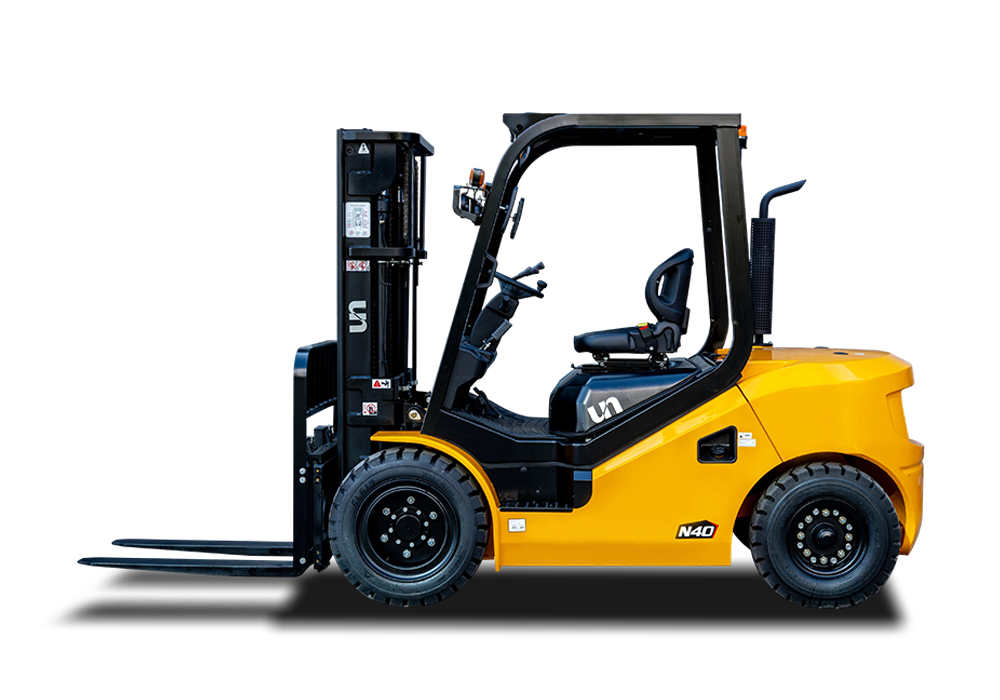
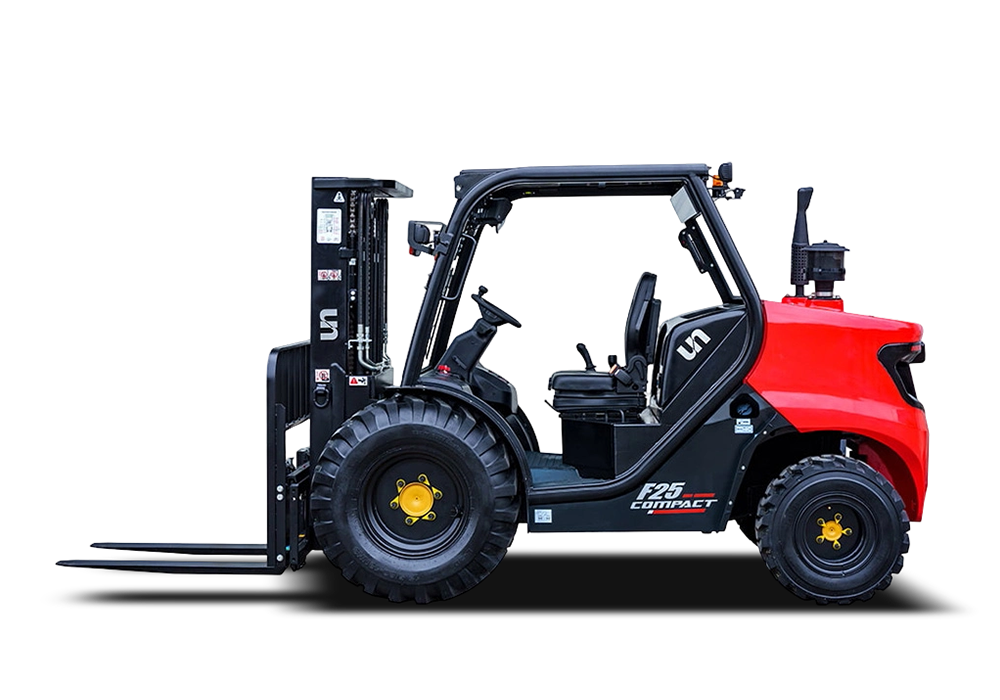
N Series Mini 4.0T Diesel Forklift
6. Visibility, Operator Protection, and Ergonomics
Forklift productivity depends heavily on the operator’s ability to see, control, and understand the machine. The N Series Mini 4.0T Diesel Forklift includes a wide-visibility mast designed to keep the load and surrounding working area clear during operation. Improved visibility can help the operator align the forks with pallets, monitor the load while lifting, and identify nearby obstacles.
Visibility is particularly important when working at height. As the mast rises, the load, fork tips, and rack structure can create visual obstructions. A wide-view mast helps reduce the amount of structure directly in the operator’s sightline. The actual visibility benefit depends on the mast type, load dimensions, lighting, and operating position, but the design supports safer and more accurate load handling.
The forklift includes an Operator Presence System, commonly referred to as OPS, with a seat switch. This system is intended to help protect the driver by monitoring operator presence and controlling selected machine functions when the operator is not properly seated. Such systems are an important part of a broader safety program that should also include training, site traffic rules, daily inspections, speed control, and proper load handling.
A heavy-duty overhead guard protects the operator from potential hazards associated with falling or shifting objects. It is designed to form a protective zone above the driving position while maintaining practical visibility. Operators should still follow all safety procedures and never place themselves beneath suspended or unstable loads.
The suspended frame design provides additional legroom and supports a more comfortable operating position. Adjustable steering and comfortable seating can help reduce fatigue during long shifts. Operator fatigue can affect concentration, reaction time, and precision, so ergonomic design has a direct relationship with productivity and safety.
A comfortable operator is more likely to maintain consistent posture and use the controls accurately. This is particularly relevant in applications involving hundreds of repeated cycles per shift. Small improvements in seating, steering position, visibility, and control layout can produce meaningful benefits over the life of the equipment.
An optional suspended powertrain system allows the forklift to be customized for specific working conditions. Depending on the final configuration, suspension can help reduce vibration transmitted through the powertrain and chassis. Customers should confirm the availability and effect of this option for their selected model and operating environment.
7. Compact Dimensions and Maneuverability
Many industrial facilities face a conflict between high lifting capacity and limited operating space. A forklift may have to enter a production bay, turn between storage rows, approach a truck from the side, or travel through a yard shared with other vehicles. Excessive dimensions can reduce productivity even when the truck has adequate lifting power.
The N Series Mini 4.0T Diesel Forklift addresses this need through a compact chassis and controlled dimensions. Its overall width is approximately 1,410 millimeters, and its standard outside turning radius is listed at approximately 2,675 millimeters in one configuration. The minimum pallet aisle width is listed at approximately 2,700 millimeters for the corresponding specification, although aisle calculations should always be confirmed using the exact pallet size, load overhang, mast configuration, and operating method.
The short and compact layout can help the operator position the forklift closer to loading points. It may also reduce unnecessary travel and maneuvering compared with a larger capacity truck. When the equipment is used in a mixed indoor and outdoor environment, this balance can be more useful than selecting a larger forklift that offers surplus capacity but requires additional space.
Compactness must never replace correct capacity planning. The operator must verify load weight, load center, lifting height, attachment impact, surface condition, slope, and overhead clearance. Nevertheless, when those factors are suitable, a compact 4-ton forklift can be a strong alternative to both smaller trucks operating at their limits and oversized trucks that are difficult to maneuver.
For competitors in the same capacity range, the most significant comparison points include turning radius, wheelbase, overall width, mast visibility, steering response, and aisle requirements. The model’s specifications show that its design is focused on reducing the physical footprint while preserving industrial load-handling capability.
8. Maintenance-Friendly Engineering
Maintenance access is one of the most important factors in total cost of ownership. A forklift that is difficult to inspect or service can require more labor, create longer downtime, and encourage delayed maintenance. The N Series Mini 4.0T Diesel Forklift includes several features intended to make routine servicing more convenient.
The engine hood can open to nearly 90 degrees. This creates a broad access area around the engine compartment and helps technicians reach filters, belts, hoses, fluid reservoirs, wiring, and other service points. Easier access can shorten inspection time and reduce the likelihood that important maintenance tasks will be skipped.
The transmission oil filter is designed for simple replacement. Regular filter changes help protect the transmission and hydraulic components from contamination. Maintenance intervals should follow the manufacturer’s service documentation and should be adjusted when the forklift operates in severe conditions such as high dust, extreme heat, continuous heavy loading, or long shifts.
Routine maintenance should include checking engine oil, coolant, hydraulic oil, transmission oil, fuel filters, air filters, tire condition, wheel fasteners, forks, mast rollers, chains, hoses, brakes, steering components, lights, warning devices, and the operator-presence system. Forks should be inspected for bending, cracks, excessive wear, and heel damage. Chains and mast components should be kept lubricated and adjusted according to the maintenance schedule.
Maintenance-friendly design can provide an advantage over equipment that requires extensive disassembly for basic service. Faster access does not eliminate the need for qualified technicians, but it can improve service efficiency and reduce the time the forklift is unavailable.
Preventive maintenance also protects residual value. A truck with documented inspections and timely component replacement is easier to evaluate, safer to operate, and more attractive in the secondary market. Fleet operators should maintain service records for each unit, including operating hours, repairs, inspections, and attachment changes.
9. Mast Options and Rated Capacity Planning
The forklift can be equipped with a range of mast configurations for different lifting requirements. The supplied mast information includes wide-view two-stage masts identified by designations such as M270, M290, M300, M320, M330, M350, M370, M400, M450, and M500. Three-stage full-free wide-view mast options include TFM400, TFM430, TFM450, TFM470, TFM500, TFM525, TFM550, and TFM600.
These mast options cover lift heights from approximately 3,000 millimeters to 6,000 millimeters. As lift height increases, rated capacity can change. The mast tables show different load capacities at different fork heights, including examples where capacity reduces from 4,000 kilograms to 3,800, 3,600, 3,300, 3,000, 2,800, 2,300, or 1,800 kilograms depending on the mast and lift height.
This capacity progression is normal in forklift design. A load raised higher creates a greater overturning moment, and the mast’s geometry, residual capacity, and stability requirements must be considered. Customers should select a mast based on the required maximum lift height, building clearance, rack design, load dimensions, and actual load weight rather than choosing the tallest mast automatically.
The two-stage wide-view mast can be suitable for general industrial stacking and truck loading. The three-stage full-free mast can be useful where the operator needs greater lift height while preserving free lift within a container, trailer, low-ceiling area, or multi-level warehouse. The full-free function allows the forks to rise within the mast stages before the overall mast height increases significantly.
The mast table also lists overall lowered and extended heights, free-lift values, tilt angles, and total operating weights. These values should be verified for the exact model, engine, tire, attachment, and mast combination. Even small configuration differences can affect overhead clearance, aisle requirements, and floor loading.
Side-shifting equipment can improve load positioning and reduce the need for repeated truck repositioning. However, attachment weight and load center changes must be included in the capacity calculation. A side shifter can reduce the available rated capacity, as indicated in the product data, so the final capacity plate and manufacturer-approved configuration must always govern operation.
| Specification Area | Representative Value | Operational Significance |
|---|---|---|
| Rated load capacity | 4,000 kg | Supports heavy industrial and palletized loads |
| Rated load center | 500 mm | Defines the reference point for rated capacity |
| Standard lift height | 3,000 mm | Suitable for common stacking and loading tasks |
| Free lift height | 150 mm | Helps with movement in areas with limited overhead clearance |
| Overall width | Approximately 1,410 mm | Supports operation in relatively restricted spaces |
| Travel speed without load | Up to 20 km/h | Improves movement between loading and storage zones |
| Maximum gradeability at full load | 20 percent | Supports operation on suitable industrial ramps and grades |
| Wheelbase | Approximately 1,900 mm | Balances stability and maneuverability |
| Fuel tank capacity | Approximately 80 L | Supports extended operating periods between refueling cycles |
| Attachment operating pressure | Approximately 18.5–20.5 MPa | Provides compatibility with approved hydraulic attachments |
10. Manufacturing Strengths and Quality-Oriented Production
The performance of a forklift depends not only on its published specifications but also on the manufacturing systems used to produce it. Zhejiang UN Forklift Co., Ltd. operates as an integrated manufacturer covering research and development, production, sales, and service. The company’s facilities occupy approximately 53,400 square meters, with an annual production capacity of approximately 15,000 units.
An integrated production model can improve coordination between design engineers, manufacturing teams, quality personnel, service departments, and customers. Feedback from field applications can be used to refine product design, component selection, maintenance procedures, and configuration options.
The company has developed a broad product range that includes 17 varieties, 96 series, and more than 200 specifications. This range indicates experience in adapting forklift designs to different capacities, power sources, applications, and regional requirements. The N Series Mini 4.0T Diesel Forklift benefits from that broader product development environment.
UN Forklift also has experience in internal combustion forklift manufacturing and supplies high-emission-standard internal combustion models to international markets. Its development history includes work on electric forklifts, reach forklifts, very-narrow-aisle equipment, lithium-ion forklifts, and diesel-to-lithium-ion solutions. This combination of conventional forklift expertise and new-energy development provides a useful engineering foundation.
The company has participated in the formulation of Chinese electric forklift industry standards and holds national patents related to electric forklift technologies. While those achievements relate primarily to electric equipment, they demonstrate broader technical engagement in the material-handling industry.
The manufacturer also operates a worldwide sales and service network with partners in Europe, South America, North America, Africa, and Asia. International support is important for customers purchasing diesel forklifts because parts availability, technical assistance, warranty coordination, and operator training can influence the success of a fleet investment.
Manufacturing strength should be evaluated through more than factory size. Customers should also consider engineering capability, production consistency, parts support, quality control, documentation, testing, and the manufacturer’s ability to supply different configurations. The product information indicates that this model is supported by a company with a long operating history and a broad equipment portfolio.
11. Advantages Compared with Conventional Competitors
The N Series Mini 4.0T Diesel Forklift has several design characteristics that can distinguish it from conventional competitors in the same general capacity class.
Compact high-capacity format
Many 4-ton forklifts are built with larger frames and more substantial dimensions. The compact chassis concept of this model may help customers work in areas where a full-size heavy-duty truck would have difficulty turning or positioning. The advantage is most noticeable in production yards, loading docks, mixed-use warehouses, and facilities with fixed obstacles.
Flexible engine selection
The availability of Xinchai and Isuzu engine configurations gives customers a choice based on local service capabilities, fuel expectations, purchasing standards, and regional regulations. A single-engine competitor may be less adaptable when customers operate across several markets or have established maintenance preferences.
Wide range of mast configurations
The availability of multiple two-stage and three-stage mast options allows the truck to be specified for standard loading, high stacking, container work, and applications with restricted ceiling height. This helps avoid the common problem of using one mast design for every task.
Maintenance access
The nearly 90-degree engine hood and accessible transmission oil filter can reduce the effort required for routine service. Competitors that provide less convenient engine-compartment access may require more time for inspections or component replacement.
Operator-oriented design
The combination of OPS seat-switch protection, wide-visibility mast, overhead guard, adjustable steering, suspended frame, extra legroom, and comfortable seating shows that the product is designed around the operator as well as the load. This is important because operator comfort and visibility can influence both safety and daily output.
Cooling for demanding environments
The high-capacity radiator and cooling approach support operation in hot and intensive working conditions. Customers in regions with high ambient temperatures or long duty cycles can benefit from considering thermal management as part of the forklift selection process.
Attachment capability
The available hydraulic operating pressure and optional side-shifting capability allow the forklift to be adapted to different load-handling tasks. This may reduce the need to purchase separate equipment for every product type, provided the attachment is properly approved and capacity-rated.
12. Applications Across Industrial Sectors
The forklift is suitable for a broad range of applications where heavy loads must be moved regularly and accurately.
Manufacturing plants
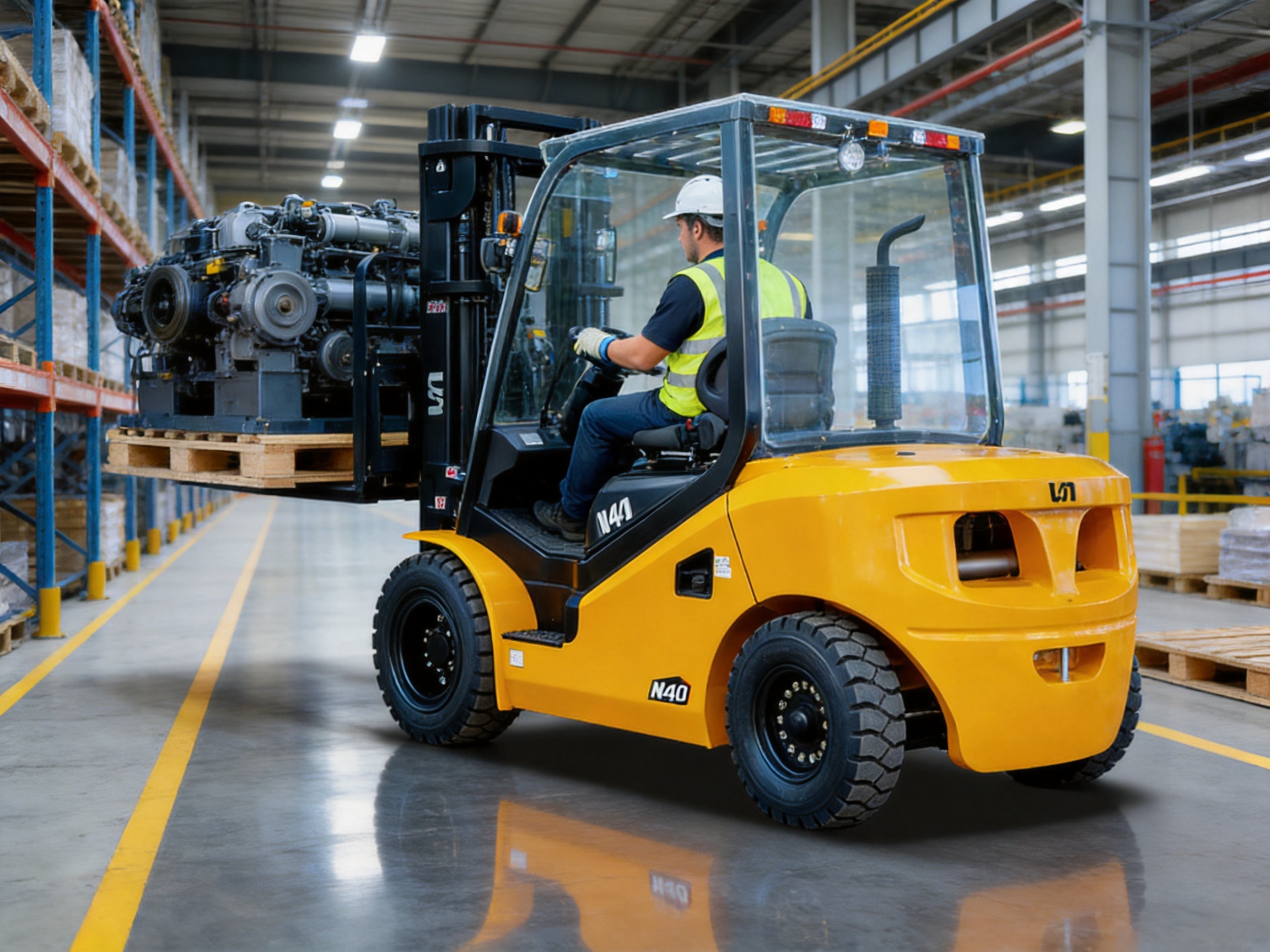
In manufacturing, the truck can move raw materials, molds, dies, machine parts, finished products, and production tooling. Its 4-ton rating supports loads that exceed the capability of many standard warehouse forklifts, while its compact dimensions can help it move around equipment and workstations.
Construction material distribution
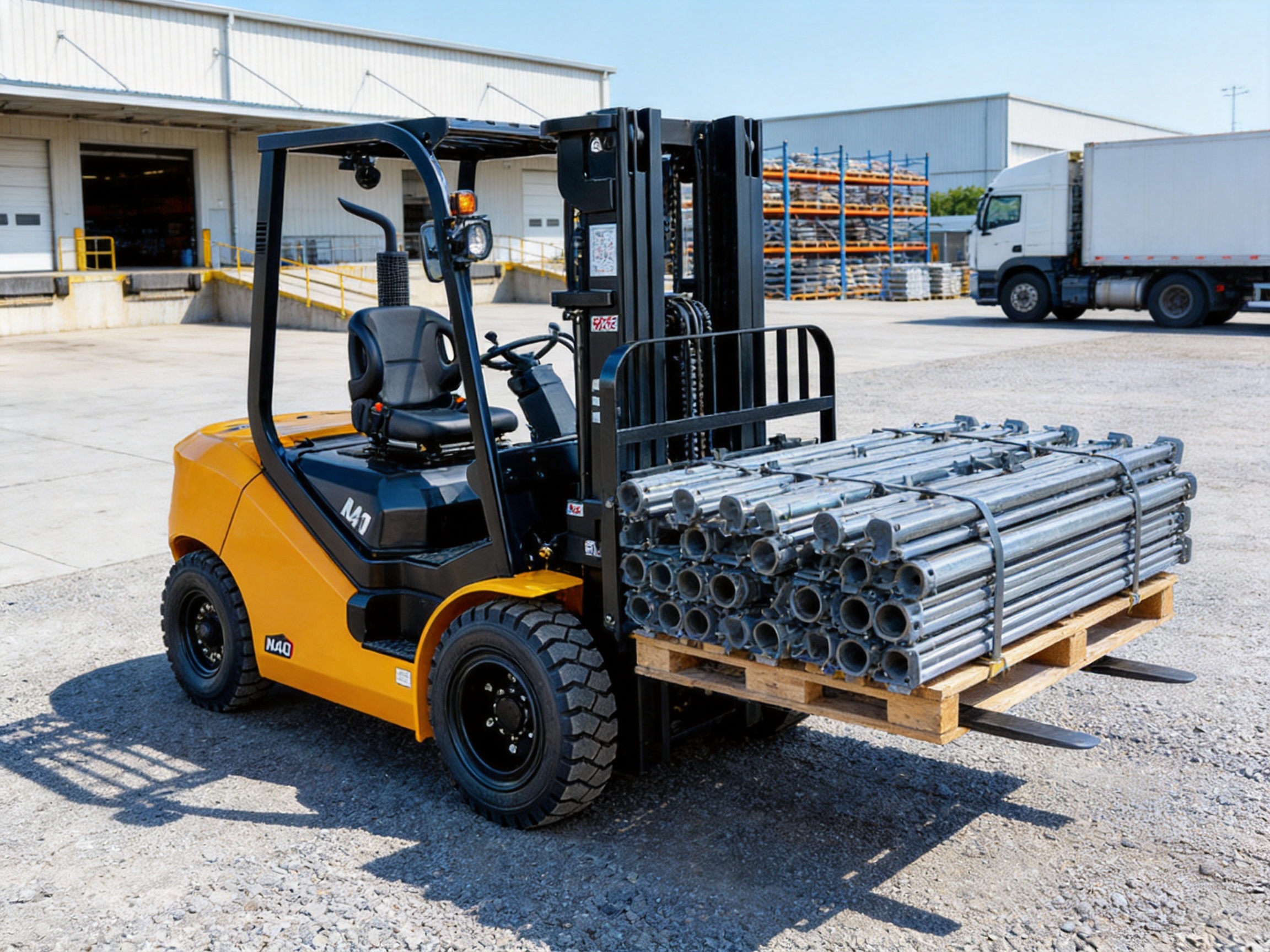
Building materials such as stone products, metal sections, cement products, timber packages, glass units, and industrial panels can be heavy and awkward. A diesel forklift with strong torque, high capacity, and suitable tires can be useful in distribution yards and loading areas. Operators must account for uneven ground, load shape, load security, and attachment requirements.
Logistics and freight terminals
Freight terminals frequently handle mixed cargo with varying weights and dimensions. The flexible mast and attachment options can support palletized goods, crates, machinery, and oversized packages. The travel speed and turning characteristics can help the truck move efficiently between trailers, staging zones, and storage areas.
Metal and steel handling
Steel coils, profiles, fabricated components, and other metal products require high load capacity and careful positioning. Specialized clamps, fork extensions, or other approved attachments may be required. The forklift’s hydraulic system and heavy-duty chassis can support these applications when the final configuration is properly engineered.
Outdoor industrial yards
Diesel power is often selected for outdoor work because it supports long shifts, refueling convenience, and operation away from fixed charging infrastructure. The forklift can be used in timber yards, agricultural equipment facilities, recycling operations, ports, and industrial storage compounds, subject to surface and environmental requirements.
Warehouse loading and unloading
The compact profile can be beneficial when loading and unloading trucks near warehouse doors. The operator can approach pallets, reverse into traffic lanes, and move loads to staging areas. Safe traffic management remains essential, especially where pedestrians and other vehicles share the same space.
13. Productivity and Total Cost of Ownership
Purchasing a forklift should involve more than comparing the initial price. The total cost of ownership includes fuel, scheduled maintenance, unscheduled repairs, tires, attachments, operator labor, downtime, depreciation, and resale value. A forklift that is slightly more expensive to purchase may be more economical if it delivers better uptime and lower operating costs.
The N Series Mini 4.0T Diesel Forklift can contribute to productivity through its capacity, travel speed, lifting performance, maneuverability, and maintenance accessibility. A 4-ton truck can complete tasks that would otherwise require multiple cycles with a smaller truck. At the same time, the compact design can reduce unnecessary repositioning in confined work areas.
Fuel efficiency is influenced by engine condition, load utilization, idle time, tire pressure, travel distance, acceleration habits, and maintenance. Operators should avoid leaving the engine idling unnecessarily and should use the correct travel speed for the site. Regular air-filter and fuel-system maintenance can help preserve engine efficiency.
Downtime reduction is another important benefit. Accessible service points can help maintenance teams complete inspections more quickly. A reliable engine, cooling system, hydraulic system, and transmission can support consistent operation when maintained according to the recommended schedule.
Fleet managers should track key performance indicators such as operating hours, fuel consumption, loads moved, maintenance cost per hour, downtime, tire wear, and operator-related incidents. These measurements can reveal whether the forklift is being used within its intended duty cycle and whether training or configuration changes are necessary.
When comparing competing products, customers should request complete configuration-specific data. A quoted capacity may apply only at a particular load center and lift height. Similarly, a published turning radius may change with tire type, mast design, or attachment. Accurate comparison requires reviewing the full specification plate and the intended application.
14. Safety Practices for Daily Operation
Technical safety features are most effective when combined with disciplined operating procedures. Before each shift, the operator should inspect the forks, mast, chains, hydraulic hoses, tires, wheels, brakes, steering, lights, horn, warning devices, seat belt, overhead guard, and fluid levels.
The operator should confirm that the load is within the rated capacity for the actual mast height, load center, and attachment. Loads should be stable, evenly distributed, and properly secured when necessary. The forks should be inserted fully under the load, and the load should be carried as low as practical while traveling.
Travel speed should be adapted to the floor condition, visibility, pedestrian traffic, slope, load size, and available stopping distance. Loads that obstruct forward visibility should be transported in reverse when it is safe to do so, with the operator looking in the direction of travel.
Ramps and grades require special care. The supplied specification lists a maximum gradeability of 20 percent at full load, but this figure does not mean that every ramp is safe to use. Surface condition, ramp length, traction, load stability, and local safety rules must also be considered. Loads should generally face uphill when traveling on a grade, following site procedures and the manufacturer’s instructions.
Operators must never carry passengers, stand under raised forks, bypass safety systems, or use damaged attachments. The OPS seat switch should not be defeated or modified. Only trained and authorized operators should use the forklift.
15. Configuration and Purchasing Guidance
Customers should define the application before selecting the final configuration. Important questions include:
What is the heaviest regular load and the heaviest occasional load?
What is the load center, and does the load extend beyond the standard pallet dimensions?
What is the required lift height and the lowest overhead clearance?
Will the forklift operate indoors, outdoors, or in both environments?
What floor surfaces, ramps, grades, temperatures, and dust levels are present?
Is a side shifter, fork positioner, clamp, rotator, or other attachment required?
Are there local engine emissions, noise, or safety requirements?
What engine brand and transmission configuration can local technicians support?
How many operating hours will the forklift complete per day?
The answers determine the correct engine, mast, tires, attachments, cooling arrangement, and service package. For example, a facility requiring 5,000-millimeter stacking may need a different mast and capacity rating than a facility that only loads trailers at 3,000 millimeters. A yard handling uneven surfaces may require careful tire and ground-clearance evaluation.
Customers should also confirm the exact model designation. The supplied product information includes configurations such as FD40T-XNGA7, FD40T-XNJB2, FD40T-XN1GA8, FD40T-XN1GA7, FD40T-XN1JB2, FD40T-XN2GA7, and FD40T-XN2JB2. Differences may involve engine, transmission, mast, axle, hydraulic, or dimensional specifications. The final quotation, data plate, and technical documentation should be treated as the controlling sources for the purchased unit.
16. Digital and International Support Considerations
International fleet customers generally need more than a machine shipment. They require spare-parts support, technical documentation, service training, warranty coordination, and communication with regional partners. The manufacturer’s international sales and service network is intended to support customers in Europe, South America, North America, Africa, and Asia.
Parts support is particularly important for diesel forklifts because filters, belts, hoses, seals, tires, mast rollers, transmission components, and engine parts are all subject to normal wear or periodic replacement. Before placing an order, fleet managers should ask about recommended spare-parts packages, service intervals, warranty terms, technician training, and the availability of local support.
Companies operating several forklifts may benefit from standardizing common components where possible. Engine and tire choices should be reviewed from a fleet perspective rather than only for one individual truck. Standardization can simplify inventory, technician training, and maintenance planning.
Documentation should include the operating manual, maintenance schedule, load charts, attachment instructions, parts information, safety warnings, and inspection forms. Accurate documentation helps ensure that operators and service teams understand the limits of each configuration.
17. Environmental and Energy Considerations
Diesel forklifts remain important in high-capacity outdoor and industrial applications because they can operate for extended periods without battery charging interruptions. However, fuel consumption and emissions must be managed responsibly. Selecting an engine that meets the applicable regional requirements is essential.
The product description emphasizes an eco-friendly engine approach intended to improve fuel efficiency and reduce emissions. Customers should request the precise emissions certification for the engine and destination market. Regulatory requirements can differ significantly between countries and regions, and compliance must be verified before purchase.
Energy efficiency also depends on operating practices. Preventing excessive idling, maintaining correct tire pressure, avoiding unnecessary travel, matching the forklift to the load, and keeping the hydraulic system in good condition can reduce fuel use. Operator training has a direct impact on emissions because aggressive acceleration, sudden braking, and unnecessary high-speed travel increase energy consumption.
The manufacturer’s broader development of lithium-ion and diesel-to-lithium-ion forklift solutions indicates attention to changing energy requirements in the material-handling sector. For customers with indoor operations, low-emission zones, or charging infrastructure, an electric alternative may be appropriate. For high-capacity outdoor work, the diesel N Series model can remain a practical solution when its operating characteristics match the application.
18. Recommended Evaluation Process
A demonstration or site evaluation is recommended before final fleet selection. The forklift should be tested with representative loads, not only empty. Operators should evaluate approach control, fork visibility, steering effort, reversing, mast response, ride quality, braking, turning space, and access to the engine compartment.
The test should include the actual pallet dimensions and the highest required lift height. If an attachment is planned, it should be installed during the evaluation. The customer should verify residual capacity, visibility, hydraulic response, and aisle clearance with the attachment fitted.
Maintenance personnel should inspect the accessibility of filters, fluid points, radiator areas, battery connections, and mast lubrication points. Procurement teams should compare the availability of service parts, warranty support, training, and technical assistance.
Financial evaluation should include estimated fuel consumption, expected operating hours, scheduled service, tire replacement, attachment costs, financing, and residual value. A forklift that performs well in a short demonstration but is poorly supported over several years may not be the most economical choice.
The N Series Mini 4.0T Diesel Forklift is most compelling when its compact dimensions, 4-ton capacity, engine flexibility, mast choices, and maintenance design align with the customer’s actual work. Proper specification is the key to achieving the advertised benefits.
19. Frequently Asked Questions
Q1: What is the rated capacity of the forklift?
The rated load capacity is 4,000 kilograms at a standard 500-millimeter load center. The actual allowable capacity can change with lift height, mast type, attachment, load center, and configuration, so the capacity plate for the specific unit must always be followed.
Q2: Why is it called a mini 4-ton forklift?
The model uses a compact chassis concept associated with a smaller capacity class while delivering a 4-ton rated lifting capability. The purpose is to provide high capacity with more manageable dimensions than some larger heavy-duty forklifts.
Q3: What engines are available?
The supplied specifications identify Xinchai and Isuzu diesel engine options. Depending on the selected model, engines include the Xinchai A498BPG-521, Xinchai 4D32G31-066, and Isuzu 4JG2. Customers should confirm the final engine and emissions specification for their market.
Q4: What is the standard lift height?
The standard main specification lists a rated lift height of 3,000 millimeters and a free lift height of 150 millimeters. Optional mast configurations extend the available lift-height range up to approximately 6,000 millimeters.
Q5: Can the forklift use attachments?
Yes. The hydraulic system is designed to support approved attachments, and the supplied data lists operating pressure in the range of approximately 18.5 to 20.5 megapascals depending on configuration. Attachment weight and changed load center must be included in the capacity calculation.
Q6: Does a side shifter affect capacity?
Yes. The supplied information states that a separated side shifter can reduce load capacity by 200 kilograms, while an integrated side shifter can reduce capacity by 100 kilograms. The final capacity rating should be confirmed from the approved configuration and data plate.
Q7: Is it suitable for outdoor use?
The diesel powertrain, heavy-duty tires, gradeability, cooling design, and high load capacity make it suitable for many outdoor industrial applications. The customer should evaluate ground conditions, slopes, weather, emissions requirements, and attachment needs before selection.
Q8: How does the forklift support operator safety?
Safety-related features include an Operator Presence System with seat switch, a wide-visibility mast, a heavy-duty overhead guard, adjustable steering, comfortable seating, and a suspended frame with additional legroom. These features must be combined with operator training and site safety procedures.
Q9: How is maintenance access improved?
The engine hood opens to nearly 90 degrees, creating more room for inspection and servicing. The transmission oil filter is also designed for convenient replacement. Regular maintenance remains necessary to protect engine, hydraulic, transmission, mast, and safety-system performance.
Q10: What makes this forklift different from a larger 5-ton model?
The model focuses on delivering 4-ton capacity with a more compact chassis and narrower overall dimensions. This may improve maneuverability and space utilization where a larger 5-ton truck would be difficult to operate. The correct comparison should include actual capacity, dimensions, mast height, turning radius, and application requirements.
Q11: Can it be used indoors?
It may be used indoors where diesel equipment, ventilation, emissions, noise, and floor conditions are acceptable. Indoor users should verify local regulations and consider whether an electric forklift would be more appropriate for enclosed spaces.
Q12: What should buyers confirm before ordering?
Buyers should confirm the exact model, engine, mast type, lift height, residual capacity, tire specification, transmission, attachment, overall height, turning radius, aisle requirement, emissions certification, warranty, service support, and spare-parts availability.
20. Conclusion
The N Series Mini 4.0T Diesel Forklift is designed for customers who need substantial lifting capability without the full physical footprint of a larger heavy-duty truck. Its 4,000-kilogram capacity, compact chassis concept, multiple diesel engine options, hydraulic transmission, wide-view mast, heavy-duty cooling system, and maintenance-friendly construction form a practical package for demanding industrial work.
Its advantages over conventional alternatives include a useful balance between capacity and maneuverability, a broad selection of mast configurations, flexible engine sourcing, support for approved hydraulic attachments, operator-focused ergonomics, and convenient service access. These features can help improve productivity in manufacturing, logistics, construction-material distribution, metal handling, outdoor storage, and truck loading.
The manufacturing background of Zhejiang UN Forklift Co., Ltd. adds further value. With a history dating back to 1978, integrated research and production capabilities, a broad product portfolio, international service partnerships, and experience in both internal combustion and electric forklift development, the company is positioned to support a wide range of material-handling requirements.
As with any forklift, performance depends on correct specification, responsible operation, and preventive maintenance. Customers should select the mast and attachment according to actual loads and lifting heights, verify local emissions requirements, and confirm configuration-specific data before purchase. When properly matched to the application, this compact 4-ton diesel forklift can provide reliable heavy-duty performance, efficient handling, and long-term operational value.
References
1. Product specification and technical information supplied for the N Series Mini 4.0T Diesel Forklift.
2. Manufacturer-provided information regarding engine options, hydraulic systems, mast configurations, safety features, and maintenance access.
3. Manufacturer background information concerning research and development, production capacity, product categories, and international service coverage.
4. General industrial forklift safety principles concerning rated capacity, load centers, mast height, attachments, operator presence, and daily inspections.
5. General material-handling engineering principles concerning stability, residual capacity, tire selection, cooling performance, ergonomics, and total cost of ownership.
Product: N Series Mini 4.0T Diesel Forklift
For exclusive deals and latest offers, sign up by entering your email address below.
Stay In Touch
ADDRESS : NO.1 ROAD ONE, XINDENG NEW DISTRICT, FUYANG, HANGZHOU, ZHEJIANG, CHINA 311404.
PHONE : +86-571-8688 8355 (AMERICA)
PHONE : +86-571-8886 9363 (EUROPE)
PHONE : +86-571-8688 8377 (ASIA, AFRICA, OCEANIA)
EMAIL : [email protected]
EMAIL : [email protected](PARTS INQUIRY)

