


 中文简体
中文简体 Français
 русский
 Español
 عربى
عربى Deutsch



6.0T–7.0T LPG Cushion Tire Forklift: Heavy-Duty Performance for Demanding Industrial Operations
Admin 2026-10-13Introduction
Heavy-duty material handling operations require more than a high rated load capacity. A forklift must combine lifting power, stability, maneuverability, durability, operator usability, and dependable performance over long working periods. These requirements become especially important in manufacturing plants, distribution facilities, warehouses, building-material operations, and other industrial environments where large loads must be moved continuously and safely.
The F Series 6.0T–7.0T LPG Cushion Tire Forklift is designed for this class of application. Available in the FL60T and FL70T configurations, the forklift provides rated capacities of 6,000 kg and 7,000 kg respectively. It combines an LPG power system, cushion tires, a compact overall width, and a robust chassis to support intensive indoor and industrial work.
Developed for North American operating environments, this forklift focuses on practical performance rather than unnecessary complexity. Its design provides the strength needed for heavy loads while maintaining dimensions suitable for facilities where aisle space, doorway clearance, and turning room must be carefully managed. This balance gives the forklift a useful advantage over larger, less maneuverable heavy-duty machines and over smaller models that may not provide sufficient capacity.
The forklift is manufactured by Zhejiang UN Forklift Co., Ltd., a material handling equipment producer with experience in research and development, production, sales, and service. Founded in 1978, the company operates a 53,400-square-meter facility and has an annual production capacity of 15,000 units. Its product development experience covers internal combustion forklifts, electric forklifts, reach forklifts, VNA trucks, lithium-ion models, warehouse equipment, and other material handling solutions.
This article examines the product’s specifications, operating advantages, application value, manufacturing background, quality-oriented development approach, and suitability for customers searching for a heavy-duty LPG cushion tire forklift.
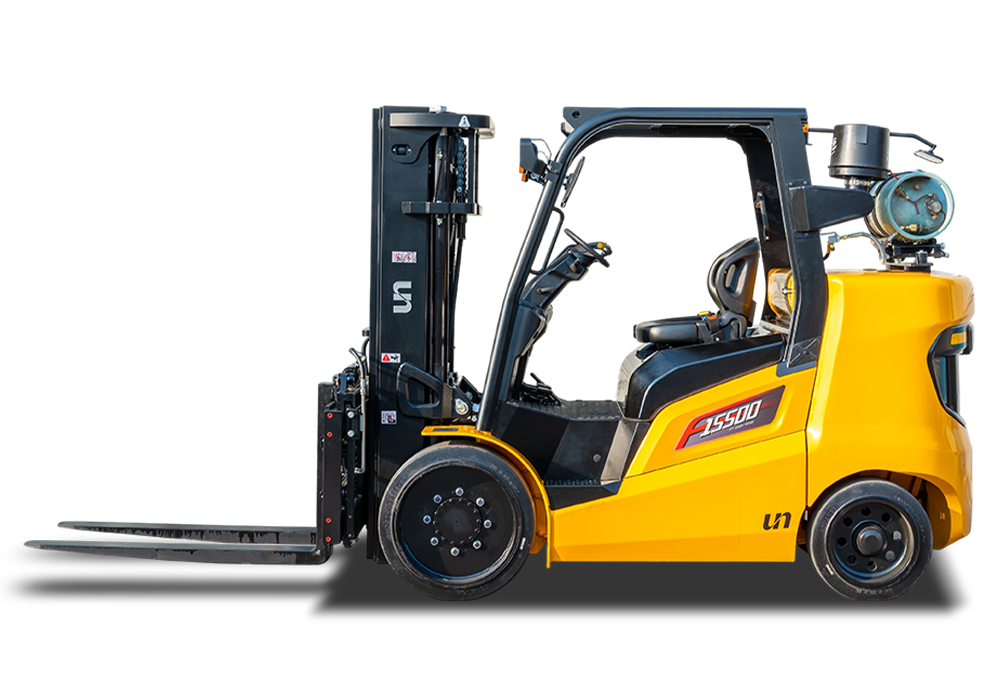
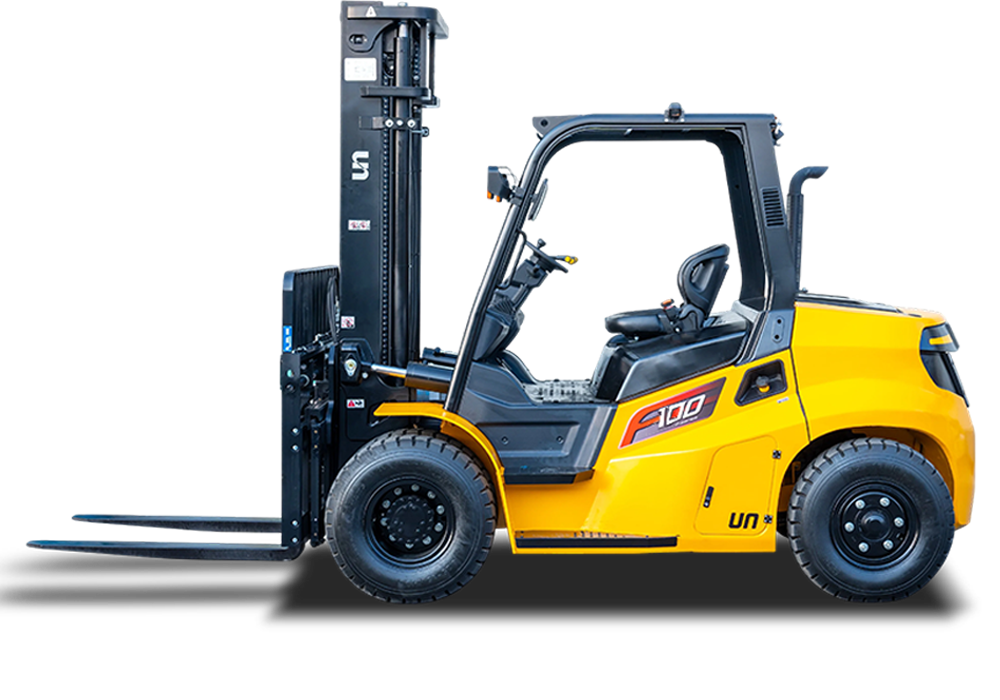
F Series 6.0T-7.0T LPG Forklift (Cushion Tire)
Product Overview
The F Series forklift is a heavy-duty LPG cushion tire model intended for industrial applications that require substantial lifting capability in a relatively compact package. The FL60T offers a rated load capacity of 13,500 lb, or 6,000 kg, while the FL70T provides a rated load capacity of 15,500 lb, or 7,000 kg.
Both configurations use a 24-inch, or 610-millimeter, load center. This specification is important because rated capacity is always related to the distance between the load center and the vertical face of the forks. A 610-millimeter load center represents a common heavy-load handling requirement and helps users evaluate whether the forklift is suitable for pallets, crates, steel products, industrial components, and other loads with substantial dimensions.
The two models share many important dimensions. Each has a length to the face of the fork without the fork of 118 inches, or 3,000 millimeters. Overall width is 55.9 inches, or 1,420 millimeters, and overhead guard height is 88 inches, or 2,235 millimeters. The outside turning radius is 102 inches, or 2,590 millimeters.
These dimensions create a practical balance between heavy-load capability and operational accessibility. A forklift with a high capacity but excessive width may be difficult to use in indoor production areas. Conversely, a compact forklift with insufficient capacity may require additional handling cycles or expose the machine to overload risks. The F Series is positioned between these extremes by combining a narrow body profile with substantial lifting performance.
Power is supplied by a Kubota WG3800 engine in both the FL60T and FL70T models. The LPG configuration is suitable for operations that require internal combustion performance while seeking a fuel type commonly used in indoor and semi-indoor industrial environments. LPG forklifts can provide consistent operation without relying on battery charging schedules, which can be valuable in multi-shift work.
The use of cushion tires further supports operation on firm, relatively smooth surfaces. Cushion tire forklifts are often selected for warehouses, factories, loading areas, and paved industrial floors where compact turning performance is more important than the ability to travel over rough terrain. Their design can help reduce the overall footprint of the machine and make it easier to position close to racks, production lines, trailers, and storage zones.
Key Specifications
The main specifications of the two F Series models are summarized below.
| Specification | Unit | FL60T | FL70T |
| Rated load capacity | lb (kg) | 13,500 (6,000) | 15,500 (7,000) |
| Load center | in (mm) | 24 (610) | 24 (610) |
| Length to face of fork, without fork | in (mm) | 118 (3,000) | 118 (3,000) |
| Overall width | in (mm) | 55.9 (1,420) | 55.9 (1,420) |
| Overhead guard height | in (mm) | 88 (2,235) | 88 (2,235) |
| Outside turning radius | in (mm) | 102 (2,590) | 102 (2,590) |
| Travel speed, no load | mph (km/h) | 13/13 (21/21) | 13/13 (21/21) |
| Maximum gradeability | % | 31/24 | 27/23 |
| Wheelbase | in (mm) | 74.2 (1,885) | 74.2 (1,885) |
| Total weight | lb (kg) | 19,510 (8,850) | 21,319 (9,670) |
| Engine model | — | Kubota WG3800 | Kubota WG3800 |
The table shows that the FL70T increases rated capacity to 7,000 kg while retaining the same overall width, wheelbase, turning radius, and overhead guard height as the FL60T. This common dimensional platform can simplify fleet planning. A customer may select the capacity level needed for a specific application without moving to a substantially wider machine.
The higher capacity of the FL70T is accompanied by a higher total weight of 9,670 kg, compared with 8,850 kg for the FL60T. The FL60T has maximum gradeability figures of 31 percent and 24 percent, while the FL70T is rated at 27 percent and 23 percent according to the specified operating conditions. Users should evaluate these figures together with load weight, surface condition, ramp design, and site safety procedures.
Heavy-Duty Lifting Capability
The most important advantage of the F Series is its ability to handle loads in the 6.0T and 7.0T class. Many material handling tasks cannot be performed efficiently with standard warehouse forklifts. Machinery components, metal products, large molds, construction materials, paper products, industrial containers, and heavy pallets may require a machine designed specifically for high-capacity lifting.
The FL60T offers a rated capacity of 6,000 kg, providing a substantial working margin for companies that regularly handle heavy materials. The FL70T extends this capability to 7,000 kg for applications where additional capacity is required. Choosing between the two models allows users to align the forklift with actual load requirements instead of automatically purchasing a larger machine than necessary.
High capacity also supports operational efficiency. When the forklift is correctly matched to the load, operators can move larger quantities in fewer trips. This may reduce handling time between storage areas, production lines, staging zones, and shipping points. In high-volume operations, fewer trips can help improve workflow consistency and reduce congestion.
However, rated capacity should not be interpreted as permission to lift every load weighing up to the stated maximum under every condition. Load center, attachment weight, mast configuration, load shape, lifting height, and ground conditions all affect safe handling. Operators and fleet managers should consult the machine’s official load chart and follow applicable workplace regulations.
Compared with a smaller forklift, the F Series provides a stronger platform for demanding tasks. Compared with an oversized heavy-duty machine, it may offer better access to facilities that cannot accommodate excessive width or turning requirements. This combination of lifting strength and compact geometry is one of the product’s primary competitive advantages.
LPG Power for Continuous Industrial Work
The LPG power system supports applications where continuous availability, rapid refueling, and internal combustion performance are important. Battery-electric forklifts can be highly effective in many facilities, but they may require charging infrastructure, battery exchange procedures, and planned charging intervals. An LPG forklift provides an alternative for customers whose work schedules, load demands, or operating environments are better suited to fuel-based equipment.
The Kubota WG3800 engine is specified for both models. Using the same engine platform across the two capacity options can help simplify operator familiarity, maintenance planning, and parts management within a fleet. It also gives customers a consistent powertrain concept when they operate both FL60T and FL70T forklifts in the same facility.
LPG forklifts are commonly considered for indoor and industrial applications because they do not produce the same type of particulate emissions associated with conventional diesel equipment. Nevertheless, proper ventilation, fuel storage, inspection, and local compliance remain essential. LPG systems must be operated and maintained by trained personnel in accordance with safety procedures.
For multi-shift applications, fuel-based operation can help reduce downtime associated with battery charging. A properly managed LPG supply system allows a machine to return to service quickly after refueling. This can be especially useful in manufacturing, logistics, and distribution operations where material flow continues throughout the day.
Fuel selection should always be based on the site environment, emission requirements, operating hours, available infrastructure, and local regulations. The F Series is most suitable for buyers who need heavy-duty internal combustion capability and who can provide an appropriate LPG operating environment.
Cushion Tires and Indoor Maneuverability
Cushion tires are a defining feature of this forklift. Unlike pneumatic tires designed for uneven outdoor ground, cushion tires are intended for hard, smooth surfaces. Their compact design can help reduce the machine’s overall footprint and support close-quarters maneuvering.
The 55.9-inch overall width is particularly relevant for indoor industrial operations. Production lines, storage aisles, loading bays, and transfer areas often have fixed boundaries. A forklift that is too wide may create delays, require more clearance, or limit access to certain zones. The F Series is designed to provide high capacity without adopting an excessively wide body.
The 102-inch outside turning radius also contributes to maneuverability. While turning requirements vary according to load size, attachment, aisle arrangement, and operator technique, a controlled turning radius can make it easier to position the forklift near racks, pallets, trucks, and processing equipment.
The combination of cushion tires, a compact width, and heavy-duty capacity gives the F Series a distinct position in the market. Some high-capacity forklifts are designed primarily for outdoor yards and may be too large for indoor use. Smaller cushion tire forklifts may fit narrow spaces but lack the capacity needed for heavy loads. The F Series addresses the middle ground: high-capacity handling on firm industrial surfaces within a relatively compact operating envelope.
Customers should confirm that the site surface is suitable for cushion tires. For gravel, mud, broken pavement, outdoor construction areas, and other uneven surfaces, a rough-terrain forklift or pneumatic tire model may be more appropriate. The F Series should be selected for applications that match its tire design and intended operating environment.
Stability, Chassis Design, and Load Control
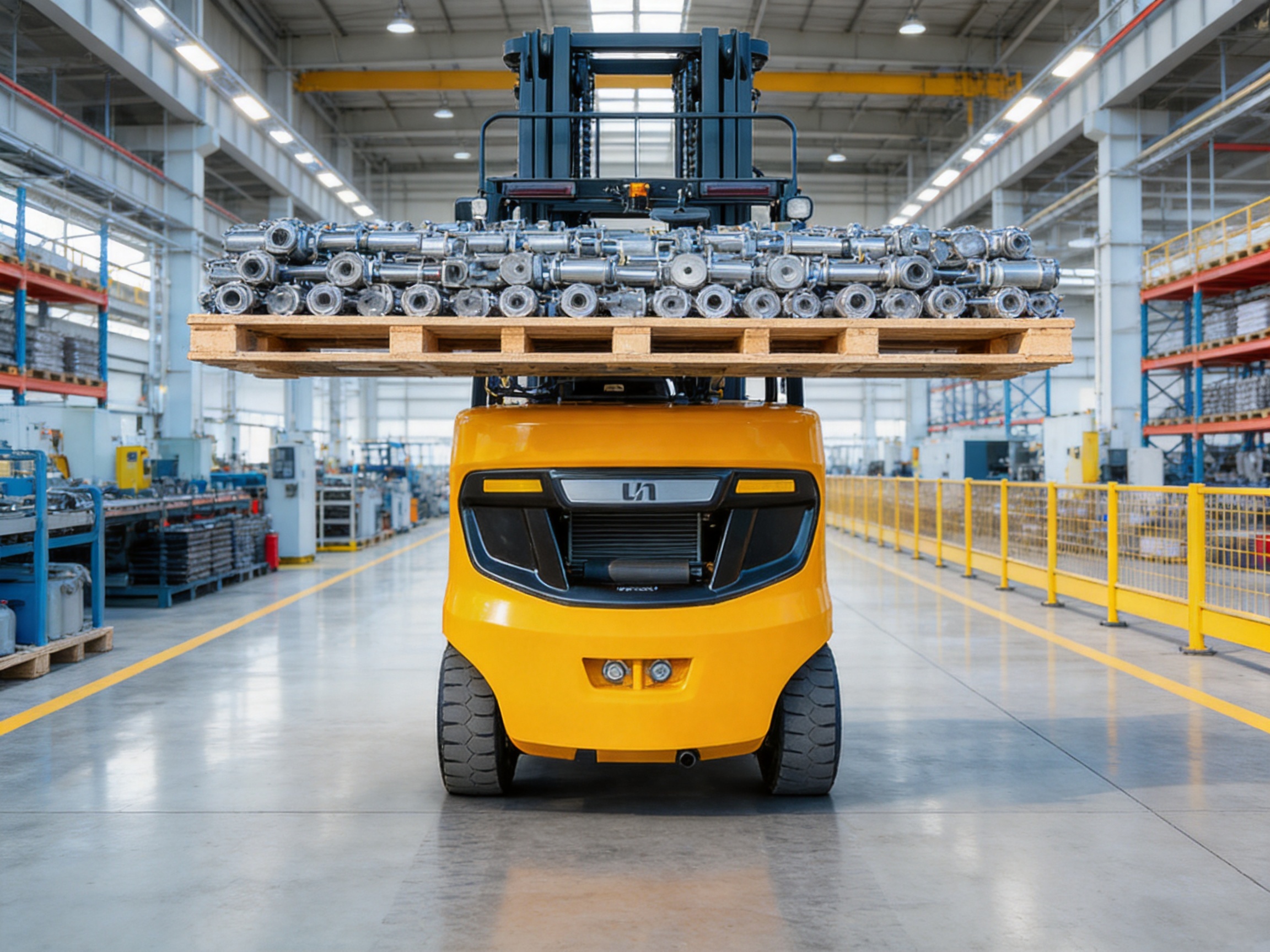
A heavy-duty forklift must provide more than a powerful engine. Its chassis, counterweight, wheelbase, mast system, axle arrangement, and load-handling components must work together to support stability during travel and lifting. The F Series has a 74.2-inch, or 1,885-millimeter, wheelbase in both configurations. This common wheelbase supports a consistent operating concept across the two models.
The total weight of the FL60T is 19,510 lb, or 8,850 kg, while the FL70T weighs 21,319 lb, or 9,670 kg. Machine weight is a functional part of forklift design because the counterbalance system helps offset the load carried on the forks. The specified weights reflect the substantial structure required for the rated lifting capacities.
Load handling must always be carried out with the load properly positioned, centered, and secured. Operators should avoid sudden turns, abrupt braking, excessive speed, and lifting loads that exceed the applicable capacity chart. Safe performance depends on the complete interaction between machine design, load characteristics, operator behavior, and site conditions.
The overhead guard height of 88 inches, or 2,235 millimeters, should be checked against doorways, lighting systems, sprinkler pipes, mezzanines, truck bodies, and other overhead obstructions. This dimension offers a useful reference for facility planning, but it does not replace a complete clearance assessment at the operating site.
A stable machine helps support predictable handling. When the forklift is correctly configured and operated within its rated limits, the operator can position heavy loads with greater confidence. This is particularly important when handling expensive equipment, fragile products, high-value materials, or loads that must be placed accurately in a production area.
Travel Performance and Gradeability
Both the FL60T and FL70T have a no-load travel speed specification of 13/13 mph, or 21/21 km/h, according to the supplied data. The two figures may correspond to different operating directions or specified travel conditions. Actual travel speed should always be controlled according to load, visibility, floor condition, traffic, pedestrian activity, and site rules.
Travel speed is valuable only when it is combined with control. In a heavy-duty facility, fast movement between loading and unloading points can improve productivity, but excessive speed can increase stopping distance and handling risk. The F Series is intended to provide a practical balance between transport efficiency and controlled operation.
Maximum gradeability is listed as 31/24 percent for the FL60T and 27/23 percent for the FL70T. These values indicate the machine’s specified ability to negotiate grades under stated test or operating conditions. The lower figures for the higher-capacity model should remind users that gradeability depends on total machine weight, load weight, direction of travel, surface traction, and ramp design.
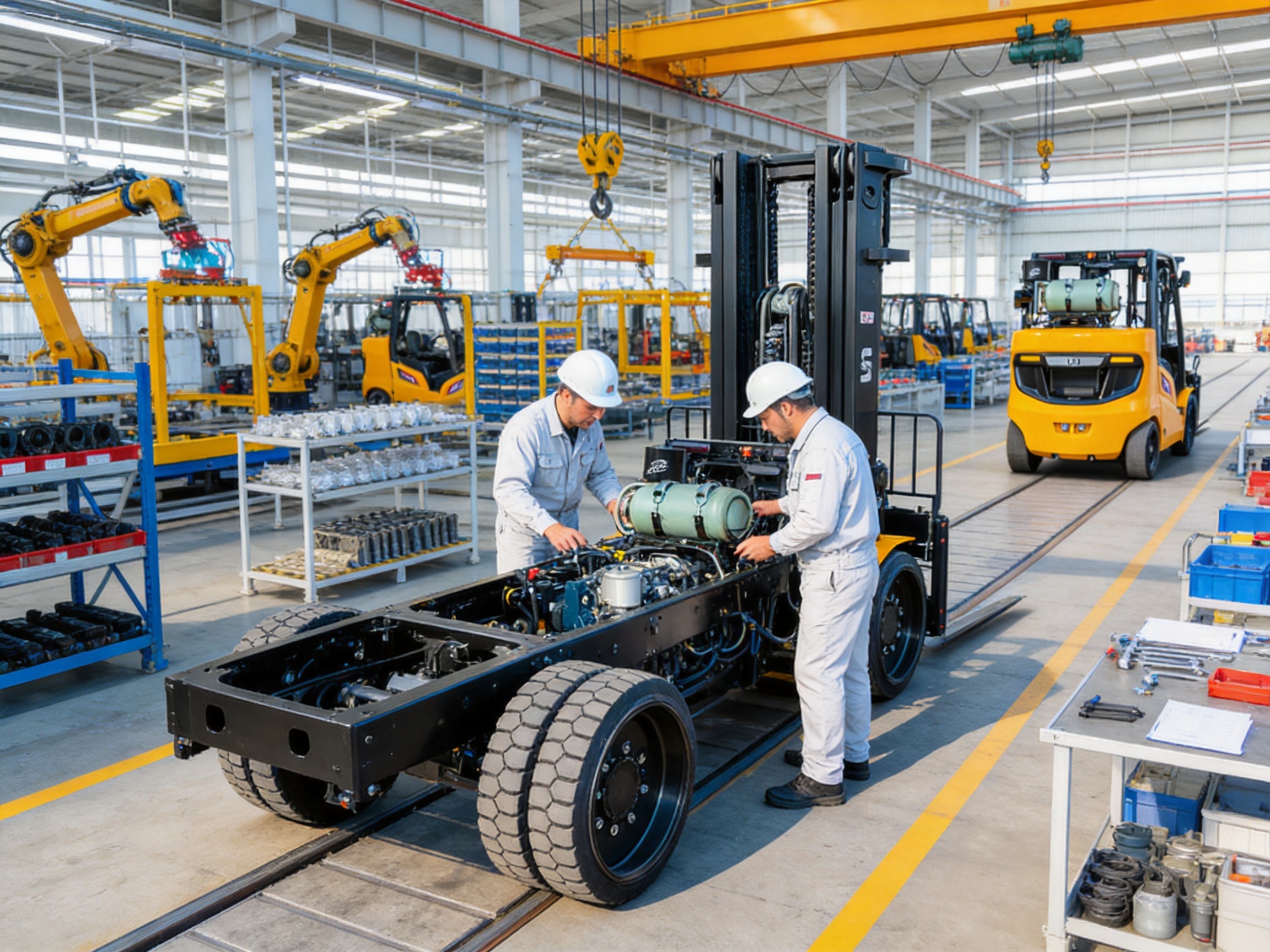
Facilities using ramps should establish clear procedures for loaded and unloaded travel. Loads should be positioned in accordance with safe forklift practice, visibility should be maintained, and operators should understand how the center of gravity changes on an incline. Gradeability figures are engineering specifications, not a substitute for a site-specific risk assessment.
Advantages over Alternative Heavy-Duty Forklift Choices
The F Series competes in a market that includes diesel forklifts, electric high-capacity forklifts, pneumatic tire LPG forklifts, and smaller cushion tire models. Its advantages are most apparent when the customer needs a combination of high capacity, indoor suitability, compact dimensions, and LPG operation.
Compared with a diesel forklift of similar capacity, the LPG cushion tire configuration may be more suitable for facilities that prioritize indoor use and a clean, hard-surface operating environment. It also avoids the need for battery charging infrastructure. The appropriate choice depends on emissions requirements, ventilation, duty cycle, fuel access, and local regulations.
Compared with a high-capacity electric forklift, the LPG model may offer more convenient refueling for customers operating long shifts without scheduled charging breaks. It can be a practical option for facilities that need continuous internal combustion operation and have established LPG handling procedures.
Compared with pneumatic tire forklifts, the cushion tire design can provide a more compact profile for smooth indoor floors. Pneumatic tires may be preferable for rough outdoor ground, while cushion tires are generally better matched to paved industrial surfaces and confined operating areas.
Compared with smaller cushion tire forklifts, the F Series provides significantly greater lifting capability. This can help reduce the need to divide loads, use multiple machines, or rent specialized equipment for occasional heavy tasks. The FL60T and FL70T also share a similar dimensional platform, allowing capacity selection without a major change in machine width.
Compared with very large heavy-duty forklifts, the F Series may offer easier access to indoor plants and warehouses because its overall width is 1,420 millimeters. The product is not intended to replace every larger yard or container-handling machine, but it can be a more balanced choice for customers whose loads are heavy but whose working areas remain relatively confined.
These advantages should be evaluated against the complete application. The right forklift is determined not only by rated capacity, but also by floor quality, lift height, attachment requirements, aisle width, operating hours, fuel availability, emissions standards, and maintenance support.
Manufacturing Experience and Industrial Capability
The product is manufactured by Zhejiang UN Forklift Co., Ltd., a company that integrates research and development, production, sales, and service. This integrated structure is important in the forklift industry because product performance depends on coordination between engineering, manufacturing, testing, supply chain management, field feedback, and after-sales support.
The company was founded in 1978 and has developed a broad material handling portfolio over several decades. Its reported product range includes 17 varieties, 96 series, and more than 200 specifications. Such product breadth requires experience in different vehicle architectures, power systems, lifting configurations, control systems, and application requirements.
The company’s facility covers 53,400 square meters, with an annual production capacity of 15,000 units. Production capacity alone does not determine quality, but it indicates the scale of the organization’s manufacturing operations and its ability to support customers across multiple markets.
The company has experience with internal combustion forklifts as well as electric and warehouse equipment. It has also developed reach forklifts and VNA trucks, and it reports that China’s first reach forklift and VNA truck were developed at the company. This background is relevant because it demonstrates experience in both heavy-duty counterbalance equipment and specialized warehouse handling solutions.
Manufacturing an LPG cushion tire forklift requires coordination among structural fabrication, counterweight production, mast assembly, steering and axle installation, powertrain integration, hydraulic system installation, painting, electrical integration, final assembly, and inspection. Each stage influences the reliability and usability of the finished machine.
A mature manufacturer can use experience from multiple product categories to improve design decisions. For example, feedback from warehouse equipment may inform maneuverability and operator visibility, while experience with internal combustion forklifts may support powertrain durability and heavy-load structural design. Cross-category engineering knowledge can help create a machine that is both strong and practical.
Research and Development Strengths
Research and development is central to the company’s long-term product strategy. The company holds national patents for electric forklift technologies and has participated in the formulation of Chinese electric forklift industry standards. Although the F Series is an LPG model, this broader technical capability reflects an organization that works across multiple powertrain and vehicle technologies.
The company has also developed new energy products in response to global attention to carbon emissions. Its portfolio includes diesel-to-lithium-ion forklifts and standard lithium-ion battery forklifts. This gives customers access to different energy solutions as their operational and environmental requirements change.
In addition, the company supplies internal combustion forklifts designed for high-emission-standard markets, including the European Union and North America. Market-specific development requires attention to regulatory requirements, operating conditions, documentation, component selection, and customer expectations.
The development of the F Series for North American operating environments demonstrates the importance of application-oriented engineering. A forklift designed for this market must consider imperial and metric specifications, common industrial layouts, operator expectations, fuel practices, safety requirements, and the working conditions found in North American facilities.
Technical development is not limited to creating a new model. It also includes improving manufacturability, simplifying service access, standardizing components where practical, validating performance, and responding to customer feedback. These activities can influence the total cost of ownership throughout the machine’s service life.
Advanced Manufacturing Processes
The supplied company information identifies an integrated manufacturing organization rather than a trading operation. This distinction matters to buyers seeking a heavy-duty forklift because the manufacturer’s control over engineering and production can influence consistency, customization capability, quality management, and technical support.
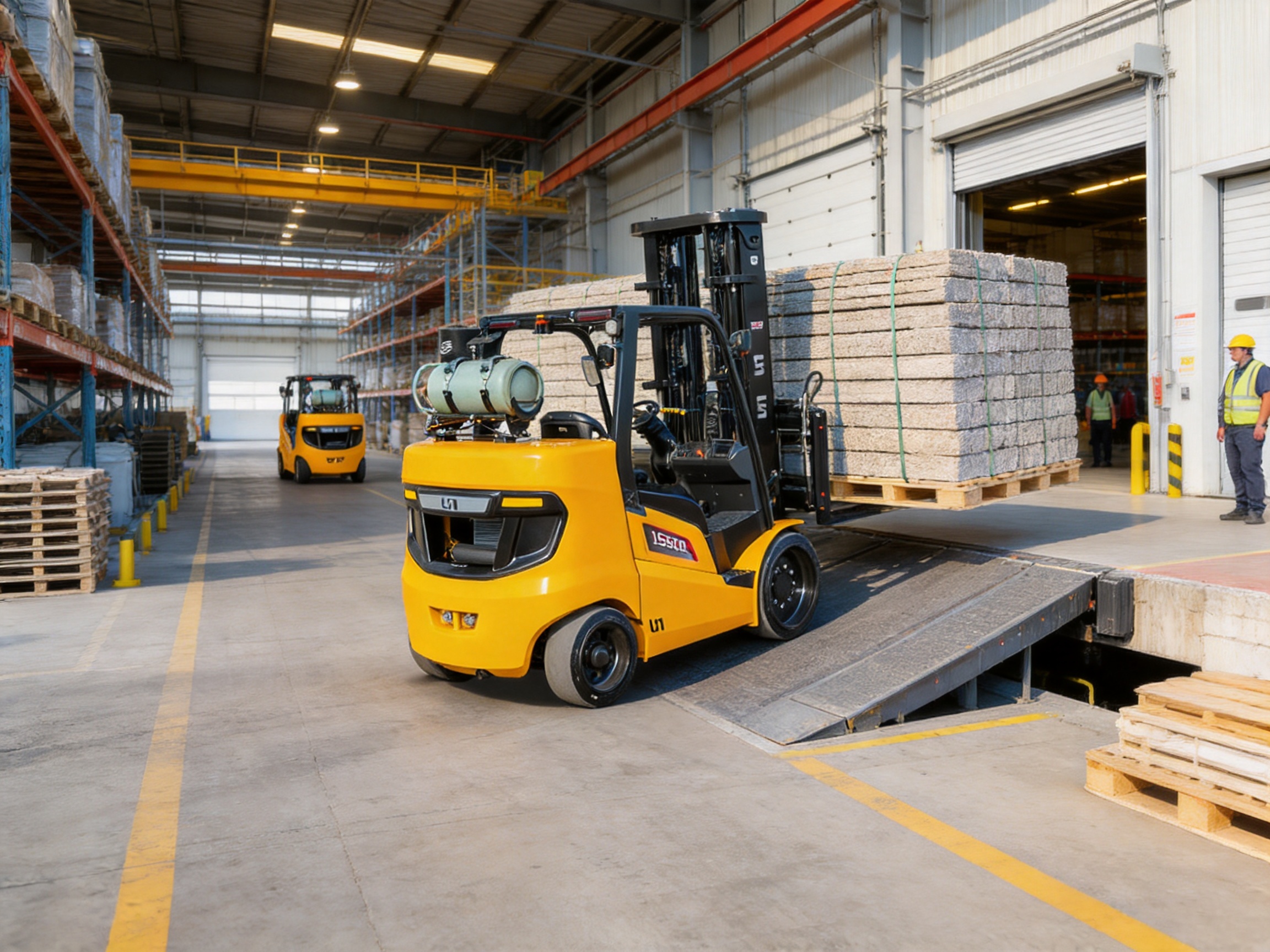
A typical heavy-duty forklift manufacturing process begins with engineering design and specification confirmation. The manufacturer must establish the rated capacity, load center, wheelbase, tire type, powertrain, counterweight, mast arrangement, hydraulic requirements, and target operating environment. The F Series specifications reflect a design developed around a clear application: high-capacity LPG handling on hard industrial surfaces.
Structural components require accurate fabrication and strong joining processes. The frame and counterweight must support the machine’s operating loads, while the mast and fork carriage must transfer lifting forces safely. Dimensional accuracy is important because errors in alignment can affect steering, mast movement, tire wear, hydraulic operation, and load positioning.
Powertrain integration is another critical stage. The Kubota WG3800 engine must be installed with the appropriate fuel system, cooling arrangement, exhaust components, transmission interface, controls, and mounting structure. The final system must operate as a coordinated unit rather than as a collection of unrelated components.
Hydraulic assembly requires attention to hose routing, fittings, valve performance, cylinder installation, contamination control, and pressure testing. The hydraulic system is responsible for lifting and tilting functions, so consistent operation is essential for accurate load handling. Proper assembly and inspection can help reduce the risk of leakage, uneven movement, or premature wear.
Cushion tire installation and axle assembly must be matched to the intended floor environment and load capacity. The steering system must provide predictable response within the specified turning radius, while the braking system must be capable of controlling a machine with a substantial total weight.
Electrical integration includes the instrument panel, lighting, switches, sensors, safety-related circuits, engine controls, and warning systems. Even an internal combustion forklift depends on reliable electrical architecture for starting, monitoring, and operator information. Harness routing and connector protection are important considerations in an industrial machine exposed to vibration, dust, heat, and repeated use.
Surface treatment and painting provide more than visual appeal. Proper preparation and coating can help protect structural components against corrosion and support a consistent appearance across the fleet. Industrial customers often operate forklifts in environments where moisture, dust, chemicals, and temperature changes can affect exposed surfaces.
Final assembly should be followed by systematic inspection and functional testing. Tests may include engine operation, steering response, braking, mast movement, hydraulic performance, travel behavior, instrumentation, and general assembly verification. Load testing and performance checks must be conducted according to the manufacturer’s procedures and applicable standards.
Although individual process details are not provided in the source material, the company’s integrated R&D and production structure supports a manufacturing approach in which engineering requirements can be carried through to assembly and validation. This is a key strength when producing equipment for demanding industrial use.
Service, Parts, and Global Support
A forklift is a long-term industrial asset, and its value depends on more than the initial purchase price. Availability of service information, replacement parts, technical assistance, and regional support can influence uptime and ownership cost. The company reports a worldwide sales and service network with partners in Europe, South America, North America, Africa, and Asia.
International support is particularly important for customers operating mixed fleets or purchasing equipment for multiple locations. A global network can help coordinate product supply, service communication, parts inquiries, and local customer support. Actual service availability should be confirmed with the relevant regional distributor or sales representative before purchase.
The company also maintains a dedicated parts inquiry contact, which indicates the importance of replacement parts support within its business structure. For a heavy-duty forklift, common service planning may include engine maintenance, LPG system inspection, hydraulic filters, lubricants, tires, brakes, steering components, mast rollers, chains, forks, and electrical parts.
Preventive maintenance should be scheduled according to operating hours, load severity, environmental conditions, and manufacturer recommendations. Heavy loads, multi-shift use, dust, heat, and poor floor conditions may increase wear. A planned maintenance program can help identify problems before they affect production.
Operators should conduct daily inspections before use. These inspections may include checking fluid levels, LPG connections, tires, forks, mast chains, hydraulic hoses, brakes, steering, lights, warning devices, seat restraints, and visible structural components. Any abnormality should be reported and corrected before the forklift returns to service.
Proper training is equally important. Even a well-manufactured forklift cannot compensate for overloading, poor visibility, unsafe speed, improper parking, unauthorized modifications, or operation on unsuitable surfaces. Customers should establish site-specific procedures and ensure that operators are trained and authorized.
Application Areas
The F Series is suited to a variety of heavy-duty industrial applications. In manufacturing plants, it can move dies, molds, machinery components, steel products, castings, and production materials. Its compact width may be useful where heavy loads must travel between production lines, storage areas, and loading docks.
In warehouses and distribution centers, the forklift can handle dense pallets, heavy industrial goods, large containers, and inbound or outbound shipments. Cushion tires are appropriate where floors are paved and maintained, while the LPG power system supports extended work schedules.
In metal processing and fabrication, the 6,000-kg and 7,000-kg capacity classes may support handling of raw materials, finished components, coils, plates, tooling, and heavy assemblies. Operators must use the correct attachment and verify capacity when load dimensions or centers differ from the standard specification.
In building-material operations, the forklift may be used for concrete products, stone, packaged materials, structural components, and other dense loads. The suitability of the machine depends on surface conditions. If the work is primarily on smooth indoor floors, the cushion tire configuration may be appropriate; if the work involves rough yards, another tire type may be required.
In shipping and receiving areas, the forklift can support trailer loading, unloading, staging, and transfer operations. The 88-inch overhead guard height and 55.9-inch width should be checked against dock doors, trailer clearances, and facility layouts.
In equipment rental fleets, the FL60T and FL70T may serve customers requiring higher capacity than standard warehouse forklifts. The two-model range allows a rental provider to offer different lifting levels while maintaining a similar basic dimensional platform and engine model.
Choosing between the FL60T and FL70T
The FL60T is suitable for customers whose normal requirements center on loads up to 6,000 kg at the specified 610-millimeter load center. It may be an efficient choice when the facility needs substantial capacity but does not routinely handle 7,000-kg loads.
The FL70T is intended for applications requiring up to 7,000 kg at the same specified load center. It provides an additional capacity level while retaining the same overall width, wheelbase, turning radius, overhead guard height, and engine model shown in the specifications.
Customers should analyze the heaviest regular load, not only the average load. Occasional heavy items may justify selecting the higher-capacity model if renting another machine would interrupt production or create additional logistics costs. At the same time, choosing the smallest suitable model can reduce acquisition and operating costs when the higher capacity is not needed.
Attachment requirements must also be considered. Clamps, rotators, fork extensions, booms, and other attachments add weight and may change the load center. The applicable capacity must be recalculated using the manufacturer’s approved configuration and load chart.
Facility layout is another selection factor. Both models have the same listed width and turning radius, but customers should still test aisle access with the intended load and attachment. The load itself may require more clearance than the forklift.
Operational and Economic Value
The economic value of a heavy-duty forklift is created through safe productivity, uptime, serviceability, and suitability for the application. A machine that can move the required load in fewer cycles may help reduce handling time. A machine that fits the facility can avoid costly layout changes. A machine that matches the fuel and shift pattern can reduce operational interruptions.
The F Series supports these objectives through its combination of high capacity and compact dimensions. The LPG system provides an alternative to battery-dependent operation, while cushion tires match smooth industrial floors. The FL60T and FL70T capacity choices help customers avoid selecting a machine that is either too small or unnecessarily large.
Economic evaluation should include fuel consumption, maintenance, tires, operator training, infrastructure, insurance, downtime, and residual value. Buyers should request complete operating data for their specific duty cycle and compare the result with alternative powertrain options.
Fuel and emissions requirements may vary by country, region, and facility. Customers should verify that the LPG configuration complies with local regulations and site policies. Ventilation and fuel-handling arrangements should be established before equipment delivery.
Long-term value also depends on parts availability and technical support. The company’s international sales and service network can be an advantage for customers who need assistance beyond the initial purchase. Regional support capabilities should be confirmed during the procurement process.
Safety and Responsible Use
Heavy-duty forklift safety begins with correct machine selection. The load must remain within the applicable capacity rating, and the load center must be considered. Loads should be stable, evenly distributed, and secured when necessary. Damaged pallets, unstable containers, or shifting materials can create hazards even when the total weight is below the nominal capacity.
Operators should keep the load as low as practical during travel, maintain clear visibility, use appropriate warning devices, and follow pedestrian-control procedures. Speed should be reduced near intersections, ramps, doorways, loading docks, and areas with limited visibility.
LPG cylinders, hoses, valves, and connections should be inspected regularly. Refueling should take place in a designated area with suitable ventilation and according to approved procedures. Smoking, open flames, and unauthorized service work should be prohibited near fuel-handling areas.
Cushion tires should be inspected for wear, damage, and correct installation. The forklift should not be used on surfaces that exceed the intended capability of the tires. Uneven ground can affect stability, traction, ride quality, and component life.
Maintenance personnel should use approved parts and follow the manufacturer’s service instructions. Modifications that affect capacity, visibility, stability, emissions, or safety systems should not be made without authorization and engineering review.
Frequently Asked Questions
What are the rated capacities of the two models?
The FL60T has a rated load capacity of 13,500 lb, or 6,000 kg. The FL70T has a rated load capacity of 15,500 lb, or 7,000 kg. These ratings apply at the specified 24-inch, or 610-millimeter, load center and must be confirmed against the applicable load chart and configuration.
What type of fuel does the forklift use?
The product is an LPG forklift and uses a Kubota WG3800 engine in both the FL60T and FL70T configurations. Customers should verify fuel-system requirements, local regulations, ventilation, storage, and refueling procedures before operation.
What are cushion tires best suited for?
Cushion tires are best suited to firm, smooth surfaces such as warehouse floors, factory floors, paved loading areas, and other maintained industrial surfaces. They are generally not the first choice for rough terrain, loose ground, mud, or severely uneven outdoor yards.
How wide is the forklift?
Both models have an overall width of 55.9 inches, or 1,420 millimeters. This relatively compact width can be beneficial in indoor industrial areas, although the complete aisle requirement must also account for the load, fork length, attachment, and turning method.
What is the turning radius?
The outside turning radius is listed as 102 inches, or 2,590 millimeters, for both models. Actual maneuvering space depends on the load, attachment, operating speed, floor conditions, and facility layout.
Do both models use the same engine?
Yes. The supplied specifications identify the Kubota WG3800 engine for both the FL60T and FL70T. Using the same engine model can support consistency in operator training and fleet maintenance planning.
Which model should a customer choose?
The FL60T is appropriate when the required capacity is within the 6,000-kg class. The FL70T is appropriate when loads may reach the 7,000-kg class or when additional capacity is needed for the application. Selection should consider load center, attachment weight, lifting height, duty cycle, floor conditions, and local safety requirements.
Can the forklift be used outdoors?
The product is designed for industrial applications and uses cushion tires, so it is most suitable for firm, smooth surfaces. It may be used in suitable paved outdoor areas, but rough terrain, loose ground, or poor surfaces may require a pneumatic tire or rough-terrain forklift instead.
What manufacturing experience supports this product?
The manufacturer has operated since 1978 and integrates research and development, production, sales, and service. It operates a 53,400-square-meter facility, reports annual production capacity of 15,000 units, and maintains a broad product portfolio covering internal combustion, electric, warehouse, reach, VNA, and lithium-ion equipment.
Does the company support international customers?
The company reports a worldwide sales and service network with partners in Europe, South America, North America, Africa, and Asia. Customers should confirm regional dealer coverage, parts availability, warranty conditions, and technical support before placing an order.
Conclusion
The F Series 6.0T–7.0T LPG Cushion Tire Forklift is designed for businesses that need substantial lifting capability without sacrificing the compact dimensions required in indoor and industrial facilities. The FL60T and FL70T provide 6,000-kg and 7,000-kg capacity options, respectively, while sharing a 1,420-millimeter overall width, 2,590-millimeter outside turning radius, 1,885-millimeter wheelbase, and Kubota WG3800 engine platform.
Its primary advantages include heavy-duty capacity, LPG operating flexibility, cushion tire maneuverability, a relatively compact body, and two capacity levels on a similar dimensional platform. These characteristics make it a strong candidate for manufacturing, warehousing, distribution, metal processing, building-material handling, and other applications conducted on firm industrial surfaces.
The product is supported by the manufacturing experience of Zhejiang UN Forklift Co., Ltd., an established material handling equipment producer with integrated R&D, production, sales, and service capabilities. The company’s broad product portfolio, international network, electric forklift patents, industry-standard participation, and experience developing new energy products demonstrate a diversified technical foundation.
For the best result, customers should match the forklift to the actual application rather than relying only on rated capacity. Load center, attachment, lift height, floor condition, aisle width, operating hours, fuel infrastructure, emissions requirements, and service support should all be reviewed before purchase.
When correctly specified and responsibly operated, the F Series provides a balanced solution for customers seeking a heavy-duty LPG forklift that can work efficiently in demanding industrial environments while remaining practical for confined operating areas.
References
1. Product specification information for the F Series 6.0T–7.0T LPG Forklift with Cushion Tires, including FL60T and FL70T model data.
2. Manufacturer-provided company profile and corporate history for Zhejiang UN Forklift Co., Ltd.
3. Manufacturer-provided information regarding research and development, product categories, production capacity, and international service support.
4. General principles of powered industrial truck selection, rated capacity, load center evaluation, operator training, and workplace safety.
5. General industrial guidance concerning LPG-powered forklift operation, cushion tire applications, preventive maintenance, and facility suitability.
Product: F Series 6.0T-7.0T LPG Forklift (Cushion Tire)
For exclusive deals and latest offers, sign up by entering your email address below.
Stay In Touch
ADDRESS : NO.1 ROAD ONE, XINDENG NEW DISTRICT, FUYANG, HANGZHOU, ZHEJIANG, CHINA 311404.
PHONE : +86-571-8688 8355 (AMERICA)
PHONE : +86-571-8886 9363 (EUROPE)
PHONE : +86-571-8688 8377 (ASIA, AFRICA, OCEANIA)
EMAIL : [email protected]
EMAIL : [email protected](PARTS INQUIRY)

