


 中文简体
中文简体 Français
 русский
 Español
 عربى
عربى Deutsch



High-Density Warehouse Performance with a Man-Down Very Narrow Aisle Truck
Admin 2026-07-05Modern warehousing is measured by cubic utilization, order speed, safety, and the ability to handle more stock without expanding the building footprint. The Man Down VNA truck is designed for precisely this challenge. As a battery-powered very narrow aisle truck, it supports pallet handling, transport, stacking, and high-level storage in aisles that are far narrower than those required by conventional counterbalance forklifts. For operations where every square meter of warehouse space must produce value, this machine offers a practical path to higher storage density and more controlled material flow.
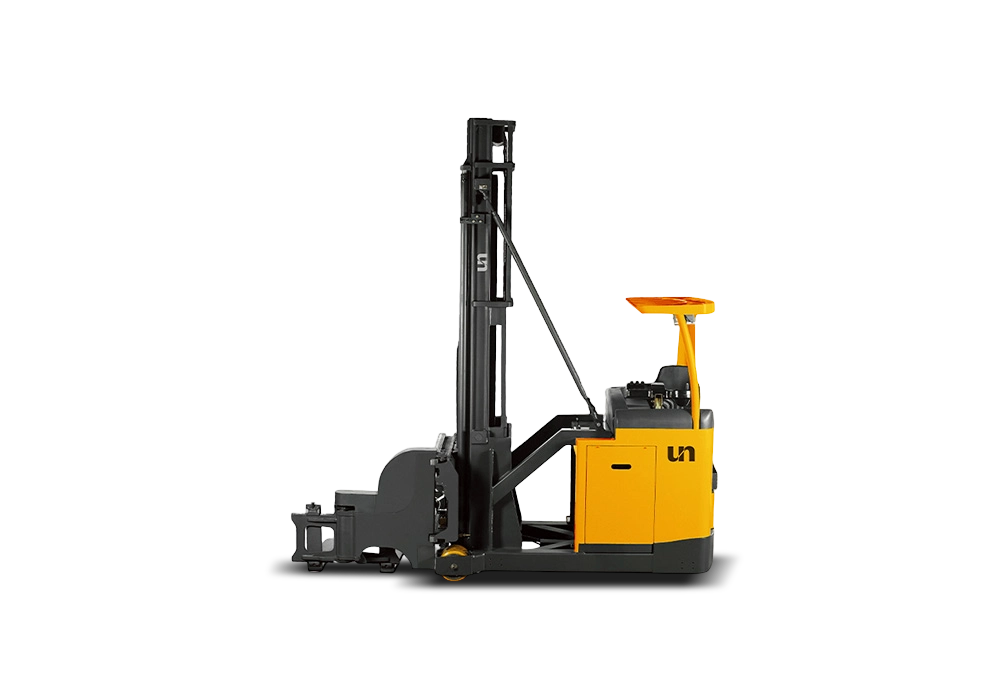
The product is positioned as a specialized warehouse equipment solution rather than a general-purpose forklift. It is built for high-rack environments, distribution centers, manufacturing warehouses, spare parts facilities, cold-chain support areas, and any site where long aisles, tall racking, and frequent pallet movements must be coordinated efficiently. With a rated load capacity of 1,500 kg in its core specification, a 600 mm load center, battery power, electronic steering, electromagnetic braking, automatic height control, and CAN-BUS system support, the truck is engineered to combine productivity with operational control.
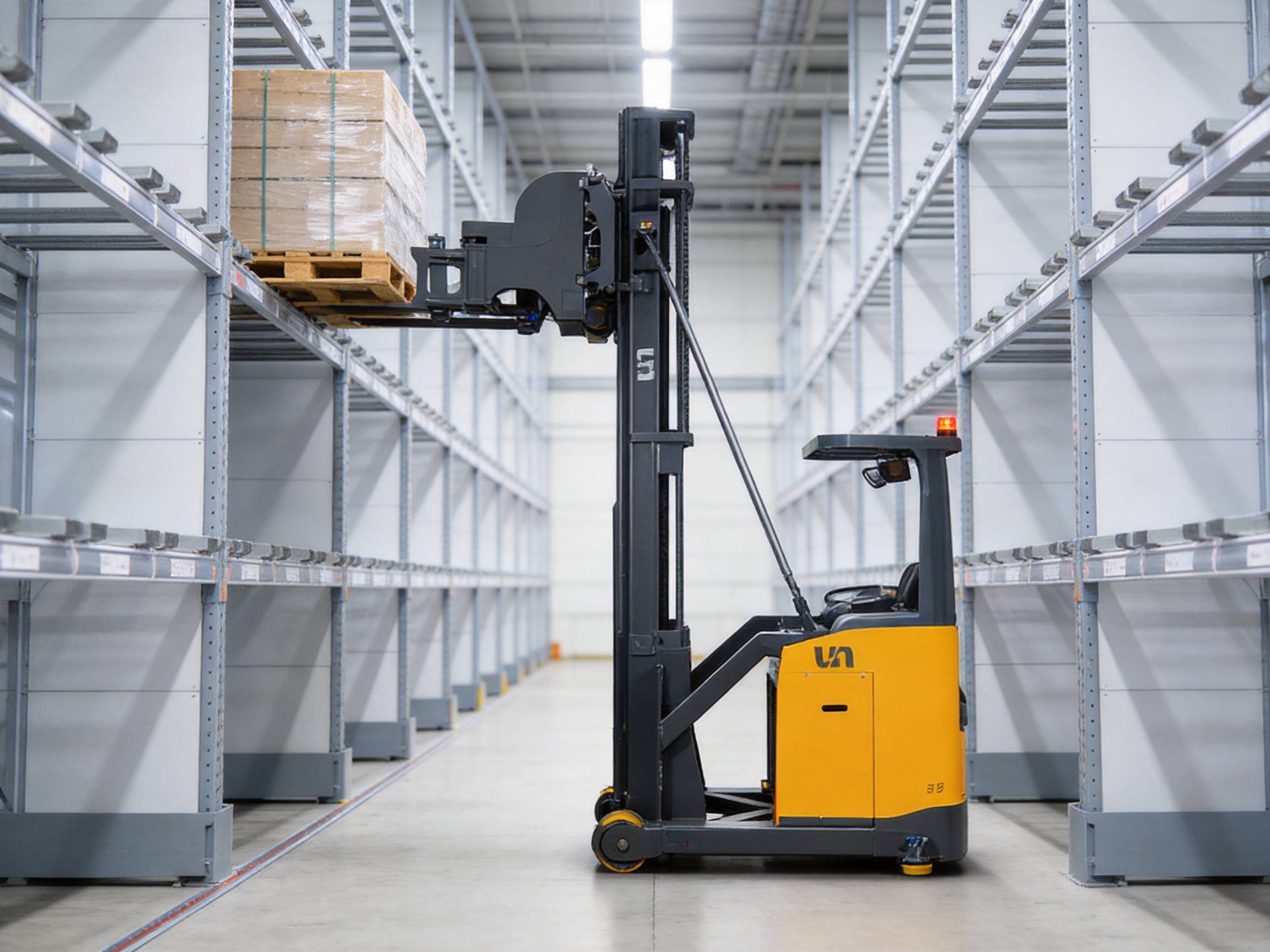
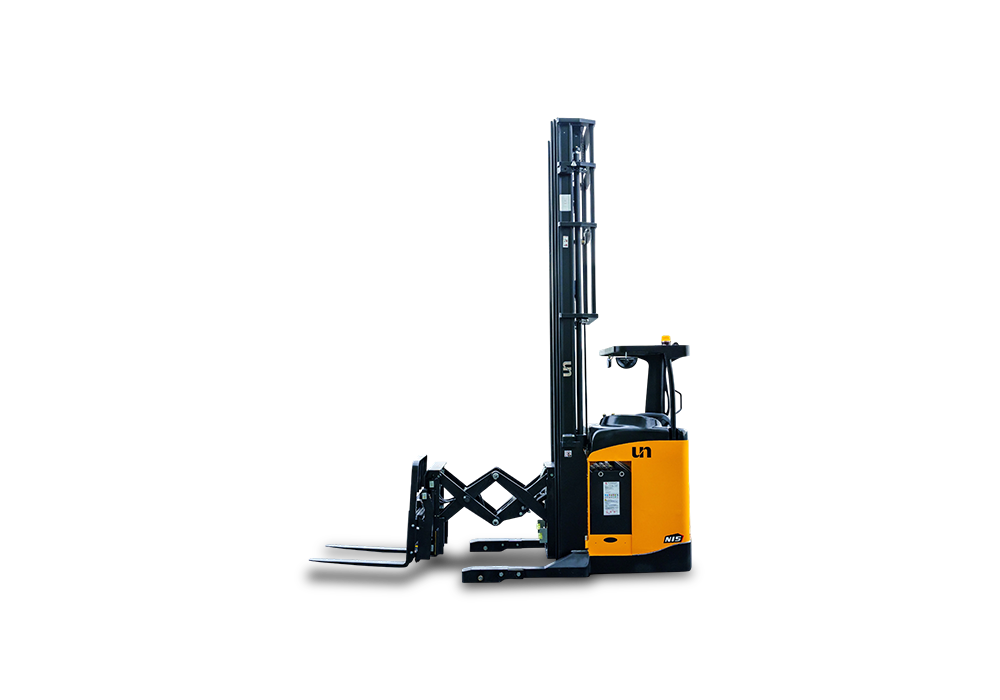
Unlike a standard electric forklift that must turn fully into a pallet location, a very narrow aisle truck works with a turret-style fork system capable of side shifting and rotating. This allows the truck to handle pallets from either side of the aisle while the chassis remains largely aligned with the aisle direction. The result is a smaller working aisle requirement, improved storage density, and a smoother workflow for repetitive pallet movements.
Product Positioning in a High-Density Warehouse
The Man Down VNA truck belongs to the VNA truck category, a category developed for warehouses that cannot afford wasted space. Traditional warehouse layouts often require wide aisles to allow turning and positioning. These wide aisles reduce the number of rack rows that can be installed in a given building. By contrast, a very narrow aisle layout can increase rack count and improve vertical storage capacity, especially when paired with high-lift equipment.
This truck is suitable for companies that need to raise storage density without purchasing or constructing additional warehouse space. In many operations, the cost of property, building expansion, labor, and handling delays is much higher than the cost of choosing the correct truck. A VNA truck therefore becomes not only a piece of equipment, but also a warehouse strategy.
The model information supplied for the product includes FBAP15-UQZ2 and FBAP15 references, with a battery power system and sit-on operation. Its key operating values include a rated capacity of 1,500 kg, rated lift height of 6,000 mm in the main specification table, and mast options extending into high-lift ranges. The mast specification table shows a broad selection of three-stage full free wide-view mast options, with maximum fork heights from 4,000 mm up to 11,000 mm, depending on mast selection and capacity requirements.
Core Advantages Over Conventional Forklifts
The first advantage is space utilization. Conventional counterbalance forklifts typically require wider aisles because the whole truck must turn and align with the pallet position. In a VNA system, the truck can travel within a narrow aisle while its forks rotate and shift to reach loads on either side. This architecture allows warehouses to place racking closer together and increase pallet positions within the same floor area.
The second advantage is high-level storage capability. With mast options reaching up to 10,000 mm in the product description and an additional listed mast option of 11,000 mm at reduced capacity, the truck is designed for vertical storage strategies. This matters because warehouse cost is not only calculated by floor area. The unused air volume above low-level racking represents lost potential. A high-lift VNA truck helps convert that volume into productive storage space.
The third advantage is controlled aisle operation. The product includes an aisle automatic guiding function and aisle terminal deceleration and alarm function. These features are valuable in VNA operations because the aisle environment is narrow and highly structured. Instead of relying only on operator judgment, the truck can support more consistent travel behavior inside the aisle, helping reduce the risk of impacts and abrupt movements.
The fourth advantage is ergonomic and precise control. The electromagnetic proportional hydraulic fingertip control system allows the operator to manage hydraulic functions with smooth input. Compared with less refined control systems, fingertip hydraulic operation can improve accuracy when positioning pallets at height, especially in high-rack applications where small adjustments matter.
The fifth advantage is integrated electronic intelligence. CAN-BUS system support provides a communication architecture that enables safety functions, system monitoring, and coordinated control of truck operations. In a competitive market where some machines still rely on simpler electrical architectures, CAN-BUS support helps improve diagnostic capability, feature integration, and reliability in complex warehouse environments.
Key Specifications
The following table summarizes important specifications from the product data. Actual configuration may vary according to mast selection, application environment, and customer requirements.
Item |
Specification |
Model |
FBAP15-UQZ2 / FBAP15 series reference |
Power Type |
Battery |
Operation Type |
Sit-on |
Rated Load Capacity |
1,500 kg |
Load Center |
600 mm |
Rated Lift Height |
6,000 mm in main specification |
Maximum Mast Options |
Up to 10,000 mm in product positioning, with listed mast option to 11,000 mm at reduced capacity |
Fork Size |
1,070 x 120 x 40 mm |
Overall Width |
1,600 mm |
Working Aisle Width |
1,700 mm |
Minimum Turning Radius |
2,270 mm |
Travel Speed, Full Load |
9 km/h |
Travel Speed, No Load |
9.5 km/h |
Lifting Speed, Full Load |
220 mm/s |
Lifting Speed, No Load |
250 mm/s |
Battery |
48 V / 840 Ah |
Drive Motor |
6 kW |
Lift Motor |
11 kW |
Steering System |
Electronic |
Service Brake |
Electromagnetic |
Controller Type |
AC |
Controller Manufacturer |
ZAPI |
Warehouse Efficiency Through Very Narrow Aisle Design
The working aisle width of 1,700 mm is one of the most important values in the specification. In many warehouses, aisle width is a hidden cost. Each extra centimeter assigned to travel space is a centimeter taken away from storage. When a warehouse uses standard forklifts, aisles may need to be wide enough for turning, reversing, correcting, and safe load approach. In a VNA layout, the truck is intended to operate in a more disciplined corridor with guided travel and side-handling capability.
The Man Down VNA truck helps reduce wasted travel space by allowing the operator to move down the aisle and access rack locations through fork rotation and side shifting. With a fork rotation angle of 180 degrees and an 8-second fork rotation time, the truck can work both left and right rack faces without leaving the aisle. This contributes to faster cycles in repetitive storage and retrieval tasks.
In high-throughput warehouses, efficiency is not only about maximum travel speed. It is about the total time required to approach, position, lift, place, lower, and move to the next task. A truck that reduces repositioning can be more productive than a faster truck that requires more maneuvering. The Man Down VNA truck is designed around this principle. Its layout and functions aim to reduce non-productive movements, support precise pallet handling, and maintain stable travel behavior in narrow aisles.
High-Lift Capability and Mast Flexibility
The mast range is a major strength of the truck. The three-stage full free wide-view mast options listed in the product data cover maximum fork heights from 4,000 mm to 11,000 mm. This range allows the equipment to be matched to different rack heights, ceiling conditions, and load requirements. For example, a lower mast may preserve higher load capacity and reduce overall mast height, while a taller mast can support high-bay storage strategies when capacity at height is properly calculated.
At 6,000 mm, the listed load capacity is 1,300 kg for one configuration and 1,500 kg for another reference in the mast capacity table. As the mast height increases, the load capacity gradually decreases, which is normal for high-lift equipment. At 10,000 mm, the listed capacities are 500 kg and 700 kg depending on the version. This capacity curve is important because serious warehouse planning must consider not only the maximum height, but also the actual load weight at each level.
This transparent mast specification approach is useful for warehouse engineers. Instead of selecting equipment based only on a headline lift height, decision-makers can compare load capacity, lowered mast height, extended height, and free lift. These values determine whether the truck can enter the building, clear doorways, work under sprinklers, and handle pallets safely at the intended rack level.
Safety-Oriented Functions
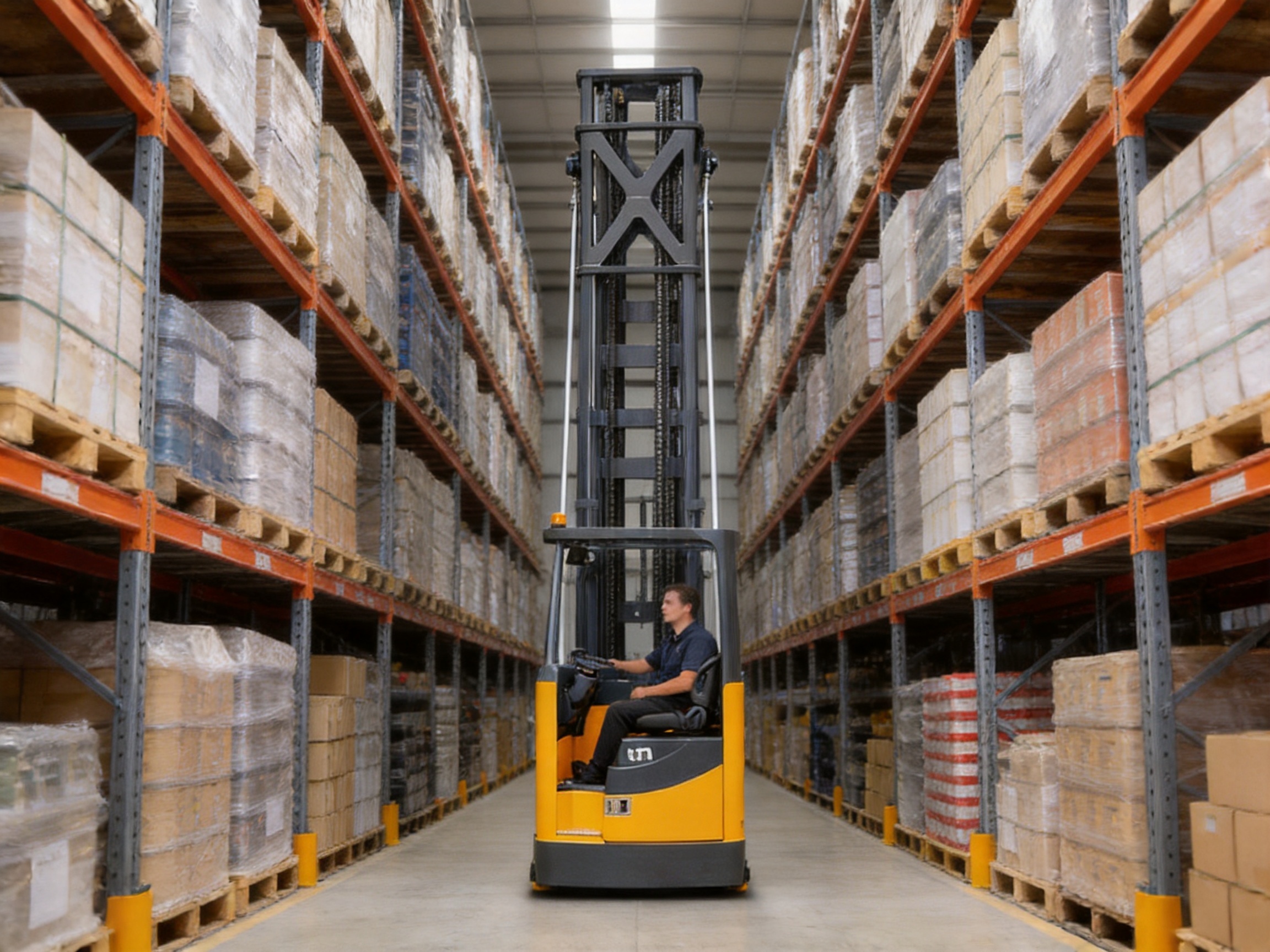
Safety is especially important in VNA operations because the truck works in narrow, high-rack environments. The Man Down VNA truck includes several features designed to support safer operation. The lifting height fixing device helps control lifting at defined positions, which can improve consistency when placing pallets in repetitive rack levels. Automatic height control further supports accurate positioning and helps reduce unnecessary operator adjustment.
The aisle automatic guiding function is another important safety-related feature. In narrow aisles, small steering errors can lead to rack contact, load disturbance, or lost productivity. Guided aisle operation supports more predictable travel and helps the operator focus on load handling. The aisle terminal deceleration and alarm function adds another protective layer by helping manage speed near aisle ends, where interactions with cross traffic may occur.
The control speed upon mast lifting or lowering height function is also significant. When loads are elevated, the truck’s stability profile changes. A speed control strategy based on mast height can help reduce risk during high-level operation. This type of function reflects a more advanced understanding of warehouse safety than simple on-off control.
Electromagnetic braking provides controlled stopping and is well suited for electric warehouse equipment. Electronic steering improves maneuverability and reduces operator effort compared with mechanical systems. Together, these systems contribute to smoother, more predictable operation in demanding warehouse environments.
Electric Power and Operational Sustainability
The truck uses a battery power system with a standard 48 V / 840 Ah battery. Electric power is highly suitable for indoor warehousing because it eliminates direct exhaust emissions at the point of use, reduces noise compared with internal combustion equipment, and supports clean operation around goods, workers, and storage infrastructure.
Battery-powered VNA equipment also supports the broader industry shift toward lower-emission material handling. Many companies are under pressure to reduce carbon intensity, improve indoor air quality, and align warehouse operations with environmental policies. A battery-powered VNA truck can help support these objectives while maintaining high productivity.
The use of AC controller technology and a ZAPI controller reference indicates a modern drive control approach. AC systems are known for efficient power delivery, reduced maintenance compared with older DC architectures, and responsive performance. When paired with electronic steering and CAN-BUS communication, the truck becomes a coordinated electric platform rather than a simple powered vehicle.
Operator Experience and Productivity
The Man Down VNA truck is specified as a sit-on machine. This is suitable for longer working periods and repetitive travel cycles in warehouse aisles. Operator comfort matters because fatigue can reduce accuracy, slow productivity, and increase safety risk. A seated operating position helps support longer shifts, especially in facilities where the truck is assigned to continuous storage and retrieval tasks.
Fingertip hydraulic control allows precise movement with reduced physical effort. When operators must repeatedly lift, shift, rotate, and place loads, ergonomic control becomes a productivity factor. Smooth proportional hydraulic response helps avoid abrupt pallet movement, improves confidence at height, and supports accurate placement in tight rack openings.
The truck’s travel speeds of 9 km/h under full load and 9.5 km/h without load are appropriate for structured warehouse operation. In VNA applications, safe controlled movement often matters more than extremely high speed. Since the truck reduces aisle maneuvering and supports direct access through fork rotation, productivity comes from optimized movement patterns, not only from travel speed.
Competitive Advantages in Real Warehouse Conditions
Compared with conventional electric counterbalance forklifts, the Man Down VNA truck provides a clear advantage in aisle efficiency. A counterbalance truck is flexible, but it requires a wider aisle and is not optimized for dense high-bay storage. In facilities where space is limited, the VNA truck can enable more pallet positions without building expansion.
Compared with reach trucks, the VNA truck offers improved side-handling capability in very narrow aisles. Reach trucks are excellent for many warehouse layouts, but they still require more maneuvering space than specialized VNA equipment in many configurations. The turret fork concept of the VNA truck supports access to both sides of the aisle while maintaining aisle alignment.
Compared with basic VNA alternatives, this truck stands out through its safety and control features. CAN-BUS system support, automatic height control, aisle automatic guiding, aisle terminal deceleration and alarm, electromagnetic proportional hydraulic control, and controlled speed according to mast height all indicate a machine designed for integrated operation rather than basic lifting only.
Compared with machines from suppliers without strong technical depth, this product benefits from the manufacturer’s long experience in material handling equipment. The company behind the truck was founded in 1978 and integrates research and development, production, sales, and service. Its experience includes electric forklifts, internal combustion forklifts, warehouse equipment, and advanced new-energy models. This broad foundation strengthens its ability to design and manufacture specialized trucks such as VNA machines.
Manufacturing Strength Behind the Product
Zhejiang UN Forklift Co., Ltd. is a professional material handling equipment manufacturer with a long industrial history. Founded in 1978, the company has developed into a comprehensive manufacturer integrating research and development, production, sales, and service. The production base occupies 53,400 square meters and has an annual production capacity of 15,000 units. This scale is important because VNA trucks require precise manufacturing, consistent assembly, and reliable quality control.
The company has a strong background in innovation. It is recognized in the provided materials as the first VNA manufacturer in China and the first to introduce international technologies for VNA. It has 26 national advanced technologies, 18 national patents, and 8 international advanced technologies. These achievements matter because specialized warehouse trucks are not simple machines. They require integration of structural engineering, hydraulic control, electrical systems, drive control, mast stability, operator safety, and application knowledge.
The company also participated in the formulation of China’s electric forklift industry standards. Participation in standards development reflects technical credibility and industry influence. Manufacturers involved in standards are typically familiar with safety, performance, and reliability requirements at a deeper level than companies focused only on assembly.
As an OEM supplier for well-known domestic and overseas companies, including Hyundai Heavy Industries and Xuzhou Construction Machinery Group, the company has experience meeting different customer specifications and quality expectations. OEM supply relationships often require stable production control, documentation, process discipline, and consistent product performance.
Advanced Production Philosophy
A VNA truck requires more precise manufacturing control than many ordinary handling vehicles. The mast system must be strong and accurately aligned. The chassis must support stability within a narrow aisle. The hydraulic system must provide smooth movement. The drive and steering systems must respond predictably. The electrical architecture must support communication among subsystems. These requirements make manufacturing capability a competitive advantage.
The manufacturer’s integrated process supports the development of such equipment from concept to production. Research and development capability enables design improvement and technology adoption. Production scale enables repeatability and cost control. Sales and service feedback helps refine product details based on real warehouse applications. This closed-loop capability is especially valuable for specialized equipment, where small design changes can have meaningful effects on daily productivity.
The company’s focus on energy saving, environmental protection, high efficiency, and safety is directly reflected in this truck. Battery power supports cleaner indoor operation. Efficient AC control supports responsive electric drive. Safety functions support controlled aisle movement. High-lift VNA design supports better space utilization and reduces the need for facility expansion.
Application Scenarios
The Man Down VNA truck is appropriate for high-density pallet warehouses where rack aisles are planned specifically for VNA operation. It is especially useful in distribution centers handling high SKU counts, where more pallet locations are needed within a fixed building. By increasing storage density, the truck can help reduce the need for overflow storage and improve inventory organization.
Manufacturing warehouses can also benefit. In factories where raw materials, components, and finished goods must be stored near production lines, space is often limited. A VNA system allows vertical storage and narrow aisle planning, freeing floor area for production activities while maintaining access to materials.
Spare parts warehouses are another strong fit. These facilities often hold a large number of palletized and boxed items with varied turnover rates. A VNA truck can support organized high-rack storage while maintaining efficient access to inventory.
Third-party logistics providers may use the truck to increase revenue per square meter. Since 3PL operations often charge for storage, handling, and throughput, increasing pallet density without sacrificing access can improve business performance. The truck’s controlled aisle functions and high-lift capability make it suitable for professional warehouse environments where productivity and safety must be balanced.
Load Handling and Turret Operation
The product data includes a side shifter distance of 1,320 mm, fork side time of 8 seconds, fork rotation angle of 180 degrees, and fork rotation time of 8 seconds. These values are central to the machine’s VNA function. Instead of turning the whole truck toward a rack face, the forks can rotate and position loads laterally.
This system improves pallet access in narrow aisles. The operator can drive down the aisle, stop at the correct storage location, rotate the forks toward the target rack, shift as required, and place or retrieve the pallet. This movement pattern is efficient because it avoids repeated reversing and turning. It also supports a more structured aisle traffic pattern.
Precise fork movement is especially important when working at height. A pallet location several meters above the floor leaves little margin for rough operation. Smooth proportional control helps reduce the chance of rack impact, product damage, or pallet misalignment. In this respect, the truck’s hydraulic control system is not merely a comfort feature; it is part of the productivity and safety package.
Maintenance and Reliability Considerations
Electric warehouse equipment generally has fewer maintenance demands than internal combustion equipment because it does not require engine oil, fuel systems, exhaust systems, or combustion-related service. The Man Down VNA truck’s battery power system, AC controller, electronic steering, and electromagnetic brake contribute to a modern maintenance profile.
CAN-BUS communication can also support diagnostics by allowing system information to be shared across electronic modules. In practical terms, this can help service personnel identify issues more efficiently, reduce downtime, and improve maintenance planning. For high-density warehouses, downtime is costly because a VNA truck may be central to accessing large sections of inventory.
The manufacturer’s worldwide sales and service network is another advantage. With partners in Europe, South America, North America, Africa, and Asia, the company is positioned to support international customers. For specialized trucks, service support matters as much as initial specification. A VNA truck is integrated into the warehouse layout, so reliable support helps protect the customer’s storage strategy.
Why the Truck Supports Better Return on Investment
The business case for a VNA truck usually begins with space. If a warehouse can increase the number of pallet positions within the same building, the value of the equipment can be measured against avoided expansion, reduced external storage, better inventory accessibility, and improved order efficiency. The Man Down VNA truck supports this value proposition through its 1,700 mm working aisle width and high-lift mast options.
Return on investment is also supported by reduced handling inefficiency. Because the truck can access both sides of the aisle with rotating forks, it reduces the need for excessive repositioning. Over thousands of pallet cycles, even small time savings per movement can become substantial.
Safety functions also contribute to ROI. Product damage, rack damage, and downtime can be expensive. Features such as guided aisle operation, terminal deceleration and alarm, height-based speed control, and smooth hydraulic operation help reduce operational risk. While safety features may not always appear directly in productivity calculations, they protect assets, workers, and uptime.
Energy efficiency and cleaner operation further strengthen the investment case. Battery-powered equipment can reduce indoor ventilation concerns associated with internal combustion machines and support sustainability objectives. In facilities where customers or regulators expect cleaner operations, electric VNA equipment can be a strategic advantage.
Comparison with Typical Competing Solutions
Many competing solutions focus on one benefit but compromise another. A low-cost standard forklift may offer general flexibility but cannot deliver the same aisle density. A basic reach truck may work well in medium-density storage but may not maximize high-bay VNA layouts. A simplified VNA truck may fit narrow aisles but lack advanced safety and control functions. The Man Down VNA truck combines narrow-aisle architecture, high-lift mast selection, electric power, proportional hydraulic control, CAN-BUS support, and intelligent aisle safety functions.
The manufacturer’s technical heritage gives the product another competitive dimension. The company’s early role in VNA development in China, its introduction of international VNA technologies, and its patent portfolio indicate that the product is supported by accumulated engineering experience. This matters in a specialized category where reliability depends on deep system integration.
The broad product range of the manufacturer also supports confidence. With complete forklift categories including electric forklifts, internal combustion forklifts, heavy-duty lift trucks, warehouse equipment, IC cushion tire forklifts, rough terrain forklifts, and compact equipment, the company understands different material handling environments. This cross-category experience can improve application advice and product development.
Technical Details That Matter in Daily Use
The overall width of 1,600 mm and working aisle width of 1,700 mm reflect a narrow operating profile. The overall length of 4,250 / 3,615 mm indicates configuration-dependent dimensions that should be checked against warehouse layout requirements. The wheelbase of 1,950 mm and minimum turning radius of 2,270 mm provide important data for warehouse planners when designing transfer aisles and end-of-aisle areas.
The mast lowered height of 3,034 mm for the listed 6,000 mm mast configuration is important for entry clearance. The mast extended height with backrest of 7,046 mm indicates required overhead space during lifting. Height to safeguard of 2,220 mm affects operator clearance and facility compatibility.
Ground clearance of 60 mm confirms that the truck is intended for smooth indoor warehouse floors rather than rough outdoor surfaces. This is consistent with VNA equipment. Floor flatness, rack alignment, and aisle guidance design should be considered during implementation to achieve best performance.
The total weight listed as 5,700 kg including battery box in one main specification table and 5,550 kg in another summary table should be verified during final configuration selection. Differences may reflect model or configuration variations. For warehouse planning, floor loading and rack aisle design should always be reviewed with final equipment drawings.
Implementation Guidance for Warehouse Planners
To gain the full advantage of the Man Down VNA truck, the warehouse should be planned as a system. Rack height, aisle width, pallet type, load weight, floor flatness, guidance method, battery charging area, traffic rules, and operator training all affect performance. A VNA truck is most effective when the facility is designed or adjusted around its operating principles.
First, confirm the heaviest pallet weight and the highest storage level. Capacity decreases as mast height increases, so the warehouse should match heavier goods to lower levels and lighter goods to higher levels when appropriate. Second, verify the building height, sprinkler clearance, lighting, and overhead obstacles. Third, confirm aisle length and transfer aisle requirements. Fourth, evaluate charging strategy to ensure the 48 V / 840 Ah battery system supports shift requirements.
Operator training should include aisle entry and exit, guided operation, fork rotation, load placement, emergency procedures, and daily checks. Although advanced functions support safety, skilled operation remains essential. Training also helps maximize productivity because VNA trucks use a different operating pattern than conventional forklifts.
Company Strengths Supporting Long-Term Value
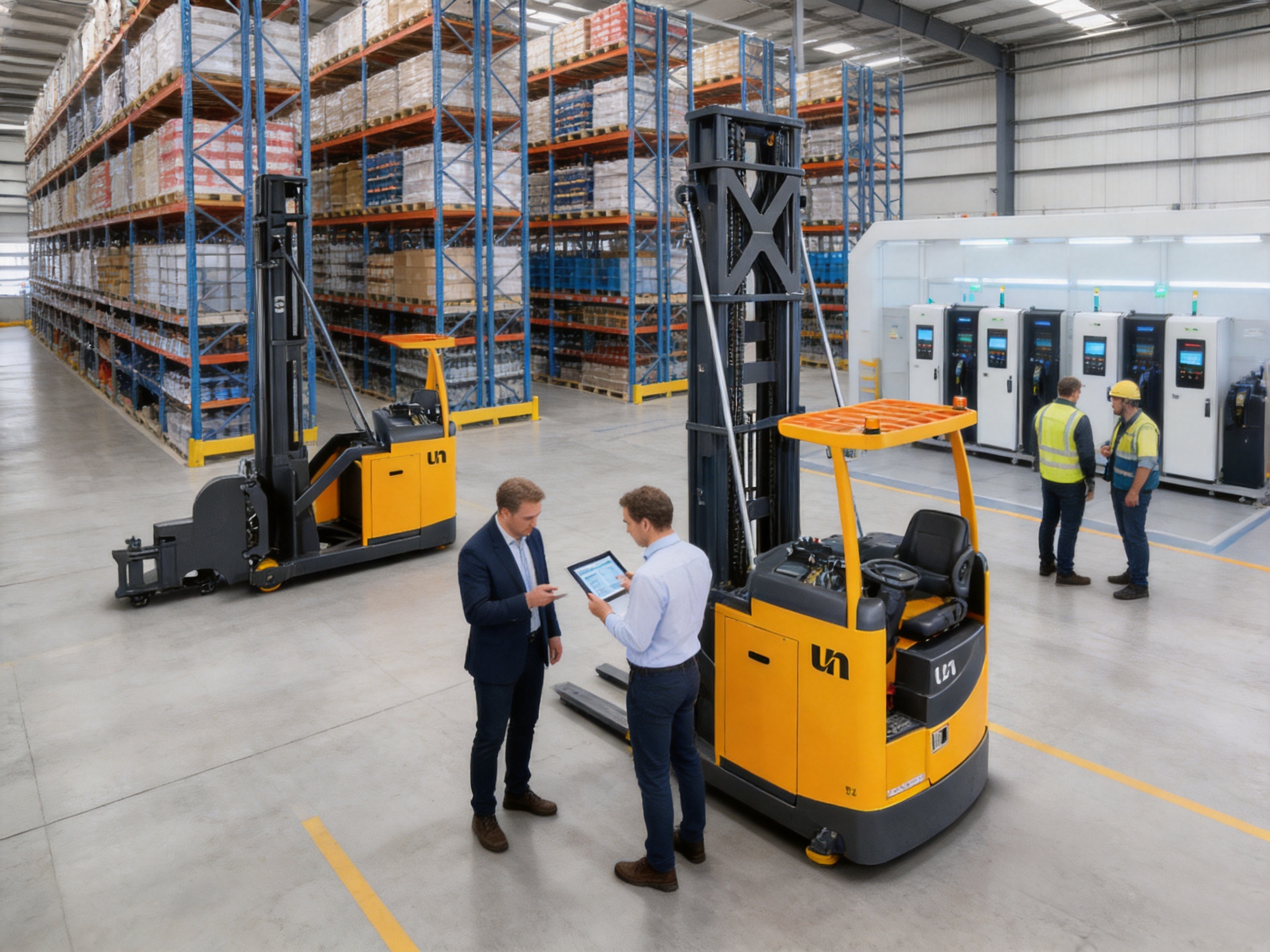
Zhejiang UN Forklift Co., Ltd. brings several strengths to this product. Its long history since 1978 provides experience across market cycles, product generations, and technology transitions. Its 53,400 square meter manufacturing base and 15,000-unit annual capacity demonstrate industrial scale. Its worldwide sales and service network supports customers beyond the domestic market.
The company’s portfolio includes 17 varieties, 96 series, and more than 200 specifications. This breadth is important because material handling customers often need more than one equipment type. A warehouse may use VNA trucks for high-density storage, electric forklifts for loading areas, reach trucks for medium aisles, and other equipment for special tasks. A manufacturer with a broad range can support integrated fleet planning.
The company’s development of new energy forklifts, including diesel-to-lithium-ion concepts and standard lithium-ion battery forklifts, shows its response to global carbon emission concerns. Although the Man Down VNA truck described here uses a 48 V / 840 Ah battery system, it belongs to the same broader trend toward cleaner electric material handling.
The company also supplies internal combustion forklifts meeting high-emission-standard requirements for international markets. This indicates familiarity with regulatory expectations in regions such as the European Union and North America. For global customers, such experience is valuable when selecting a supplier that understands compliance, export requirements, and international operating expectations.
Frequently Asked Questions
What is the main purpose of the Man Down VNA truck?
The main purpose is to improve storage density and pallet handling efficiency in very narrow aisle warehouses. It is designed for picking up pallets, transporting them, and stacking them in high-rack systems while using less aisle space than conventional forklifts.
What is the rated load capacity?
The main specification lists a rated load capacity of 1,500 kg at a 600 mm load center. Capacity at higher mast heights may be lower, so final capacity should be checked against the selected mast configuration.
How high can the truck lift?
The product description highlights lift height up to 10,000 mm. The mast specification table also lists options up to 11,000 mm with reduced load capacity. The correct mast should be selected according to rack height, load weight, and building clearance.
Why is the 1,700 mm working aisle width important?
A 1,700 mm working aisle width allows warehouses to install racking closer together than in many conventional forklift layouts. This can increase pallet positions within the same building and improve space utilization.
What safety features does the truck include?
Key safety-oriented features include a lifting height fixing device, aisle automatic guiding function, aisle terminal deceleration and alarm function, speed control according to mast lifting or lowering height, electromagnetic braking, electronic steering, and CAN-BUS system support.
Is the truck suitable for outdoor rough terrain?
No. The product is designed as warehouse equipment for smooth indoor floors and very narrow aisle operation. Its polyurethane tires and 60 mm ground clearance are consistent with indoor warehouse use.
How does it compare with a reach truck?
A reach truck is useful in many warehouse layouts, but a VNA truck is more specialized for very narrow aisles. The Man Down VNA truck can rotate and shift the forks to handle loads on both sides of the aisle while maintaining a narrow aisle position.
What type of power system does it use?
It uses battery power, with a standard battery specification of 48 V / 840 Ah. This supports clean indoor operation and helps reduce noise and direct emissions in the warehouse.
What makes the manufacturer technically strong?
The manufacturer has decades of experience, a large production base, broad product coverage, national patents, advanced technologies, and experience participating in electric forklift industry standards. It is also recognized in the supplied information as China’s first VNA manufacturer.
What should customers confirm before purchasing?
Customers should confirm pallet weight, maximum storage height, rack design, aisle width, floor flatness, battery charging plan, transfer aisle layout, building clearance, and service requirements. Final specifications should be verified according to the selected configuration.
Conclusion
The Man Down VNA truck is a specialized high-density warehouse solution designed for operations that need more storage capacity, higher lift performance, safer aisle movement, and more efficient pallet handling. Its 1,500 kg rated capacity, 600 mm load center, battery power, 1,700 mm working aisle width, rotating fork system, electronic steering, electromagnetic braking, automatic height control, and CAN-BUS support create a strong technical foundation for modern warehouse operations.
Its advantages over conventional forklifts and many competing solutions are clear. It helps reduce aisle width, increase rack density, access high storage levels, reduce unnecessary maneuvering, and support controlled operation in narrow environments. Its safety and control features make it more than a simple lifting machine; it is a coordinated warehouse productivity tool.
The strength of Zhejiang UN Forklift Co., Ltd. further reinforces the product’s value. With a history dating back to 1978, a 53,400 square meter production base, annual production capacity of 15,000 units, extensive patents and advanced technologies, international service coverage, and recognized VNA development experience, the company provides the manufacturing depth required for specialized warehouse equipment.
For warehouses seeking to improve cubic utilization, reduce operating waste, and support modern electric material handling, the Man Down VNA truck offers a compelling solution. When properly matched to rack layout, load profile, and facility conditions, it can become a central asset in a high-efficiency warehouse system.
References
Industrial Truck Association. General Principles of Powered Industrial Truck Selection and Safe Operation.
ISO 3691 Series. Industrial Trucks Safety Requirements and Verification.
European Materials Handling Federation. Guidance on Warehouse Truck Applications and Storage Systems.
Forklift Engineering Handbook. Electric Drive, Mast Stability, and Hydraulic Control Principles for Industrial Trucks.
Warehouse Design and Management Manual. High-Density Storage, Aisle Planning, and Pallet Handling Systems.
Manufacturer Technical Materials. Man Down VNA Truck Specifications, Mast Capacity Data, and Company Profile.
Product: Man Down VNA
For exclusive deals and latest offers, sign up by entering your email address below.
Stay In Touch
ADDRESS : NO.1 ROAD ONE, XINDENG NEW DISTRICT, FUYANG, HANGZHOU, ZHEJIANG, CHINA 311404.
PHONE : +86-571-8688 8355 (AMERICA)
PHONE : +86-571-8886 9363 (EUROPE)
PHONE : +86-571-8688 8377 (ASIA, AFRICA, OCEANIA)
EMAIL : [email protected]
EMAIL : [email protected](PARTS INQUIRY)

