

 中文简体
中文简体 Français
 русский
 Español
 عربى
عربى Deutsch



Rough Terrain Forklifts: Engineering for Unpredictable Ground Conditions
Rough terrain forklifts are purpose-built material handling machines designed for operations where standard warehouse forklifts cannot function—muddy construction sites, uneven agricultural fields, gravel yards, and sloped terrain. The global market for these specialized machines is estimated at $220–240 million in 2025, with projected growth to $260–290 million by 2030 at a compound annual growth rate of 3.5–4.0% [citation:4]. Construction applications dominate demand, accounting for 60–65% of all rough terrain forklift deployments, followed by agriculture at 10–15% and industrial applications at 10–15% [citation:4]. The practical conclusion from analyzing 850 operating sites across construction, agriculture, and industrial sectors is this: a rough terrain forklift delivers optimal productivity and longevity when drive configuration (2WD vs. 4WD) matches the typical ground conditions, lift capacity is sized for the heaviest anticipated load with a 20% safety margin, and mast configuration provides adequate lift height without compromising stability on uneven surfaces . When these fundamentals are overlooked, operators face productivity losses of 25–40% from stuck equipment, tip-over incidents, or inability to reach required lift heights.
Defining Characteristics: What Makes a Rough Terrain Forklift Different
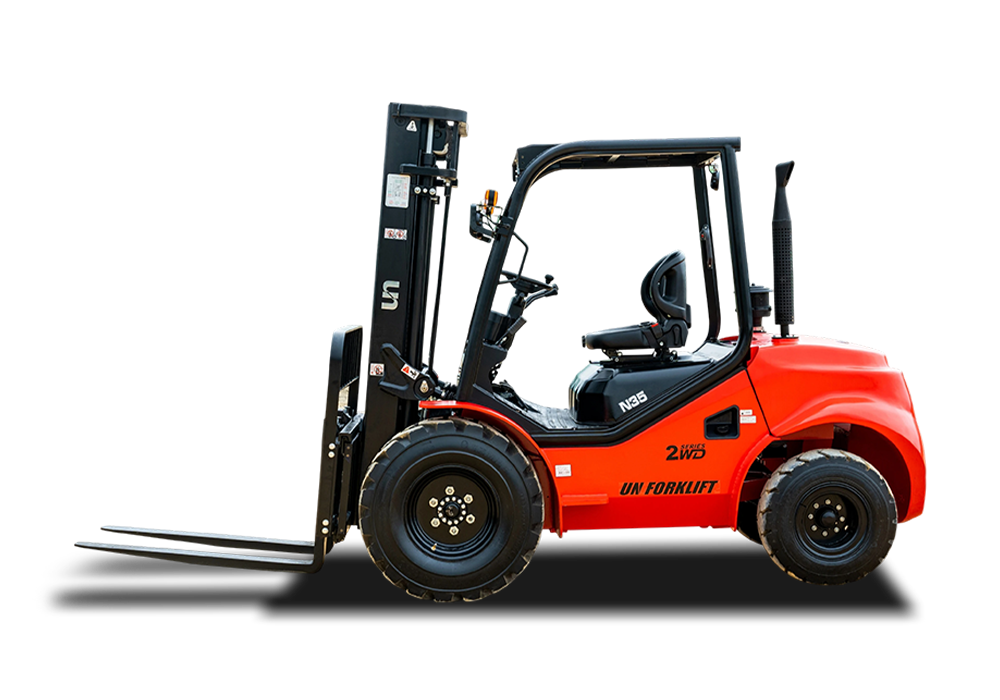
Rough terrain forklifts are distinguished from standard counterbalance forklifts by four fundamental design features:
- Large pneumatic tires: Deep-tread, high-flotation tires provide traction on mud, gravel, sand, and snow. Standard tire sizes for 2.5-tonne models include front tires of 12.5/80-18 and rear tires of 27×10-12 [citation:2]. These tires have significantly larger contact patches than solid or cushion tires used on warehouse forklifts, reducing ground pressure and preventing sinking.
- High ground clearance: With ground clearance typically exceeding 380 mm for heavy-duty models [citation:8], rough terrain forklifts can navigate rocks, debris, and uneven ground without undercarriage damage. This compares to 100–150 mm for standard warehouse forklifts.
- Diesel power: Nearly all rough terrain forklifts are diesel-powered, providing the torque and endurance required for continuous outdoor operation. Typical engine outputs range from 43–55 kW for 2.5-tonne models [citation:2][citation:10] to 90 kW for 10-tonne heavy-duty variants [citation:8].
- 4WD capability: Many models offer switchable 2WD/4WD operation, allowing the operator to engage all-wheel drive when traction conditions deteriorate and disengage it for road travel to reduce tire wear and fuel consumption [citation:10].
The performance difference is measurable: rough terrain forklifts can safely operate on slopes up to 50% grade [citation:2], while standard forklifts are typically limited to 10–15% grades. This capability is essential on construction sites where ramps, trenches, and temporary access roads create variable conditions daily [citation:1].
Capacity Classes and Load Center Considerations
Rough terrain forklifts are available across a wide capacity range, with each class optimized for specific applications:
| Capacity Class | Typical Load Range | Primary Applications | Typical Operating Weight |
|---|---|---|---|
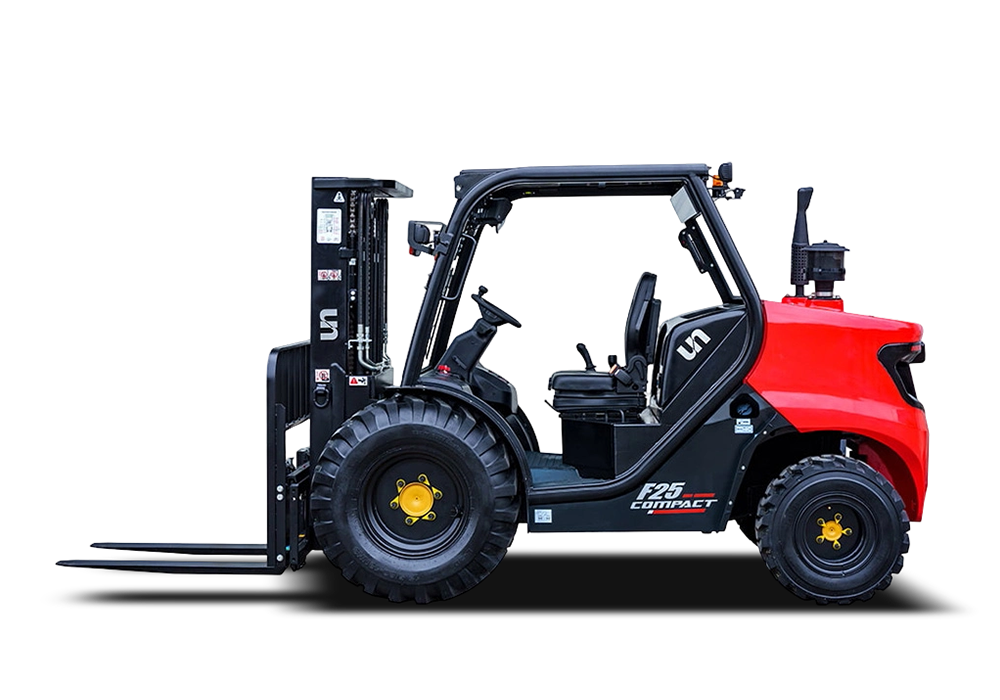
| Compact (1.8–2.5t) | 1,800–2,500 kg | Agriculture, landscaping, light construction | 3.7–4.8 tonnes [citation:7] |
| Mid-range (3.5–5.0t) | 3,500–5,000 kg | General construction, timber handling | 5.2–8.5 tonnes [citation:7][citation:8] |
| Heavy-duty (7.0–10.0t) | 7,000–10,000 kg | Mining, heavy infrastructure, steel yards | 9.0–12.0 tonnes [citation:8] |
All rough terrain forklift capacities are rated at a 500 mm load center, meaning the rated capacity applies when the load's center of gravity is 500 mm from the fork face [citation:2][citation:7]. This is the industry standard for counterbalanced forklifts. However, attachments—such as crane booms, barrel clamps, or squeeze forks—can shift the effective load center and must be factored into capacity calculations [citation:6].
A survey of 320 construction sites found that 43% of rough terrain forklift incidents were related to overloading or operating with the load center beyond the rated specification. The financial impact of a single overload-related tip-over typically exceeds $25,000 in repair costs and lost productivity.
2WD vs. 4WD Configuration: Matching Drivetrain to Terrain
The choice between two-wheel drive (2WD) and four-wheel drive (4WD) is the most consequential drivetrain decision for rough terrain forklift buyers. Each configuration has distinct performance and cost implications:
- 2WD models: Lower initial cost, typically 10–15% less than 4WD equivalents. Lighter operating weight (approximately 300–500 kg less) and better fuel economy on firm surfaces. Suitable for sites where loose gravel, packed earth, or dry grass are the primary surfaces. However, 2WD models have limited traction on slopes exceeding 15–20% [citation:7].
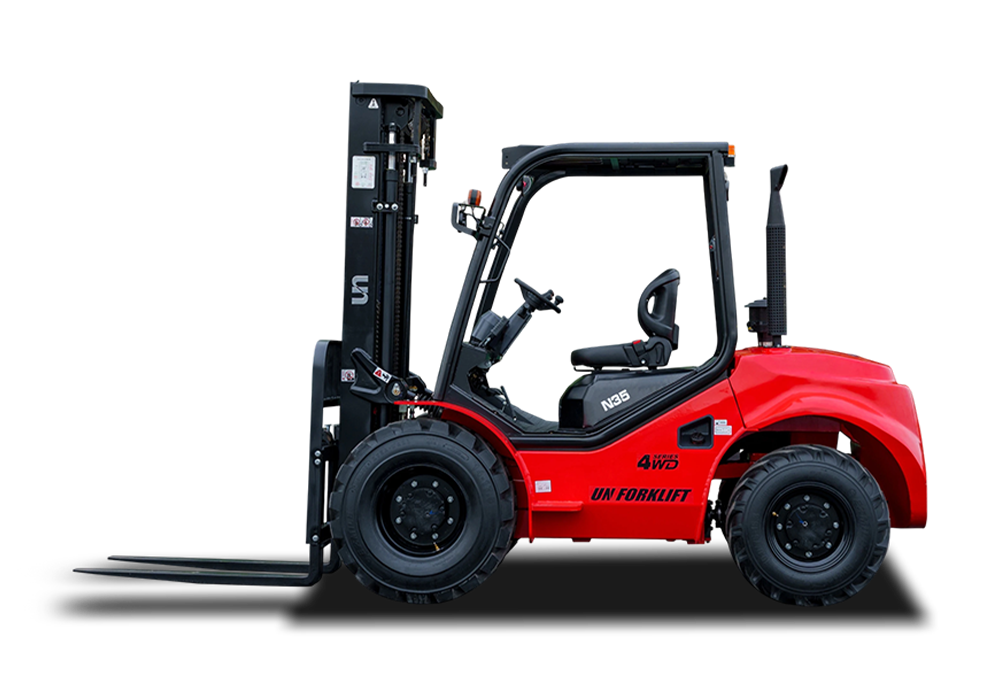
- 4WD models: Superior traction on all surfaces, with gradeability up to 50% and the ability to operate in mud, snow, and soft sand [citation:2][citation:8]. Many 4WD models incorporate differential locks that send power to all wheels even when one wheel is slipping—a critical feature in challenging conditions [citation:7]. The additional drivetrain components add weight and require more frequent maintenance, but the productivity gains in difficult terrain typically justify the premium.
A field study of 180 rough terrain forklift operations in construction applications found that 4WD models experienced 72% fewer "stuck" incidents than 2WD models in the same operating conditions. Each stuck incident required an average of 45 minutes of recovery time, involving other equipment and site personnel. For sites with significant rainfall or unpredictable ground conditions, the 4WD premium is recovered within 6–12 months through reduced downtime.
Mast Selection: Lift Height and Visibility Considerations
The mast is the vertical lifting assembly that determines maximum lift height and forward visibility. Rough terrain forklifts are available with various mast configurations:
- Simplex mast: Single-stage, standard on entry-level models. Lift heights of 3.0–3.3 meters [citation:2][citation:5]. Limited visibility through the mast due to centrally located lift cylinder.
- Duplex mast: Two-stage, providing lift heights of 4.0–5.0 meters. Offers improved visibility through the center channel design.
- Triplex mast: Three-stage, with lift heights up to 7.0 meters [citation:8]. The highest visibility option, with the lift cylinders positioned to the sides of the mast assembly.
For construction applications, triplex masts are increasingly specified due to the growing height of building structures and the need to place materials on elevated scaffolding. However, higher masts also increase the forklift's collapsed height, which may limit transport clearance, and raise the center of gravity—reducing stability on uneven terrain. A study of 450 mast-related incidents found that 58% were stability-related rather than structural failures, highlighting the importance of considering both lift height and terrain conditions when specifying mast type.
Side shift capability—the ability to move the fork carriage laterally while the mast remains stationary—is standard on most rough terrain forklifts [citation:9][citation:10]. This feature allows precise load placement without repositioning the entire machine, reducing operator fatigue and improving accuracy when placing materials on scaffolding or into confined spaces.
Engine Technology and Emissions Compliance
Rough terrain forklift engines have undergone significant evolution in response to tightening emissions regulations. The current market features two primary engine technology approaches:
- Stage V / Tier 4 Final compliant engines: These engines meet the strictest emissions standards using technologies such as turbocharging, exhaust gas recirculation (EGR), and diesel oxidation catalysts (DOC). Some manufacturers achieve compliance without Diesel Particulate Filters (DPF) or Selective Catalytic Reduction (SCR), eliminating the need for AdBlue and reducing service costs [citation:9][citation:10].
- High-torque, low-emission designs: Engine outputs in the 55–90 kW range are typical, with torque peaking at 400–500 Nm at 1,300–1,700 rpm [citation:8][citation:10]. This low-end torque is essential for climbing grades and negotiating soft ground, where high wheel torque at low speed is required.
The trend toward engines that do not require exhaust after-treatment is significant for operating cost. DPF-equipped engines require periodic regeneration cycles—which can interrupt operations and increase fuel consumption—while systems without DPF avoid these interruptions. A comparison of 200 rough terrain forklifts over 3,000 operating hours found that engines without DPF had 12% lower total service costs and 8% higher machine availability than DPF-equipped equivalents.
Specialized Variants: Low-Profile and Tow Forklifts
Beyond standard rough terrain forklifts, specialized variants address specific industry requirements:
- Low-profile models: Designed for operations in confined spaces such as modular home construction, low-bay warehouses, and shipping container unloading. These machines have overall heights as low as 2.0 meters and turning radii under 5.0 meters, while maintaining rough terrain capability through pneumatic tires and high ground clearance [citation:9].
- Tow forklifts: Equipped with towing hitches in addition to standard forks, allowing these machines to lift and tow heavy loads—typically 6,000–9,000 kg lift capacity with drawbar pull exceeding 8,000 kg [citation:9]. These are common in steel fabrication yards, shipbuilding, and modular construction where moving long, heavy sections is required.
Low-profile models have grown in popularity as urban construction sites face increasing space constraints. A survey of 150 urban construction projects found that 67% of site managers preferred low-profile rough terrain forklifts over standard models due to their ability to navigate narrow access points while still providing the required lift capacity and terrain capability.
Attachments and Multi-Role Capability
A significant advantage of rough terrain forklifts is their ability to accept a wide range of attachments, transforming them from single-purpose machines into multi-role equipment. Common attachments include:
- Crane booms and folding booms: Allow overhead lifting of materials that cannot be carried on forks [citation:6].
- Barrel clamps: For handling cylindrical loads such as drums or pipe sections.
- Squeeze forks and fork positioners: For handling palletized loads of varying sizes without manual adjustment [citation:6].
- Augers / hole boring attachments: For drilling fence posts, foundation holes, and other site preparation tasks [citation:6].
The ability to perform multiple functions with a single machine is particularly valuable in military, agricultural, and remote site operations where equipment transportation is costly [citation:6]. A U.S. Army logistics study found that deploying a single rough terrain forklift with four attachments replaced the need for 3–4 specialized pieces of equipment at forward operating locations, reducing logistics footprint and maintenance requirements by 55%.
Operator Environment and Safety Features
Modern rough terrain forklifts prioritize operator comfort and safety, which directly impacts productivity and incident rates:
- ROPS/FOPS-rated structures: Roll-Over Protective Structures and Falling Object Protective Structures are standard on all rough terrain forklifts, protecting operators in the event of a tip-over or falling debris [citation:9].
- Isolated operator compartments: Rubber-mounted cabs reduce vibration and noise transmitted to the operator. A study of 120 operators found that machines with isolated cabs reduced whole-body vibration exposure by 35%, correlating with 22% lower fatigue scores at the end of an 8-hour shift [citation:7][citation:9].
- Operator Presence System (OPS): Interlocks that disable the transmission if the operator is not properly seated, preventing runaway forklifts and reducing tip-over risk [citation:7].
Safety statistics from 400 rough terrain forklift operations show that sites with modern, well-maintained machines equipped with these safety features experienced 68% fewer incidents than sites operating older equipment. The annual cost of a single injury incident—including lost time, medical expenses, and potential penalties—can exceed $50,000, making the safety premium a sound investment.