


 中文简体
中文简体 Français
 русский
 Español
 عربى
عربى Deutsch



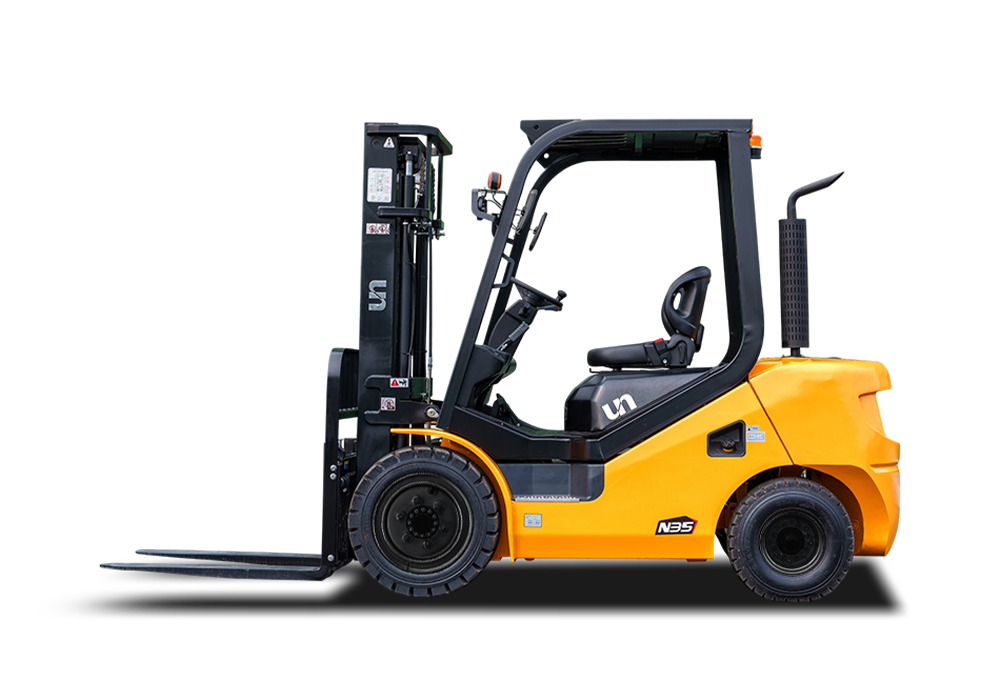
FE Series 3.0T–3.5T Four-Wheel Electric Forklift: Power, Precision, and Sustainable Material Handling
Admin 2026-08-16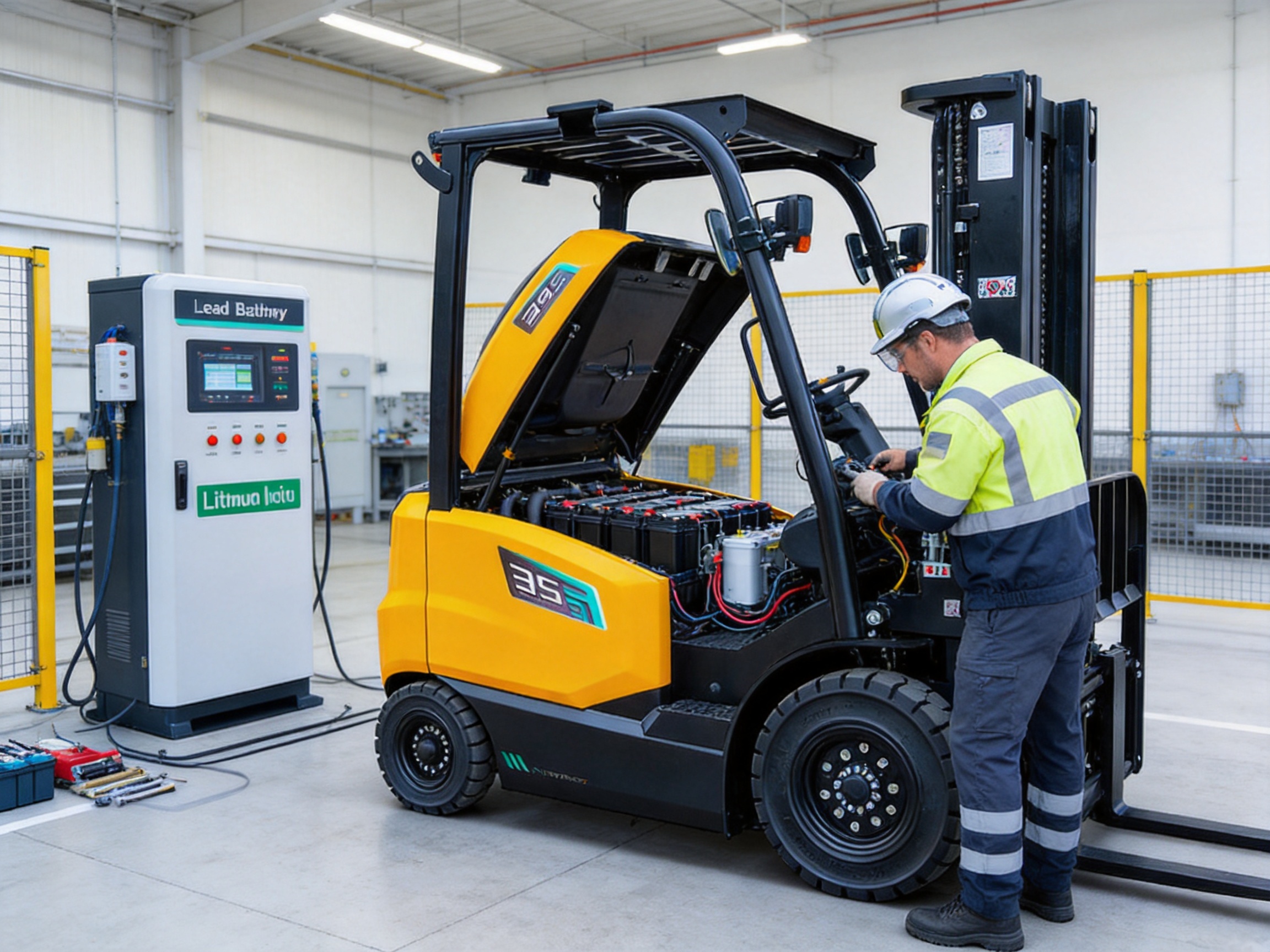
Modern material-handling operations require more than lifting capacity alone. Warehouses, manufacturing facilities, distribution centers, construction-support sites, and industrial plants need equipment that can work continuously, operate safely in confined areas, control energy consumption, and remain dependable over many years of service. The FE Series 3.0T–3.5T four-wheel electric forklift is designed to meet these demands with a combination of high-capacity battery technology, full AC drive performance, intelligent energy management, stable load handling, and simplified maintenance.
Developed as a fully upgraded model based on an established four-wheel electric forklift platform, the FE Series is positioned for medium-intensity indoor handling and selected covered outdoor applications. Its 3.0-ton and 3.5-ton capacity classes provide a practical solution for users who require more lifting strength than compact warehouse trucks can offer, while still seeking the cleanliness, low operating noise, and reduced local emissions associated with electric power.
The design combines a robust chassis, a carefully balanced wheelbase, pneumatic tires, a wide-view mast, proportional lifting, multiple speed modes, and a modern operator environment. These features help the truck compete with conventional internal-combustion forklifts in productivity while offering the environmental and maintenance benefits expected from electric equipment.
Designed for Demanding Four-Wheel Electric Forklift Applications
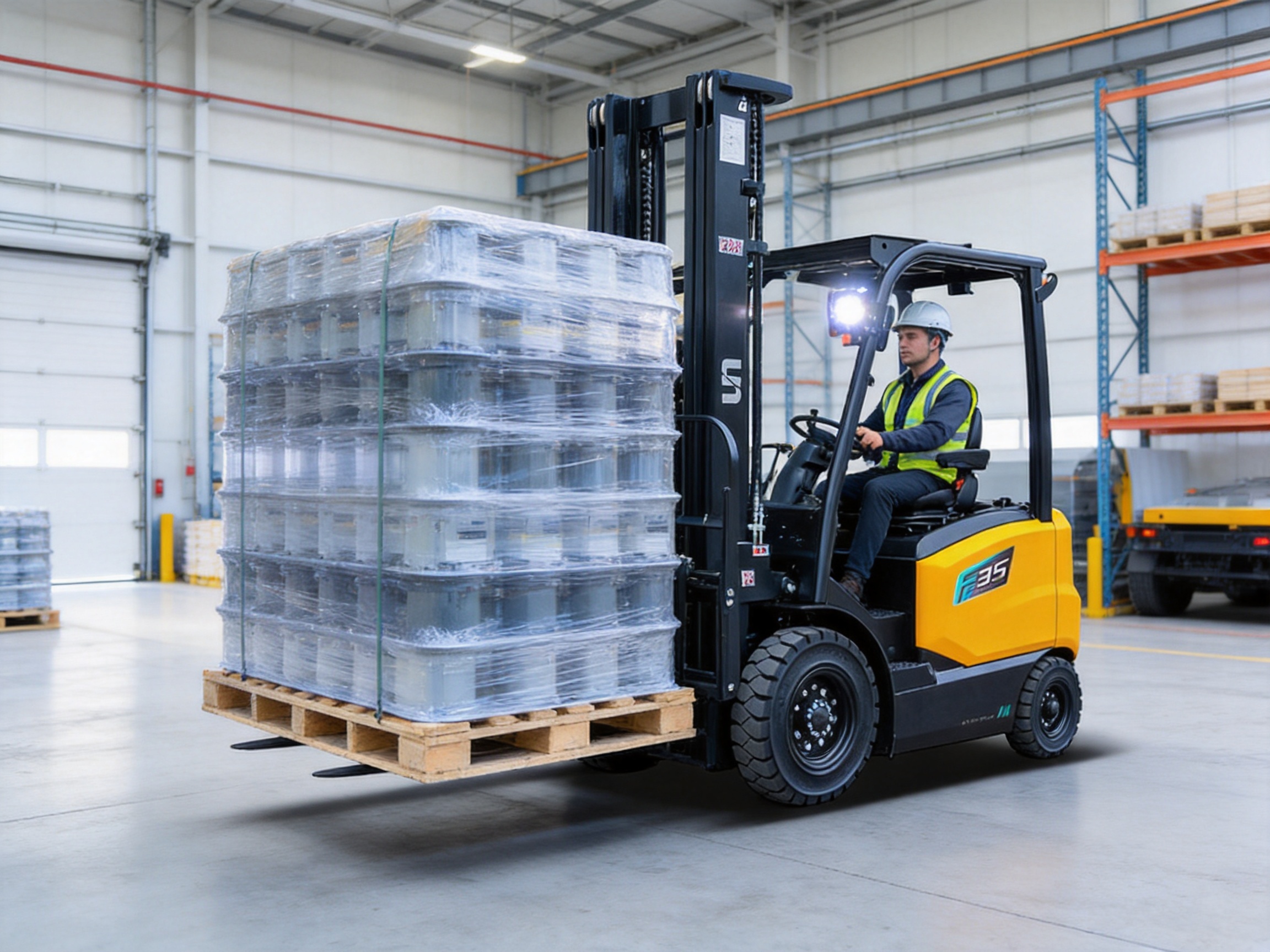
The FE Series has a rated capacity range of 3.0 to 3.5 tons, making it suitable for handling palletized goods, machinery components, metal products, building materials, packaged industrial goods, and other substantial loads. The four-wheel configuration provides a stable operating platform for applications where load security, turning control, and predictable handling are essential.
Unlike smaller electric forklifts designed mainly for light warehouse work, this series is built around the requirements of heavier material movement. It uses a longer wheelbase and a substantial counterweight structure to maintain balance when carrying rated loads. At the same time, the electric power system avoids the exhaust fumes, engine vibration, and high noise levels commonly associated with diesel or liquefied-gas forklifts.
The truck is particularly appropriate for operations that require repeated loading and unloading, transportation between production areas, pallet movement through storage aisles, and indoor logistics support. With the correct tires, mast arrangement, attachment, and operating configuration, it can also support covered loading docks and other semi-outdoor environments.
Its rated load center is 500 millimeters. This specification is important because forklift capacity depends not only on the rated load but also on the distance between the load center and the fork face. Operators should always consult the approved capacity chart for the selected mast and attachment combination before lifting a load.
Key Product Advantages
High-Capacity Electric Power
The FE Series can be equipped with a high-capacity lead-acid battery system or a lithium-ion battery system, depending on the customer’s operating model and energy requirements. The standard technical data for the 3.0T–3.5T configuration lists an 80-volt, 400-ampere-hour battery option, while a 76.8-volt, 280-ampere-hour lithium-ion configuration is also indicated.
This electrical architecture supplies the voltage and current required for heavy-duty travel and lifting performance. A high-voltage system helps reduce current demand at equivalent power levels, supporting efficient energy transmission and stable operation. For fleet users, the choice between lead-acid and lithium-ion power allows the forklift to be matched to duty cycle, charging infrastructure, budget, and sustainability objectives.
Lead-acid batteries remain attractive where purchase cost, established service procedures, and flexible battery replacement are priorities. Lithium-ion batteries are particularly useful for operations that require opportunity charging, frequent shifts, reduced battery maintenance, and consistent voltage during demanding work cycles. The lithium-ion option also includes a charging-heating function that permits charging at temperatures as low as minus 20 degrees Celsius when the specified battery system is used.
Full AC Drive Technology
The use of full AC drive technology is one of the central advantages of the FE Series. AC drive systems provide precise speed control, smooth acceleration, efficient regenerative braking behavior, and reduced dependence on mechanical wear components. Compared with older electric drive architectures, a full AC system can deliver more responsive control during starting, reversing, and low-speed maneuvering.
The truck uses an AC drive motor rated at 16 kilowatts in the 3.0T–3.5T specification group. The drive system is managed through MOS/AC control technology, with ZAPI identified as the control-system manufacturer in the technical data. This combination supports controlled power delivery and helps the operator select an appropriate performance mode for the current task.
AC drive technology can also reduce service requirements associated with traditional motor components. When properly maintained, the system supports long operating life and dependable performance in applications involving repeated direction changes, frequent stops, and variable loads.
Powerful Lifting Performance
The lifting system uses a 21-kilowatt lift motor in the stated 3.0T–3.5T configuration. Under full-load conditions, the listed lifting speed is 350 millimeters per second, while the no-load lifting speed is 500 millimeters per second. These figures allow the truck to place and retrieve loads efficiently without sacrificing control.
In practical operation, lifting speed must always be considered together with load stability, mast height, visibility, and floor conditions. The FE Series addresses these requirements through proportional lifting control, which allows the operator to make more precise adjustments when positioning loads at racks, production platforms, trailers, and storage locations.
Proportional control is especially valuable when the load is fragile, when clearance is limited, or when the operator must align the forks carefully with a pallet. Smooth hydraulic response reduces abrupt movement and contributes to better load protection.
Strong Gradeability and Drawbar Performance
The FE Series is rated for a maximum gradeability of 15 percent with and without a load under the listed specifications. Its maximum drawbar pull is stated as 18,500 newtons for the 3.0T–3.5T group. These characteristics help the truck manage ramps, loading areas, uneven transitions, and internal logistics routes where a basic warehouse forklift may lack sufficient traction or pulling capability.
Gradeability is influenced by surface condition, tire selection, battery state of charge, load weight, slope length, and operator behavior. Even with strong rated performance, safe operation requires the use of approved travel routes and compliance with site-specific safety procedures.
Fast and Controlled Travel
The listed travel speed is 14 kilometers per hour with a full load and 15 kilometers per hour without a load. These speeds provide a useful balance between productivity and control. The truck is not limited to slow warehouse movement, yet it remains suitable for facilities where pedestrian interaction, rack proximity, and changing traffic patterns require careful speed management.
Multiple speed modes allow the operator or fleet manager to adapt performance to the application. A lower-speed mode can be selected for congested aisles, loading operations, and pedestrian areas. A higher-performance mode can be used on open internal routes when site rules permit. This adaptability is a competitive advantage over simpler electric forklifts that provide fewer options for matching speed to the working environment.
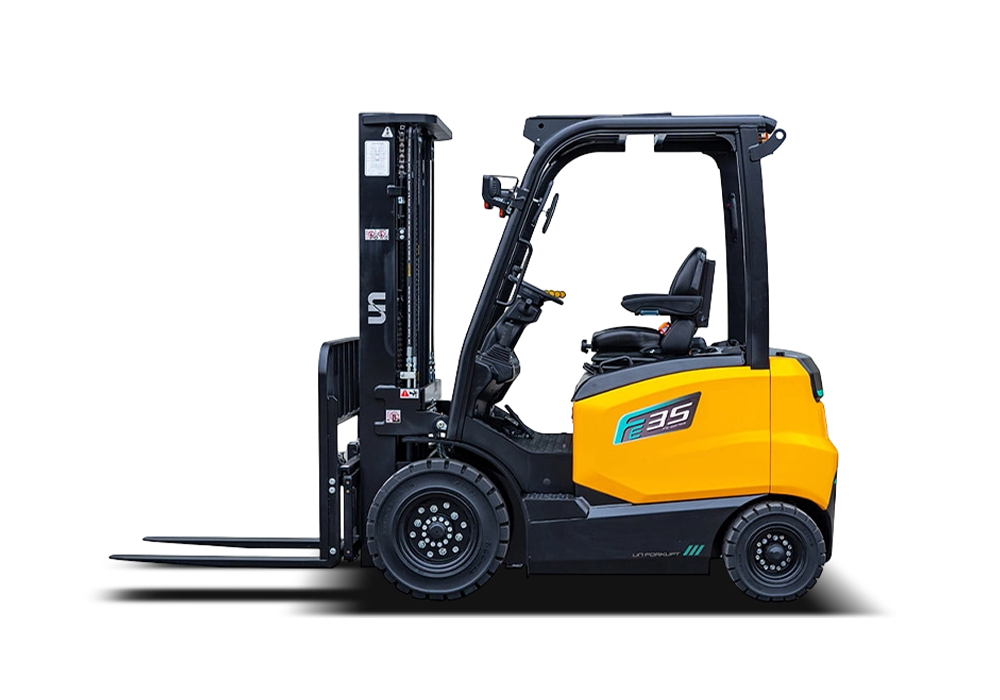
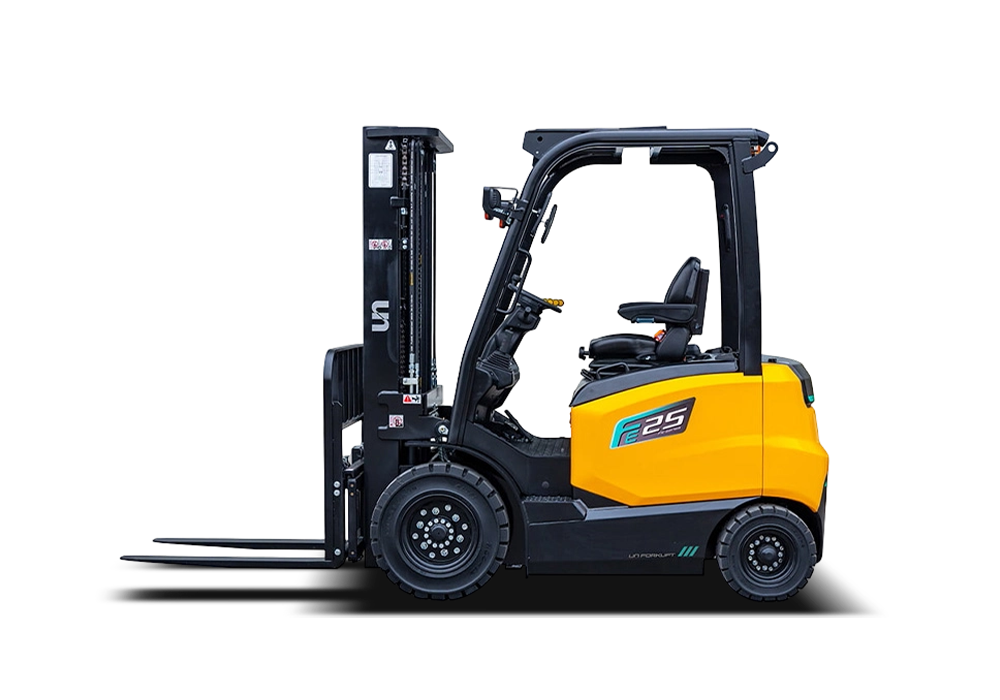
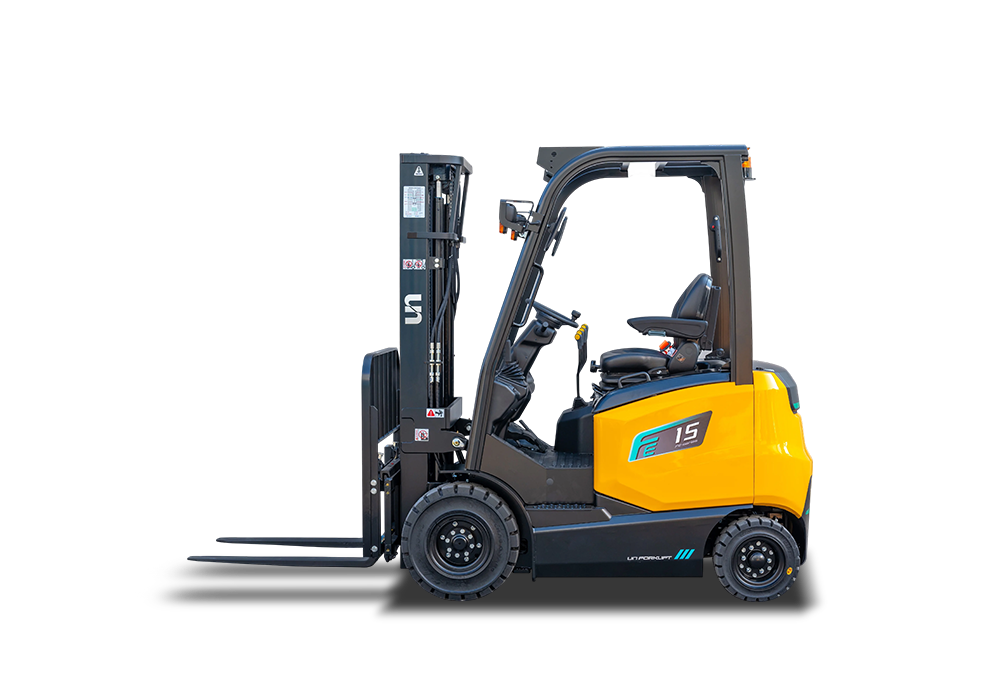
FE Series 3.0T-3.5T 4-Wheel Electric Forklift
Stable Chassis and Advanced Steering Design
Stability is essential when a forklift handles loads of three to three and a half tons. The FE Series uses a four-wheel chassis, a 1,660-millimeter wheelbase, and a counterbalanced layout to create a stable foundation for lifting and traveling. The design supports predictable load behavior during acceleration, braking, turning, and rack approach.
The drive motor adopts an H-type parallel arrangement. This arrangement is intended to support balanced power delivery and improve stability within the drive system. By organizing major drive components in a practical configuration, the design helps preserve space while supporting dependable traction and service access.
The steering axle is constructed with a cast axle body that provides a reported 30 percent increase in strength compared with the previous design reference. Tapered roller bearings improve load capacity and durability, especially under the repeated radial and axial forces generated during turning and heavy-load operation.
The high-mounted steering-axle design uses flexible connections to improve performance and stability. This arrangement can help the rear axle respond more effectively to changing ground conditions and steering inputs. A load-sensing steering gear further contributes to efficient steering operation by adjusting hydraulic assistance according to demand.
The outside turning radius is listed as 2,210 millimeters for the 3.0-ton model and 2,250 millimeters for the 3.5-ton model. These dimensions make the FE Series suitable for many standard industrial workspaces while preserving the stability expected from a heavy-capacity four-wheel truck.
Advantages Over Conventional Internal-Combustion Forklifts
Electric forklifts have traditionally been associated with lighter indoor work, while internal-combustion forklifts have been selected for heavier applications. The FE Series narrows this performance gap by combining a high-capacity battery, substantial electric motors, strong gradeability, pneumatic tires, and a heavy-duty chassis.
Compared with a diesel forklift of similar capacity, the FE Series produces no direct exhaust emissions during operation. This makes it better suited to enclosed facilities, food-related handling areas, clean manufacturing spaces, and workplaces where air quality is a major concern. It also creates a more comfortable environment for operators and nearby personnel by reducing engine noise and vibration.
Compared with a liquefied-gas forklift, the electric model avoids fuel-cylinder handling and combustion-related maintenance. Energy use can be monitored more easily, and charging can be integrated into planned work breaks or shift changes. The result can be a more predictable operating routine for facilities with stable electrical infrastructure.
Electric drive systems also provide immediate torque and precise low-speed control. This is beneficial when entering pallets, positioning loads, or maneuvering around production equipment. The absence of a conventional engine transmission system can reduce certain maintenance requirements and simplify daily inspections.
Advantages Over Smaller Electric Forklifts
Small electric forklifts may have excellent maneuverability, but they are not always suitable for heavy pallets or high-density industrial loads. The FE Series offers considerably greater capacity and structural strength while retaining the smooth control associated with electric operation.
The 3.0-ton and 3.5-ton versions are designed for users who need a strong industrial truck but do not want the emissions, heat, and noise of an internal-combustion model. Their larger battery and motor systems are intended for longer or more demanding work cycles than those typically assigned to compact electric warehouse trucks.
The use of pneumatic tires also gives the FE Series greater flexibility than models equipped exclusively with small solid or polyurethane tires. Pneumatic tires can provide improved cushioning over imperfect indoor surfaces, loading ramps, and covered outdoor areas. Tire selection should nevertheless be matched to the floor, contamination level, puncture risk, and operating environment.
Operator Safety and Visibility
Wide-View Mast
Visibility directly affects safety and productivity. The FE Series is equipped with a wide-view mast designed to give the operator a clearer view of the forks, pallet openings, load edges, and surrounding traffic. Improved visibility can reduce the need for repeated repositioning and help the operator make more accurate approaches.
The mast system can be configured in different styles, including wide-view, full-free-lift, and three-stage full-free-lift arrangements. The appropriate choice depends on rack height, ceiling clearance, container or trailer access, and the amount of free lift required before the mast begins to extend.
For the 3.0T–3.5T capacity range, a 3,000-millimeter rated lift height is listed in the main specifications. Other mast heights may be available depending on the selected configuration. Users should verify lowered mast height and extended height before purchasing, particularly when the truck will operate under doors, sprinkler systems, mezzanines, or low ceilings.
Stamped Overhead Guard
The robust stamped overhead guard helps protect the operator from falling objects and provides a durable protective structure above the seat. Its listed height for the 3.0T–3.5T configuration is 2,225 millimeters. This dimension should be compared with the lowest obstruction in the intended operating area.
The overhead guard is part of the forklift’s overall protective system, but it does not eliminate the need for load-security procedures, approved pallets, correct stacking, and safe operating practices. Loads must be properly positioned and the mast must be kept within the operating limits shown on the capacity plate.
LED Lighting and Speed Deceleration
LED lights improve visibility while consuming relatively little electrical energy. They can support safer operation in dim aisles, loading bays, production areas, and facilities with changing light levels. LED technology also generally provides long service life and strong resistance to vibration.
The speed-deceleration function helps reduce travel speed in situations where greater control is needed. This may be useful during turning, approaching a rack, or operating in restricted areas. Speed management is an important part of protecting both the load and the surrounding infrastructure.
Controlled Mast Movement
Proportional lifting gives the operator better control over vertical movement. Rather than relying only on full-speed hydraulic actuation, the operator can make more gradual adjustments. This supports accurate pallet placement and reduces sudden load movement.
The mast tilt range listed in the technical data is 6 degrees forward and 12 degrees backward. Tilt functions help stabilize a load during travel and assist with fork engagement or release. Operators must use tilt carefully and maintain the load as low as practical during travel.
Hydraulic System and Load Handling Efficiency
The FE Series uses a high-power hydraulic pump motor together with a low-noise, high-displacement hydraulic pump. This arrangement supports rapid lifting and attachment operation while controlling hydraulic noise. A well-matched hydraulic system is essential for a high-capacity electric forklift because lifting performance must be delivered without creating excessive battery drain or heat.
The listed operating pressure for attachments is 20.5 megapascals. This provides a useful foundation for optional hydraulic attachments, subject to the capacity, flow, pressure, and compatibility requirements of each accessory. Possible applications may include side shifters, fork positioners, clamps, rotators, and other tools used for specialized material handling.
Attachment selection must be handled carefully. An attachment changes the effective load center and may reduce rated capacity. The supplied capacity information notes that a separated side shifter can reduce capacity by 150 kilograms, while an integrated side shifter can reduce capacity by 50 kilograms. The exact reduction depends on the configuration and must be confirmed on the final capacity plate.
Efficient hydraulics benefit the operation in several ways. Faster lifting reduces cycle time, smooth control improves placement accuracy, and lower noise creates a more comfortable working environment. The system also supports the broader objective of matching energy use to actual hydraulic demand.
Battery Options and Energy Management
Lead-Acid Battery Configuration
Lead-acid batteries remain widely used in industrial fleets because they are familiar, serviceable, and available through established supply chains. They can be suitable for single-shift applications, operations with scheduled charging periods, and customers that already maintain battery rooms and handling equipment.
The battery weight listed for the 3.0T–3.5T configuration is approximately 1,235 to 1,240 kilograms for the relevant battery options shown in the broader specification data. Battery mass contributes to counterbalance performance, which is important for a rear-counterbalanced forklift. However, battery replacement must be performed with approved lifting equipment and according to the manufacturer’s procedures.
Lithium-Ion Battery Configuration
Lithium-ion technology can provide advantages for multi-shift operations and facilities that prefer opportunity charging. Unlike conventional lead-acid batteries, lithium-ion batteries generally do not require the same watering routine, and they can maintain a more consistent voltage profile over the discharge cycle.
The charging-heating function enables charging at temperatures down to minus 20 degrees Celsius when used with the appropriate lithium-ion battery system. This feature can benefit cold-storage logistics, winter operations, and facilities where battery temperature may fall below normal indoor conditions.
Lithium-ion batteries also reduce the need for battery swapping in many duty cycles. Operators can charge during breaks or planned pauses, helping maximize equipment availability. The right charging strategy depends on shift length, charging power, battery chemistry, facility electrical capacity, and local safety requirements.
Adaptive Energy Management
The adaptive energy management system is designed to coordinate available battery power with operating demand. Travel, lifting, steering, and auxiliary functions do not always require maximum output at the same time. Intelligent management can help allocate energy more effectively and support longer operating continuity.
Energy management also helps fleet operators understand how the forklift is being used. When combined with regular inspection and operator training, it can support more consistent battery performance, lower unnecessary energy consumption, and better planning of charging intervals.
Battery life is influenced by many factors, including load intensity, ambient temperature, charging method, tire pressure, hydraulic condition, driving style, and maintenance quality. The FE Series provides a strong technical foundation, but achieving the best possible battery life still requires disciplined fleet management.
Technical Specifications
The following table summarizes key specifications for the 3.0-ton and 3.5-ton configurations. Values may vary according to mast type, battery selection, attachments, tires, and regional configuration. The final approved specification should always be confirmed before purchase.
| Item | 3.0T Configuration | 3.5T Configuration |
| Drive type | Electric | Electric |
| Operator type | Seated | Seated |
| Rated load capacity | 3,000 kg | 3,500 kg |
| Load center | 500 mm | 500 mm |
| Wheelbase | 1,660 mm | 1,660 mm |
| Total weight | 4,840 kg | 5,280 kg |
| Tire type | Pneumatic | Pneumatic |
| Overall width | 1,220 mm | 1,220 mm |
| Overhead guard height | 2,225 mm | 2,225 mm |
| Length to fork face without fork | 2,505 mm | 2,578 mm |
| Outside turning radius | 2,210 mm | 2,250 mm |
| Travel speed with full load | 14 km/h | 14 km/h |
| Travel speed without load | 15 km/h | 15 km/h |
| Maximum gradeability | 15% | 15% |
| Drive motor rating | 16 kW | 16 kW |
| Lift motor rating | 21 kW | 21 kW |
| Battery option | 80 V/400 Ah or 76.8 V/280 Ah | 80 V/400 Ah or 76.8 V/280 Ah |
| Service brake | Hydraulic | Hydraulic |
| Parking brake | Mechanical | Mechanical |
Dimensions and Warehouse Compatibility
The FE Series is designed to provide industrial lifting strength without becoming unnecessarily difficult to maneuver. The 3.0-ton model has a listed length to the fork face of 2,505 millimeters without forks, while the 3.5-ton model is listed at 2,578 millimeters. Overall width is 1,220 millimeters for both configurations.
These dimensions should be evaluated against aisle width, rack layout, pallet orientation, door openings, loading platforms, and pedestrian routes. The listed aisle-width data for related four-wheel configurations includes approximately 3,875 to 3,920 millimeters for 1,000-by-1,200-millimeter pallets placed crossways, and approximately 4,075 to 4,120 millimeters for 800-by-1,200-millimeter pallets placed lengthways.
Actual aisle requirements vary with fork length, load dimensions, steering behavior, pallet condition, rack design, and clearance policy. A site survey is recommended before ordering. The turning radius, mast height, overhead guard height, and rear swing should all be considered when planning the working area.
Ground clearance is listed at approximately 130 millimeters below the mast under laden conditions and 150 millimeters at the center of the wheelbase for the 3.0T–3.5T group. These clearances support normal industrial floors and selected uneven transitions, but the truck is not intended to be treated as a rough-terrain forklift.
Maintenance-Friendly Engineering
Fully Opening Engine Cover
Although the FE Series is electrically powered, the access cover is described as a fully opening engine cover. This broad access arrangement provides technicians with a clearer view of the battery compartment, drive components, hydraulic assemblies, wiring, and service points. Easy access can shorten inspection time and make preventive maintenance more thorough.
A maintenance-friendly design is valuable because many service problems begin with small issues such as loose connections, contaminated hydraulic oil, damaged cables, low tire pressure, or abnormal brake wear. When access is convenient, technicians are more likely to identify these conditions before they become costly failures.
Opening Electrical Control Cover
The fully opening electrical control cover improves access to controllers, wiring, and electrical protection components. Electric forklift reliability depends heavily on keeping connections secure, cooling paths clear, and electrical components free from contamination and moisture.
Technicians should follow lockout and isolation procedures before working on the electrical system. Battery voltage can remain hazardous even when the truck is switched off. Only trained personnel should inspect or repair high-voltage or high-current components.
Tool-Free Floor Plate Removal
The tool-free removable floor plate allows quick access to lower service areas. This feature can simplify routine checks of wiring, pedals, brake components, and other parts located beneath the operator compartment. Faster access supports more frequent inspections and reduces downtime during daily service.
Fleet managers should establish inspection schedules based on hours of operation, duty severity, environmental conditions, and manufacturer recommendations. A high-use forklift working multiple shifts requires more frequent attention than a lightly used truck in a clean facility.
Reduced Routine Maintenance Requirements
Electric forklifts do not require engine oil changes, fuel-filter replacement, exhaust-system service, or conventional engine-cooling maintenance. This does not mean they are maintenance-free. Tires, brakes, steering components, hydraulic oil, mast rollers, chains, forks, battery systems, chargers, and electrical connections still require regular inspection.
The FE Series’ electric architecture can reduce the number of powertrain wear items and make maintenance more predictable. When preventive service is combined with operator training and battery management, the total cost of ownership can become more competitive than that of a combustion forklift operating in similar conditions.
Manufacturing and Engineering Strengths
The product is supported by a manufacturer with a long history in forklift and material-handling equipment development. The company was founded in 1978 and operates a manufacturing facility covering approximately 53,400 square meters. Its reported annual production capacity is 15,000 units.
This scale supports organized production planning, component sourcing, assembly control, product testing, and after-sales support. A manufacturer with broad experience can also use lessons from multiple forklift categories to improve structural design, electrical integration, hydraulics, ergonomics, and serviceability.
The company integrates research and development, production, sales, and service. This integrated structure is important for industrial equipment because product development does not end when a forklift leaves the factory. Field feedback, warranty information, service data, and customer requirements can all contribute to future product improvements.
Research and Development Capability
The manufacturer has developed a broad range of internal-combustion and electric material-handling equipment, including electric forklifts, reach forklifts, very-narrow-aisle trucks, warehouse trucks, and specialized models. This product breadth provides engineering experience across different drive systems, lifting structures, load capacities, and operating environments.
The company is associated with the development of China’s first reach forklift and very-narrow-aisle truck and holds national patents related to electric forklift technologies. It has also participated in the formulation of Chinese electric forklift industry standards. These achievements indicate a long-term investment in product development rather than a narrow focus on assembly alone.
For the FE Series, that experience appears in the combination of full AC drive technology, adaptive energy management, high-capacity battery options, strengthened steering components, improved visibility, and maintenance access. Each feature addresses a practical operating requirement, and the combined system is more significant than any single component.
Production Process and Quality Focus
Advanced forklift manufacturing requires more than welding and final assembly. The process normally includes engineering design, material preparation, structural fabrication, surface treatment, component integration, electrical testing, hydraulic testing, load testing, functional inspection, and final quality verification.
For a heavy-capacity electric forklift, frame and mast manufacturing must maintain dimensional accuracy because small alignment errors can affect lifting stability, chain behavior, tire loading, and operator control. Structural components must be assembled with consistent welding quality, appropriate reinforcement, and effective corrosion protection.
Electrical integration is equally important. Battery connectors, motor cables, controllers, sensors, switches, and charging interfaces must be correctly routed and protected. Good cable management reduces the risk of abrasion, overheating, moisture intrusion, and accidental damage during maintenance.
Hydraulic assemblies must be checked for pressure, leakage, response speed, and smoothness. Brake and steering systems require functional verification under appropriate test conditions. Final inspection should also confirm mast travel, fork alignment, tilt operation, lighting, warning devices, seat controls, and emergency functions.
A structured manufacturing process helps ensure that the forklift performs consistently across production batches. It also supports parts identification and serviceability, both of which are important for fleet operators that expect equipment to remain in service for many years.
International Market Experience
The manufacturer has established sales and service partners in Europe, South America, North America, Africa, and Asia. International market experience helps a forklift producer understand different regulatory requirements, operating climates, warehouse layouts, safety expectations, and customer priorities.
The company also supplies equipment for international markets with high emission requirements. This experience is relevant to the development of electric forklifts because customers increasingly evaluate not only purchase price but also energy consumption, workplace emissions, noise, sustainability reporting, and lifecycle cost.
A global service network can help customers obtain technical support, replacement components, maintenance advice, and training. The quality of after-sales support remains a major factor when comparing forklift suppliers, particularly for users operating critical production or distribution activities.
Productivity in Real-World Operations
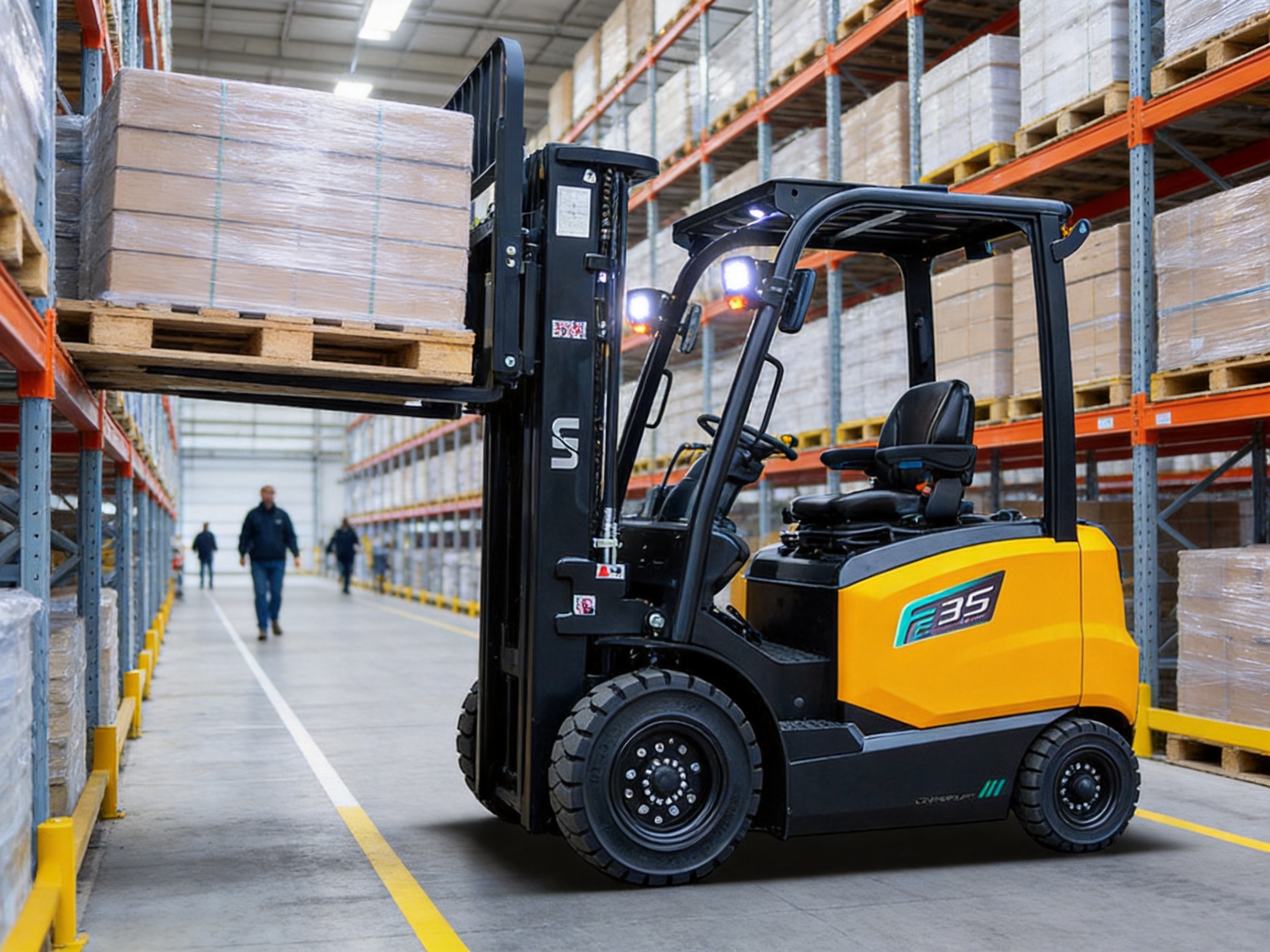
The FE Series can support a broad range of work cycles. In a manufacturing plant, it can transport raw materials from receiving areas to production lines, remove finished pallets, and position heavy components for assembly. In a warehouse, it can load and unload vehicles, replenish storage locations, and move pallets between staging zones.
In distribution applications, the forklift’s travel speed, lifting performance, and turning response can help reduce the time required for each handling cycle. The ability to use multiple speed modes allows the same truck to work in both open staging areas and more controlled warehouse aisles.
The 3.0-ton model is appropriate when users require strong capacity but want to minimize vehicle size and energy demand. The 3.5-ton model offers additional rated capacity for heavier loads or applications where a greater reserve is desirable. Choosing the correct capacity class is important because operating a larger truck than necessary can increase purchase cost, aisle requirements, and energy consumption.
Load Handling Accuracy
Forklift productivity is not measured only by speed. Accurate load placement reduces pallet damage, rack impact, product loss, and repeated handling. Wide-view mast design, proportional lifting, controlled tilt, and responsive steering all contribute to more precise operations.
The operator can approach the pallet at a controlled speed, align the forks, engage the load, tilt backward for stability, and transport it with the forks kept low. At the destination, proportional lift and tilt functions support careful positioning. This sequence reduces unnecessary corrections and helps maintain consistent work quality.
Operator Comfort
Lower noise and reduced vibration are important advantages of electric power. A quieter operating environment can improve communication between operators and nearby workers. It may also reduce fatigue during long shifts, especially in enclosed buildings where engine noise would otherwise be reflected by walls and ceilings.
Comfort is closely connected to productivity. An operator who can clearly see the load, reach controls easily, and work in a less noisy environment is more likely to maintain consistent performance. Operator training remains essential, but equipment design can either support or hinder safe and efficient behavior.
Environmental and Financial Considerations
The FE Series supports the transition toward cleaner material handling. Because it produces no direct exhaust emissions at the point of use, it can help facilities reduce indoor air contaminants and improve workplace conditions. The environmental benefit is especially relevant in warehouses, enclosed production spaces, and areas where workers remain near operating trucks for extended periods.
Electric forklifts can also reduce local noise pollution. This is valuable in urban distribution centers, multi-purpose buildings, and facilities operating near offices or residential areas. Lower noise can improve communication and reduce disruption during early-morning or evening work.
Operating cost depends on electricity prices, charging efficiency, duty cycle, battery selection, maintenance practices, tire wear, and utilization. A detailed cost comparison should include energy, fuel, scheduled maintenance, unscheduled repairs, battery replacement, charging infrastructure, operator time, and expected service life.
The FE Series may offer financial advantages where electric charging is economical and where indoor air-quality requirements make combustion equipment expensive to operate. Reduced engine-related maintenance and the ability to use opportunity charging may further improve fleet efficiency for suitable users.
However, electric forklift selection should be based on the complete application. If the truck operates continuously outdoors in severe conditions, on poor surfaces, or in environments without adequate charging infrastructure, a different configuration or power system may be more suitable. The best solution is the one that matches actual duty requirements.
Choosing the Correct Configuration
Before ordering, customers should identify the maximum load weight, load dimensions, load center, required lift height, aisle width, floor condition, operating temperature, shift pattern, charging opportunities, and attachment requirements.
Mast selection is particularly important. A standard wide-view mast may be appropriate for general warehouse operations. A full-free-lift mast can be advantageous when the forklift must operate under low ceilings or inside trailers. A three-stage mast may be necessary for high rack storage, but it normally requires additional attention to overall height and residual capacity.
Battery selection should reflect the daily duty cycle. Lead-acid batteries can be practical for scheduled single-shift work, while lithium-ion batteries may be better suited to multi-shift operations and opportunity charging. Customers should also consider charger location, electrical capacity, ventilation, battery handling equipment, ambient temperature, and fleet standardization.
Tire selection affects traction, comfort, floor protection, and puncture resistance. Pneumatic tires can provide cushioning and versatility, while solid or superelastic options may be preferred in areas with sharp debris or high puncture risk. The selected tire must be compatible with the operating surface and approved vehicle configuration.
Attachments require a separate capacity review. Side shifters, fork positioners, clamps, rotators, and other accessories add weight and move the effective load center forward. The final capacity rating must account for the attachment, mast, fork length, load center, and lift height.
Recommended Operating Practices
Operators should complete a pre-shift inspection before using the forklift. The inspection should include forks, mast chains, hydraulic hoses, tires, wheels, steering, brakes, lights, warning devices, seat belt, battery condition, charging connector, and visible electrical cables.
The forklift should be operated only by trained and authorized personnel. Loads must be centered on the forks, kept within the approved capacity, and secured when necessary. Operators should avoid sudden acceleration, abrupt braking, high-speed turning, and traveling with elevated loads.
When traveling, the forks should be kept low enough to maintain stability while avoiding contact with the floor. The mast should be tilted backward only as much as needed to stabilize the load. Operators should slow down at intersections, blind corners, ramps, wet areas, and locations where pedestrians may be present.
Battery charging should follow the procedures specified for the selected battery technology. Charging areas should be clean, properly ventilated where required, protected from unauthorized access, and equipped with suitable electrical protection. Lithium-ion and lead-acid systems have different charging and emergency requirements, so operators should not treat them as interchangeable.
Regular maintenance should be documented. Service records help identify repeated problems, plan component replacement, verify battery performance, and maintain residual-value confidence. A well-managed service history can also support safer operation and more accurate fleet-cost analysis.
Competitive Position in the Heavy Electric Forklift Market
The FE Series competes through a balanced combination of capacity, electric performance, stability, control, and serviceability. Some competing electric forklifts may offer compact dimensions but lower lifting capacity. Others may provide heavy capacity but use less flexible battery systems, simpler control technology, or less accessible maintenance layouts.
The FE Series differentiates itself by bringing several features together in one platform: 3.0T–3.5T load capacity, full AC drive, adaptive energy management, high-capacity batteries, a 21-kilowatt lifting motor, pneumatic tires, a strengthened steering axle, wide-view mast options, proportional lifting, LED lighting, multiple speed modes, and tool-free floor-plate access.
Its electric power system also gives it a clear advantage over combustion forklifts in applications where emissions, noise, and indoor air quality matter. At the same time, its chassis and performance specifications are intended to serve industrial work rather than only light warehouse duty.
The manufacturer’s long operating history, broad product portfolio, intellectual-property experience, production capacity, and international support network add further value. For fleet users, supplier stability can be as important as initial product specifications because forklifts are long-term assets that require parts, training, technical advice, and service support throughout their working life.
Conclusion
The FE Series 3.0T–3.5T four-wheel electric forklift is a heavy-capacity electric solution designed for demanding industrial material handling. It combines a stable four-wheel chassis with high-capacity battery options, full AC drive technology, adaptive energy management, strong lifting performance, and practical safety features.
Its 3.0-ton and 3.5-ton configurations provide useful capacity for manufacturing, warehousing, logistics, and distribution applications. Travel speeds of up to 14 kilometers per hour with a full load, lifting performance supported by a 21-kilowatt motor, 15 percent maximum gradeability, and pneumatic tires give the truck the capability required for substantial internal handling work.
The product’s advantages extend beyond performance. Wide-view mast design, proportional lifting, speed deceleration, LED lighting, a reinforced steering axle, and multiple operating modes support safer and more precise handling. Fully opening covers and a tool-free removable floor plate simplify service access and help reduce maintenance downtime.
Supported by a manufacturer with decades of material-handling experience, established production capacity, electric forklift research, international market knowledge, and a worldwide service network, the FE Series offers a competitive path toward cleaner, quieter, and more efficient industrial logistics.
Questions and Answers
What is the rated capacity of the FE Series?
The FE Series described in this article covers 3.0-ton and 3.5-ton rated capacity classes. The exact capacity depends on the selected model, mast, load center, lift height, tires, forks, and attachments.
Is the FE Series suitable for indoor operation?
Yes. It is designed for medium-intensity indoor handling and can be used in warehouses, factories, distribution centers, and other enclosed industrial facilities. Its electric drive produces no direct exhaust emissions during operation and generates less noise than a combustion forklift.
What battery options are available?
The platform supports high-capacity lead-acid and lithium-ion battery systems. The listed specification includes an 80-volt, 400-ampere-hour option and a 76.8-volt, 280-ampere-hour lithium-ion option. Availability should be confirmed for the required market and configuration.
Can the lithium-ion version be charged in cold conditions?
The lithium-ion configuration includes a charging-heating function that can allow charging at temperatures as low as minus 20 degrees Celsius when the specified system is used. Customers should confirm the exact battery and charger requirements for cold-storage applications.
What is the maximum travel speed?
The listed travel speed is 14 kilometers per hour with a full load and 15 kilometers per hour without a load for the 3.0T–3.5T configurations. Actual operating speed should follow site rules, traffic conditions, load stability, and safety requirements.
What lifting motor is used?
The 3.0T–3.5T specification lists a 21-kilowatt lift motor. The rated lifting speed is 350 millimeters per second with a full load and 500 millimeters per second without a load.
What mast heights are available?
The platform can be configured with different mast arrangements, including wide-view, full-free-lift, and three-stage full-free-lift options. A 3,000-millimeter rated lift height is listed in the main specifications, while other height options may be available depending on the configuration.
Can attachments be installed?
Yes. The forklift can support hydraulic attachments subject to pressure, flow, capacity, and compatibility requirements. Side shifters and other attachments change the effective load center and may reduce rated capacity. The final capacity plate must be followed.
How does the FE Series compare with a diesel forklift?
The FE Series produces no direct exhaust emissions during operation, offers lower operating noise, and can reduce engine-related maintenance. It also provides precise electric control and immediate drive response. A site-specific analysis should consider duty cycle, charging infrastructure, surface conditions, and energy costs.
How does it compare with smaller electric forklifts?
It provides higher capacity and a more substantial chassis than compact warehouse electric forklifts. Its 3.0-ton and 3.5-ton ratings, pneumatic tires, powerful motors, and stronger steering structure make it more suitable for heavier industrial loads.
What maintenance features does it provide?
The forklift has a fully opening access cover, a fully opening electrical control cover, and a tool-free removable floor plate. These features help technicians reach service areas more quickly and support efficient preventive maintenance.
What should be checked before ordering?
Customers should confirm load weight, load center, fork dimensions, required lift height, mast lowered height, ceiling clearance, aisle width, floor conditions, tire type, shift pattern, battery technology, charging infrastructure, and attachment requirements. The final configuration should be selected using the approved capacity chart.
References
1. FE Series 3.0T–3.5T Four-Wheel Electric Forklift product information and technical specifications.
2. Four-wheel electric forklift mast specifications and rated-capacity data.
3. Electric forklift battery, drive motor, lift motor, hydraulic, chassis, and dimensional specifications.
4. Manufacturer information concerning research and development, production capacity, product portfolio, patents, and international service development.
5. General industrial forklift safety, load-center, capacity-rating, battery-charging, and operator-training principles.
Product: FE Series 3.0T-3.5T 4-Wheel Electric Forklift
For exclusive deals and latest offers, sign up by entering your email address below.
Stay In Touch
ADDRESS : NO.1 ROAD ONE, XINDENG NEW DISTRICT, FUYANG, HANGZHOU, ZHEJIANG, CHINA 311404.
PHONE : +86-571-8688 8355 (AMERICA)
PHONE : +86-571-8886 9363 (EUROPE)
PHONE : +86-571-8688 8377 (ASIA, AFRICA, OCEANIA)
EMAIL : [email protected]
EMAIL : [email protected](PARTS INQUIRY)

